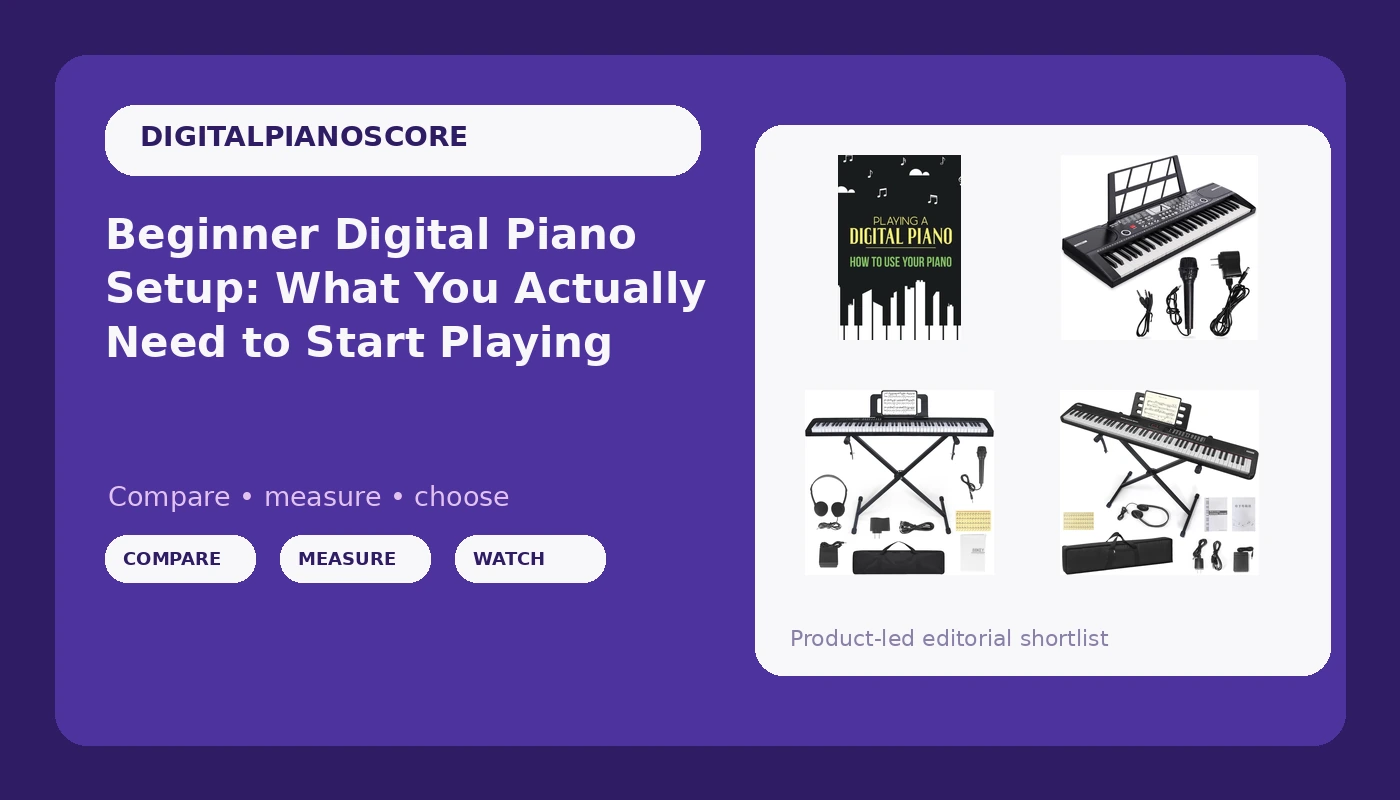
A beginner digital piano setup tends to fail for one of two reasons. Either the instrument has fewer keys than the music the student is about to learn, or the box arrives without the two things that matter most in daily practice: a stand at the right height and a sustain pedal that stays where you put it. Every September I field the same questions from parents and adult starters, and the honest answer is that the most expensive listing in the search results is rarely the right first purchase. This explainer covers what a digital piano for beginners actually needs to include, how key count and action type change what your hands learn, and how four entry-level listings differ from one another.
Related: Graded Hammer vs Semi Weighted Actions: What Your Hands Actually Feel →
Quick answer
For most beginners, an 88-key instrument with semi-weighted keys, a sustain pedal, and a stand will cover the first several years of lessons. A 61-key model makes sense for a small room, a tight budget, or a young child who has not yet decided whether piano will stick. None of the keyboards described here uses graded hammer action, so treat them as entry-level practice tools rather than as stand-ins for an acoustic piano. Whichever you choose, plan on adding a method book and a proper bench, because the instrument by itself will not teach reading, fingering, or posture.
4 useful options
| Model | Best fit | What stands out |
|---|---|---|
| 61 keys keyboard piano, Electronic Digital Piano with Built-In Speaker Microphone, Sheet Stand and Power Supply, Portable piano Keyboard Gift Teaching for Beginners | A young beginner, a small room, or a first taste of piano | 61-key layout with a built-in speaker and microphone, plus a sheet stand and power supply in the box |
| 88 Key Piano Keyboard, Electric Digital Piano with Semi Weighted Keys, Keyboard Piano with Sustain Pedal, Power Supply, Stand, Carrying Case, Headphones, USB-MIDI Compatibility, for Beginner Adults | A student who needs the full 88-key range and moves the instrument between rooms | Complete bundle with stand, sustain pedal, carrying case, and headphones, plus USB-MIDI connectivity |
| Digital Piano 88 Key Full Size Semi Weighted Electronic Keyboard Piano Set with Stand,Built-In Speakers,Electric Piano Keyboard with Sustain Pedal,Bluetooth,MIDI/USB/MP3 for Beginners Adults | A practice setup that also connects to a phone, tablet, or computer | Built-in speakers, Bluetooth, and MIDI, USB, and MP3 connectivity alongside the stand and sustain pedal |
| Playing A Digital Piano: How To Use Your Piano | Anyone who has just unboxed a keyboard and wants guidance on operating it | A book-length how-to guide about using a digital piano, not about playing repertoire |
The starter option: 61 keys keyboard piano, Electronic Digital Piano with Built-In Speaker Microphone, Sheet Stand and Power Supply, Portable piano Keyboard Gift Teaching for Beginners
The trade-off with 61 keys is range, not quality. Most first-year method books sit comfortably in the middle of the keyboard, but by the second or third year, repertoire starts reaching for the low and high ends, and a 61-key instrument runs out of notes. That is the point at which families either upgrade or the student starts transposing passages by an octave, which is a habit worth avoiding. The built-in microphone is a fun extra for a child, and it tells you this instrument is aimed at play and singing rather than serious keyboard technique. If you buy at this level, confirm in the listing whether the keys are full size, since compact layouts change how chords feel under the hand.
The 88-key travel kit: 88 Key Piano Keyboard, Electric Digital Piano with Semi Weighted Keys, Keyboard Piano with Sustain Pedal, Power Supply, Stand, Carrying Case, Headphones, USB-MIDI Compatibility, for Beginner Adults
The case and headphones are what separate this from a bare keyboard, and they matter more than they look. A carrying case means the instrument can go to lessons, a friend's house, or a summer trip without being wrapped in a blanket, and headphones mean a student in an apartment can practice after dinner without negotiating with the neighbours. USB-MIDI is the more useful connectivity option at this level, because a wired connection to a tablet or computer does not suffer the timing drift that wireless audio can introduce. Two details are worth checking before you buy: where the headphone jack sits on the chassis, and whether the bundled stand holds the keyboard at a height that lets you sit with your forearms roughly level.
The 88-key connected setup: Digital Piano 88 Key Full Size Semi Weighted Electronic Keyboard Piano Set with Stand,Built-In Speakers,Electric Piano Keyboard with Sustain Pedal,Bluetooth,MIDI/USB/MP3 for Beginners Adults
Bluetooth is the headline feature here, and it deserves a realistic expectation. Wireless audio is convenient for playing along with a track from a phone, but it can drop or drift, which is exactly the wrong behaviour in the middle of a lesson or a recording take. For anything that needs to stay in time, the wired USB or MIDI route is the safer choice. The MP3 playback function is genuinely useful for slow practice, since you can loop a passage and play over it. As for the speakers, keep physics in mind: small drivers in a slim chassis cannot move the air that a piano sound needs at the bottom end, so plan on headphones for serious practice and treat the onboard speakers as a convenience.
The learning companion: Playing A Digital Piano: How To Use Your Piano
Most beginners who get stuck in the first month are not stuck on notes. They are stuck on the instrument: how to turn on layers, how to change the touch sensitivity, how to record a phrase, how to move the keyboard up or down an octave when the music calls for it. A book aimed at using the instrument addresses that gap, and it pairs naturally with any of the keyboards above, since the controls it describes are the kind found on entry-level digital pianos. It will not replace a teacher or a graded method book, and it is not meant to. If you are buying for a child, this is the sort of purchase a parent reads, not the student.
Prices and availability may change. Product images, names, and retailer links are matched to verified listings. No current price, rating, stock status, or measured result is stated here without current evidence.
Key count, action weight, and what your hands learn
Two specifications decide most of the beginner experience, and neither of them is the number of sounds in the instrument.
The first is key count. A standard piano has 88 keys, running from A0 to C8. A 61-key keyboard covers the middle of that range and leaves out the extremes. For the first year, that is usually fine, because beginner methods stay near the middle of the instrument. The problem arrives later, when repertoire starts using the lowest octaves for bass lines and the top for melodic figures. Buying 88 keys once is generally cheaper than buying 61 keys now and 88 keys in eighteen months.
The second is action type, and this is where the marketing gets loose. A semi-weighted action uses springs plus some added resistance to imitate the feel of a piano. A weighted or graded hammer action uses actual hammers, with heavier resistance at the low end and lighter at the high end, closer to what an acoustic piano does. Terms like escapement, damper simulation, and key repetition speed describe hammer actions, and they do not really apply to semi-weighted keys. Semi-weighted is a reasonable starting point for a first instrument. It is not the same thing as a graded hammer action, and no listing should persuade you otherwise.
Polyphony is the third number you will see, usually 32, 64, 128, or 256 voices. It describes how many notes can sound at once. Nobody plays 256 notes at once. What polyphony affects in practice is what happens when you hold the sustain pedal down through a dense passage with a layered sound, where notes can begin to drop out. At the entry level, a higher polyphony figure is nice, not decisive.
Speaker quality deserves more attention than it gets. Samples at this price tier are broadly similar; the difference you hear between two instruments is usually voicing and the size of the drivers. Small speakers in a slim cabinet will sound thin at the bottom, which is why headphones are the single biggest upgrade to how good a beginner instrument sounds.
A setup sequence for your first week
- Build the stand first and set its height so that, when you sit, your forearms are roughly level with the keys and your wrists are not bent upward.
- Find middle C and mark it lightly with a sticker or a piece of removable tape, then locate it in the first page of your method book.
- Learn the transpose function before you need it, and decide now that you will not use it to avoid learning key signatures.
- Connect the keyboard to a tablet or computer over USB-MIDI if you plan to use a learning app, and test that notes register before your first lesson.
- Set a practice slot that happens at the same time each day, and start with five minutes of slow hands-separate work rather than thirty minutes of playing pieces you already know.
If the bundled sustain pedal slides across a hard floor, a square of rug grip under it solves the problem for a few dollars, and it is a common annoyance at this price level.
Practical guidance before you buy
- Count the keys against your method book: if the book uses the extremes of the staff, buy 88 keys rather than 61.
- Check the pedal arrangement in the listing, because a switch-style pedal and a piano-style pedal behave differently under the foot.
- Find out where the headphone jack sits before you commit, since a jack on the back panel is awkward in a tight space.
- Budget for a bench if one is not included, because sitting at the wrong height teaches bad habits faster than any wrong note.
- Treat Bluetooth and sound libraries as conveniences and spend your attention on the action and the speakers instead.
Which option should you choose?
Choose the 61 keys keyboard piano, Electronic Digital Piano with Built-In Speaker Microphone, Sheet Stand and Power Supply, Portable piano Keyboard Gift Teaching for Beginners when the player is young, the room is small, and the priority is finding out whether piano holds a child's attention. Choose the 88 Key Piano Keyboard, Electric Digital Piano with Semi Weighted Keys, Keyboard Piano with Sustain Pedal, Power Supply, Stand, Carrying Case, Headphones, USB-MIDI Compatibility, for Beginner Adults when you need the full 88-key range and the instrument has to travel to lessons. Choose the Digital Piano 88 Key Full Size Semi Weighted Electronic Keyboard Piano Set with Stand,Built-In Speakers,Electric Piano Keyboard with Sustain Pedal,Bluetooth,MIDI/USB/MP3 for Beginners Adults when you want full-size keys, onboard speakers, and the option of playing along with tracks from a phone or tablet. Choose Playing A Digital Piano: How To Use Your Piano when the keyboard is already in the house and the missing piece is knowing how to operate it.
One caveat applies to all four. The descriptions here come from the listings themselves, not from bench testing, and no claim about how these instruments sound or feel in the hand can be made without that evidence. Check the current specification and feature list on the product page before you decide, and remember that a semi-weighted action is an entry-level compromise rather than a substitute for a graded hammer action.
The bottom line
For a beginner, the practical minimum is 88 keys, a semi-weighted action, a sustain pedal, and a stand, which is what the two 88-key bundles here provide. The 61-key option is a legitimate first instrument for a small room or a young child, as long as you accept that it is a starting point rather than a long-term solution. Add a book that explains how the instrument works, sit at the right height, and practice at the same time each day. The instrument you actually play beats the instrument with the better spec sheet, every time.