Related: Best Digital Pianos Under $1,000 for Adult Beginners
I have taught piano for 25 years in Seattle, and every August the same thing happens. A family buys a 61-key keyboard because it was cheap and came with a hundred demo songs, and by October the kid is playing with flat fingers and no dynamic control. That is not the kid's fault. The instrument cannot tell the difference between a push and a press. If you are shopping for a digital piano for beginners, the sound bank is not what you compare. The action is.
I keep one rule in my studio: the action is the piano, and everything else is a feature. Samples, speakers, Bluetooth, rhythm styles, all of it sits downstream of the mechanism under your fingers. I can tell a $400 action from a $2,000 action with my eyes closed, and I have spent two decades watching transfer students arrive in September with instruments that spent the summer teaching them bad habits.
This guide covers four instruments doing four different jobs: a serious 88-note slab, a full-size keyboard for a tight budget, a first keyboard for a young child, and the cheapest possible way to find out whether anyone in the house will practice. For each one I will say which spec matters and where the money was saved.
Best Overall: Roland RD-08 Stage Piano
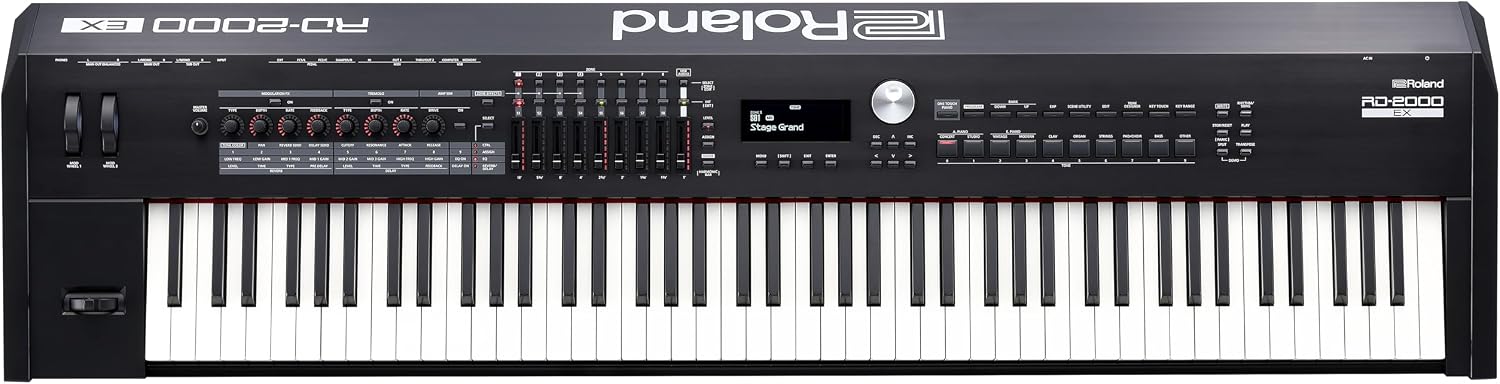
The RD-08 is the only instrument here I would put in front of a student who intends to keep going. It carries an 88-note weighted PHA-4 keyboard, and that is the part that matters. Weighted actions are a spectrum, not a checkbox. The cheap ones bounce, and the good ones let you control tone with finger speed. A student on a good action can practice pianissimo without the key fighting back, and can repeat a note quickly without the mechanism swallowing it.
It is a stage piano, which means it is a slab: portable, no cabinet, no furniture markup. I have argued for years that slabs are the smart buy for most people, because a cabinet is a thousand dollars of furniture wrapped around the same electronics. The trade-off is that a slab needs a stand, and this bundle handles that, with a keyboard stand, sustain pedal, piano bench and studio monitor headphones included.
Two notes on that bundle. First, bundled benches and pedals are usually the first things I tell families to replace, so budget for a better sustain pedal once the student is playing daily. Second, check where the headphone jack sits before you commit, because a jack on the back of the unit means reaching around the instrument every night. Headphone practice is how apartment students get their hours in, and a badly placed jack quietly kills the habit.
Best Full-Size Keyboard on a Budget: UISCOM 88-Key Digital Piano
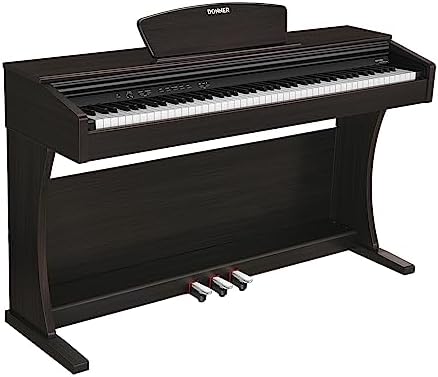
If the budget does not reach the Roland, this is the compromise I would make. It gives you 88 full-size keys, which matters more than most parents expect. Sixty-one keys run out of room by the end of the first method book, and a student who cannot play the top of the staff at home cannot practice the pieces they were assigned that week.
The keys are semi-weighted, not graded hammer, and I want to be honest about that because the difference is real. Semi-weighted means resistance without a hammer mechanism, so it is a genuine step up from springy synth keys, but it will not teach the same finger control as a weighted action. For the first year or two that is an acceptable trade. Past that, the instrument becomes the ceiling on what the student can learn at home.
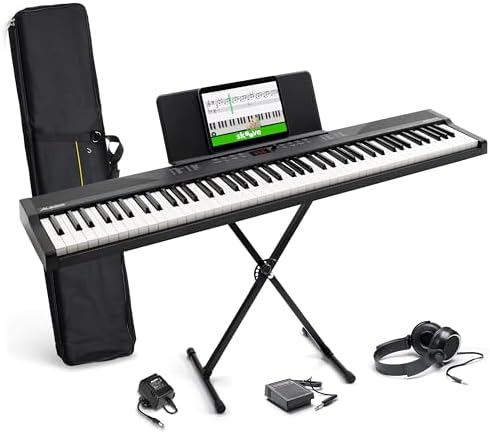
The rest of the package is aimed at an actual beginner setup: stand, power adapter, sheet music stand, pedal, headphone and USB-MIDI. The USB-MIDI connection is the quietly useful part. It lets a student run a lesson app or notation program with the keyboard as the input device, and it costs nothing extra. Same caveat as always: the pedal in the box is a starting point, not a destination. If it slides across the floor, replace it.
Best First Keyboard for a Child Under Ten: Alesis Melody 61 MK4
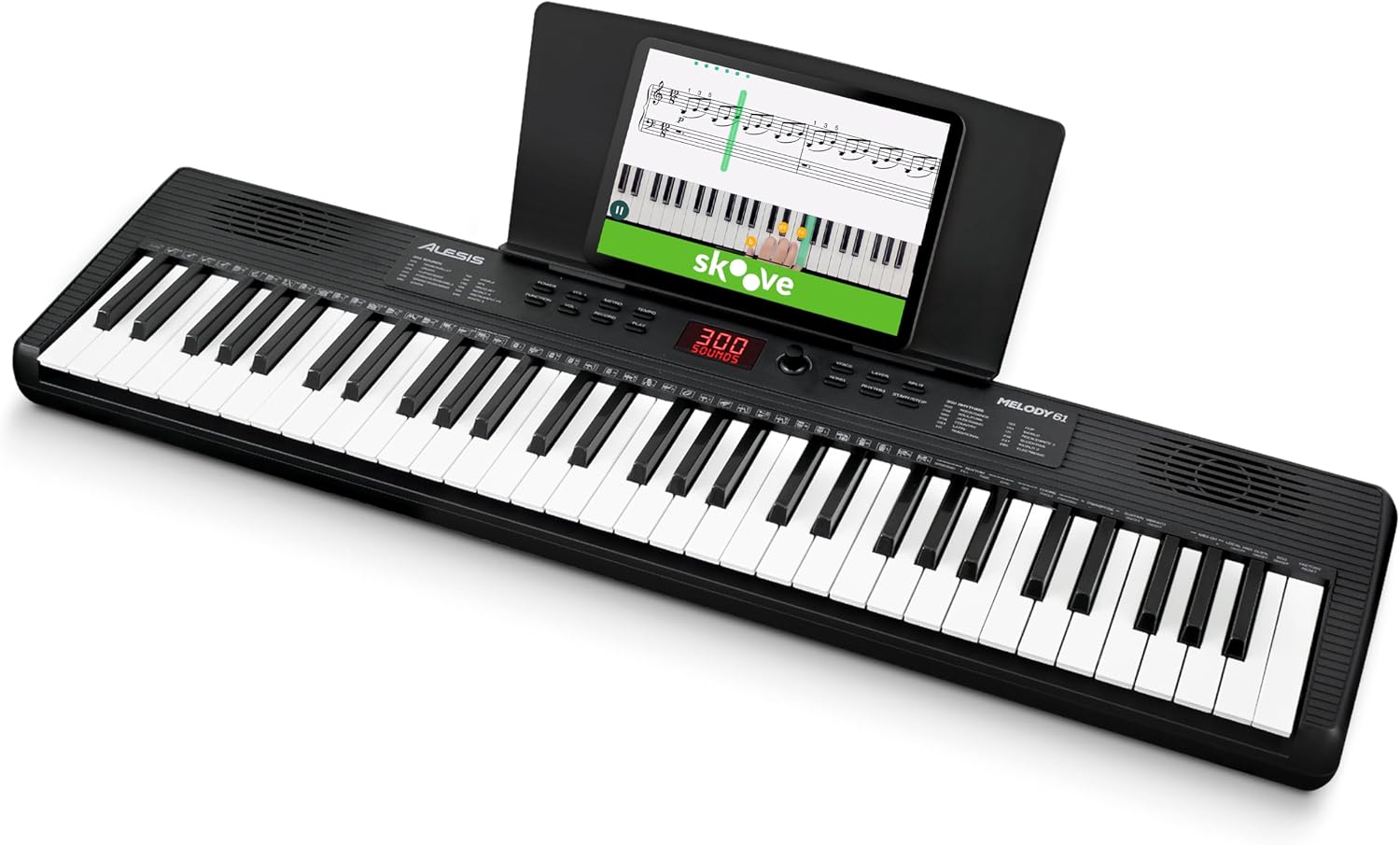
I will be straight with you, because my own rule is that I review instruments with 88 weighted keys. This one has 61 keys and no hammer action, so it is not a piano in the sense I care about. It is an audition.
Here is the case for it anyway. A six or seven year old does not know yet whether they want to play piano, and the parent does not know either. Spending a lot of money in September on an instrument nobody touches by November is a worse outcome than spending less now and upgrading after a year of real lessons. The Melody 61 MK4 is small, light enough for a child to move, and it makes sound the moment a key goes down, which is the only requirement at that stage.
What it will not do is build technique. There is no weight in the keys, so there is nothing to push against and no dynamic control to develop. Treat it as a one-year rental on the question of whether this kid likes music. If the answer is yes, move to a full-size weighted instrument and do not wait, because an unweighted action will teach flat, percussive playing within a few months and you will pay a teacher to undo it.
Cheapest Way to Find Out: JIKADA 61-Key Portable Keyboard
The JIKADA is the lowest-stakes option here: 61 portable keys and three teaching modes. The teaching modes are the reason it belongs in this guide at all. For an adult who wants to poke at piano without committing to lessons, or a household that wants to know whether anyone will touch the thing twice, guided modes give you something to do on day one instead of staring at a keyboard with no idea where to start.
Understand what you are buying. This is a portable electronic keyboard, not a digital piano. There is no weighted action, the range is 61 keys, and it will not support serious technical work. What it will do is put a keyboard in the house for less than the cost of a month of lessons, and it is light enough to sit on a desk or carry to a friend's apartment.
If you are an adult who already knows you want to learn, skip it and go to the UISCOM or the Roland. If you are buying for a child who has asked three times and you want evidence before you commit to lessons, this is the cheapest evidence available.
How I judge a beginner instrument
My routine has not changed in years. The same Bach prelude, the same Chopin nocturne, and a blues improvisation, because those three cover what a beginner instrument has to survive: steady sixteenths, a sustained singing line in the right hand, and fast repeated notes.
Repetition speed is the test most people never run. Play the same note over and over as fast as you can and listen for dropped or doubled notes. A weak action cannot keep up, and the student ends up slowing down to accommodate the instrument without ever realizing it.
Then dynamics. A beginner instrument has to let you play quietly. If every note comes out at the same volume no matter how you touch the key, the student never learns to shape a phrase, and a teacher spends a year undoing it.
I also weigh keys on a kitchen scale and keep a dB meter for speaker output, because speaker quality matters more than sample library size. A great sample through a bad speaker sounds like a great sample through a pillow. On a sub-$1,000 instrument, speaker voicing is what you are actually hearing when you compare brands, not the samples.
Ignore the polyphony numbers. They are marketing. Nobody plays 256 notes at once.
What to check in the store, or during the return window:
- Does a repeated note speak every time, at speed?
- Can you play pianissimo without the key bottoming out and getting loud?
- Where is the headphone jack, and can you reach it while seated?
- Does the sustain pedal stay where you put it?
- Does Bluetooth hold through a 30-minute lesson, or does it drop mid-piece?
The four instruments side by side
| Instrument | Keys and action | Who it is for | Price |
|---|---|---|---|
| <img src="/images/products/B0D153W4TG.jpg" alt="Roland RD-08 Stage Piano | Authentic RD Sound & Playability | 88-Note Weighted-Action PHA-4 Keyboard | Bundle, H&A Keyboard Stand, Sustain Pedal, Piano Bench & Studio Monitor Headphones" width="340" style="border-radius:8px;max-width:340px;width:340px;height:auto;max-height:420px;object-fit:contain"> Roland RD-08 Stage Piano |
 Visit on Amazon → Visit on Amazon →UISCOM 88-Key Digital Piano |
88 full-size semi-weighted | A beginner who needs the full range now | $151.20 |
 Visit on Amazon → Visit on Amazon →Alesis Melody 61 MK4 |
61 keys | A child under ten testing interest | $85.00 |
 Visit on Amazon → Visit on Amazon →JIKADA 61-Key Portable Keyboard |
61 keys, 3 teaching modes | Cheapest way to find out if anyone will practice | $175.99 |
One column that is not in the table but should be in your head: what you will replace. With the Roland, the pedal. With the UISCOM, the pedal. With either 61-key instrument, the whole thing in about a year, and that is by design, not a defect.
Keyboard, digital piano, or stage piano?
The words get used interchangeably and they should not be. A keyboard is a portable instrument with light keys and a limited range, which is what both 61-key options here are. A digital piano has 88 full-size keys and some form of weighted action, which is what the UISCOM and the Roland are. A stage piano is a digital piano built as a slab for gigging, with no cabinet, which is why the RD-08 needs a stand and why it costs less than a console model with the same action.
If a teacher or a method book tells you to buy a piano, they mean 88 weighted keys. Nothing with 61 keys is what they meant.
Should you buy the Roland RD-08?
Yes, if the student is serious and the budget stretches. The weighted PHA-4 action is the reason, and it is the one part of a digital piano that cannot be added later with an accessory. The bundle covers the stand, pedal, bench and headphones, so you are not assembling a setup piece by piece. This is the instrument I would want a transfer student to walk in with in September.
Should you buy the UISCOM 88-key?
Yes, for the first year or two, and with your eyes open about the semi-weighted action. It gives you the full 88-key range, a stand, a pedal and USB-MIDI at a beginner price. If the student is still practicing after 18 months, that is the moment to move up, and not before.
Should you buy the Alesis Melody 61 MK4?
Yes, for a child under ten, and only as a first step. It answers the question of whether lessons are worth paying for. It will not build technique and it will not carry a student past the first method book, so plan the upgrade on the day you buy it.
Should you buy the JIKADA 61-key?
Yes, if the goal is the lowest possible cost of finding out whether anyone in the house wants to play. The three teaching modes give a complete beginner something to do immediately, which is more than most budget keyboards offer. No, if anyone is already committed to learning piano.
That is the whole decision: buy the action first, the range second, and the features last.