Related: Digital Piano Action Weight, Explained for Parents
I have taught 30 students a week out of a home studio in Seattle for 25 years, and every September the same email arrives. My kid wants to learn piano. What do we put in the room? After 12 digital pianos and a lot of returns, I can tell you that a beginner digital piano setup is two decisions, not twelve. You choose the action, and you choose the handful of things that connect that action to practice, lessons, and the rest of your life. Everything else printed on the box is marketing.
My test routine never changes. The same Bach prelude, the same Chopin nocturne, and a blues improvisation, played on every instrument that comes through the door. I keep a dB meter and a scale for action weight, because my ears lie to me after an hour of playing. Here is what that routine keeps telling me: the thing a beginner outgrows first is never the sound. It is the action. A student who cannot play a controlled quiet note will not practice the quiet note, and no sample library fixes that.
So this is the order I would buy in, from the instrument down to the cable nobody thinks about.
Start with the action: Roland FP-10
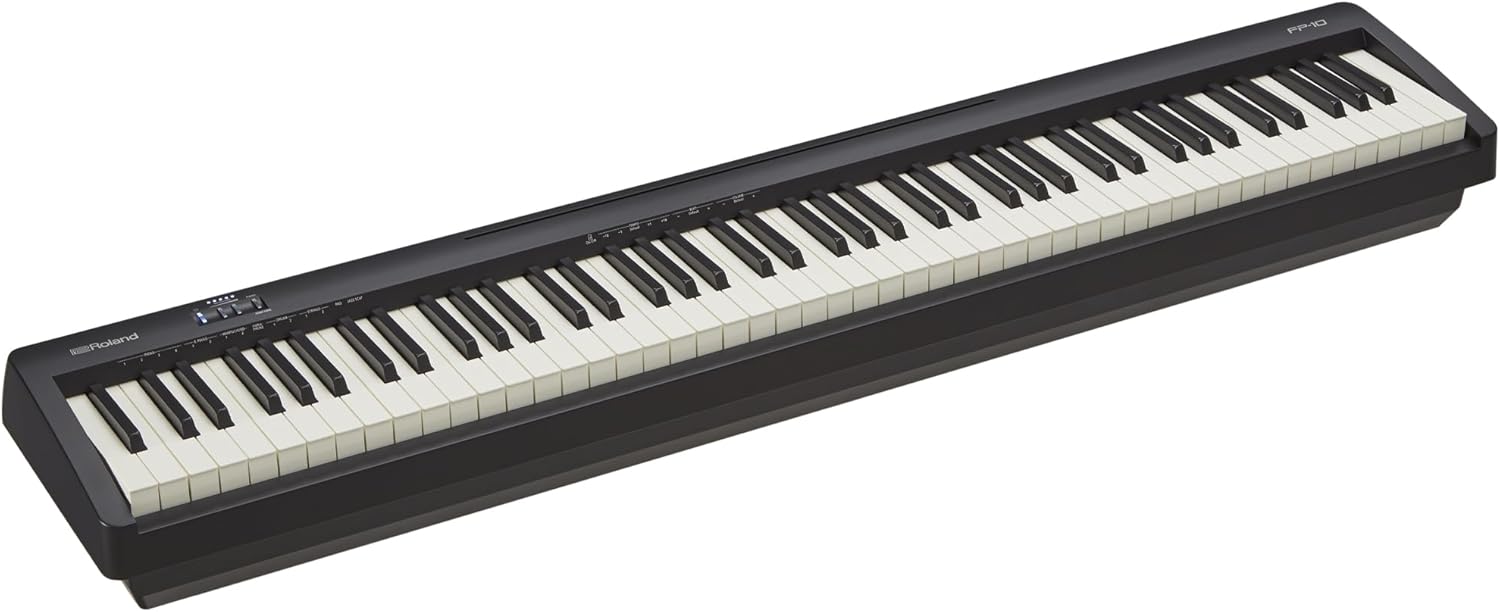
The Roland FP-10 is the instrument I tell parents to buy when the student is actually going to show up to lessons. It is a slab, which means a keyboard on a stand rather than a piece of furniture with a lid, and for a beginner that is the correct shape. A cabinet is a slab with a wooden coat on it. You pay a large premium for the coat, it is harder to move, and it does not teach a single thing the slab cannot.
What matters is the keybed. This is a graded hammer action in a compact 88-note body, and it behaves the way a piano behaves: heavier at the bottom of the range, lighter at the top, and responsive to finger speed rather than force. That last part is the whole game. On a cheap action, pressing deeper simply makes the note louder, which is exactly why beginners who practice on cheap keys get louder as a piece goes on. On this one I can open the Chopin nocturne at a whisper and push the same phrase to a forte without changing my hand position. That is the skill transfer students arrive missing, and it takes months to rebuild.
The trade-off is the speakers. Slabs have small drivers. The grand piano language on the box is a stretch, and if you expect a nine-foot instrument to come out of a four-inch speaker you will be disappointed in every brand, not just this one. Play through headphones for serious practice and use the speakers for casual playing. That is how the instrument is designed to be used, and it is not a flaw.
One more thing, and it is a pet peeve of mine: know where the connections sit before you buy. A headphone jack on the back of the unit means reaching behind the piano every time a student plugs in, and in a teaching room that cable gets yanked a hundred times a week. This one is laid out like a slab should be, with the jacks where your hand already is.
The budget starter kit: Donner DEP-07
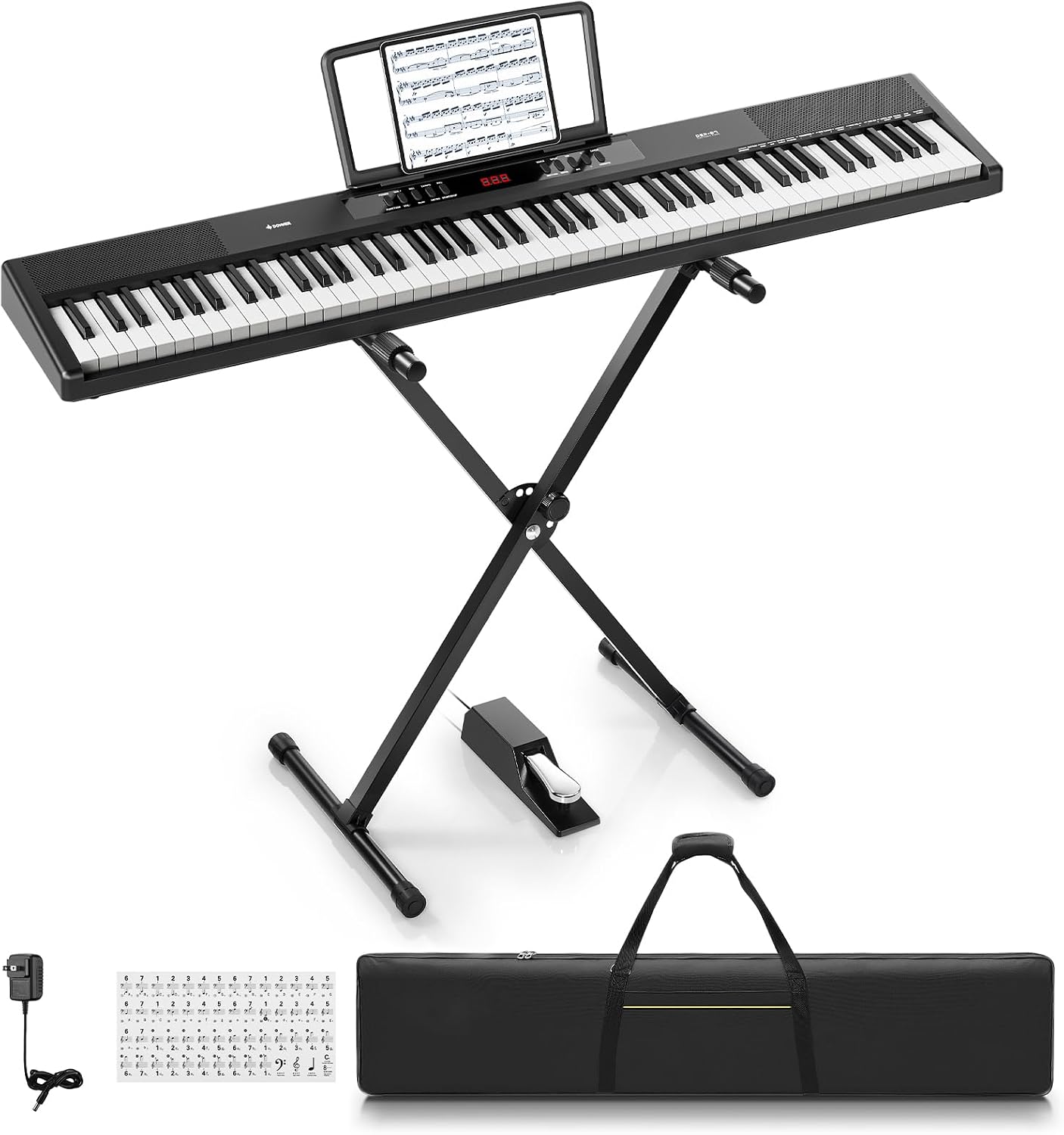
The Donner DEP-07 is what I recommend when a ten-year-old is starting and the family is not ready to commit to a serious instrument, or when the piano has to survive a move into a dorm in two years. It arrives as a complete kit: 88 keys, a carry bag, an X-stand, a pedal, and a music rest. That is genuinely useful for a first year, because it means nothing else has to be purchased before the first lesson.
Be clear about what it is. The keys are semi-weighted, not graded hammer. That is a different feel and I will not pretend otherwise. Semi-weighted keys return more slowly and give you less control at low volume, so a student who practices only here will eventually hit a ceiling. For a seven-year-old learning where middle C lives, that ceiling is years away and it does not matter. For a thirteen-year-old with two years of lessons behind them, it matters immediately, and I would push the budget toward the Roland instead.
The rest of the kit is honest for what it is. The spec sheet lists 500 tones and 128-note polyphony, and I will tell you what I tell every parent: polyphony numbers are marketing. Nobody plays 128 notes at once. What the tone list is actually good for is keeping a beginner interested in week three, when scales stop being fun and the instrument has to compete with everything else in the house.
Two things I would change on day one. The sustain pedal in the box is the kind that slides across a wood floor, so put a square of grippy shelf liner under it or replace it within the first month. And an X-stand wobbles when a student plays with any force at all. Both are cheap fixes, and neither is a reason to skip the instrument at this level.
The cable that makes the headphone jack usable: JSAUX 3.5mm to 6.35mm
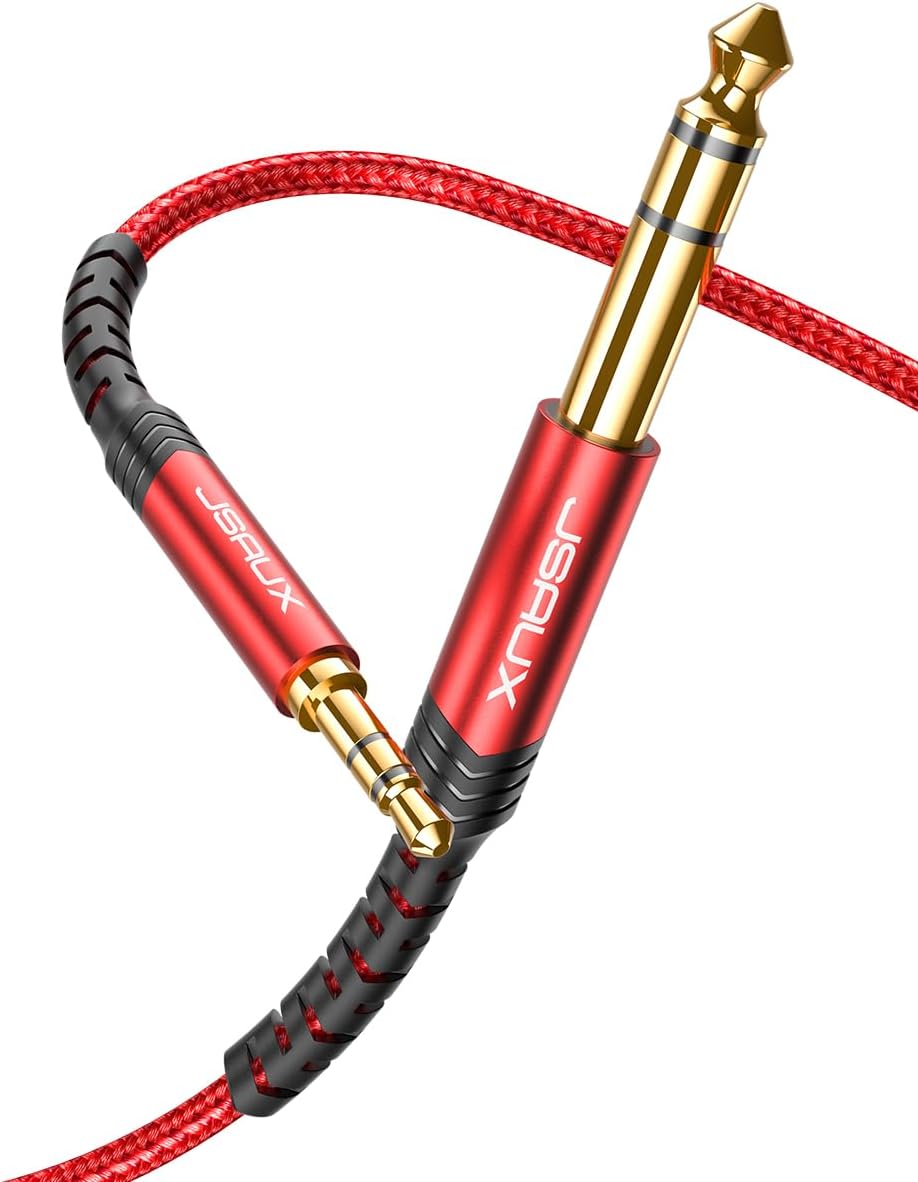
This is the least exciting item in the whole setup and the one people forget. Every slab in this price range has a small headphone output, and every serious pair of studio headphones and every powered speaker on the market ends in a quarter-inch plug. Without an adapter you are stuck with whatever earbuds are in the kitchen drawer, and I have watched students cut a practice session short because the sound through a cheap earbud was thin and discouraging.
This is a 4-foot cable, 1/8 inch on one end and 1/4 inch on the other, stereo TRS at both ends. Four feet is the right length for a keyboard on a stand: long enough to reach a headphone amp or a speaker on the floor, short enough that it does not become a trip hazard in a small room. I keep two in my studio bag.
One warning from experience. A cable that lives permanently plugged into a slab gets bent at the plug, and that is where it fails. Unplug it when the piano is not in use, or buy two and rotate them. If you want to play along with a track, use this cable rather than Bluetooth. Bluetooth drops, and it drops mid-lesson.
Sending a lesson recording: IK Multimedia iRig Pro Duo I/O
I do not hand out recording advice, and this is not that. This is the piece of the setup that lets a student send me a recording instead of describing their week in an email, or take a lesson when the roads are bad. If your teacher asks for a recording, this is how you make one that does not sound like a phone held next to a speaker.
It is a two-channel USB interface with balanced TRS outputs, a headphone output, and MIDI, and it converts at 24-bit. In plain language: the piano's audio goes in, headphones plug into it, and the computer hears the instrument directly instead of hearing the room. The MIDI side means the notes themselves can be captured, so a student can send a performance and I can see exactly where the timing drifted. That is far more useful to me than audio alone, and it is the difference between a useful lesson recording and a nice memory.
For a household where a sibling also plays, or where the piano doubles as a streaming or podcast setup, this is the one box that covers all of it. If nobody in the house records anything, skip it, buy the cable instead, and put the difference toward a better stand.
How I test an action
I test every instrument the same way, and none of it needs a lab.
The repetition test. I play the same note over and over as fast as I can and listen for whether the key returns before my finger does. A good action keeps up. A cheap one swallows notes, and the student blames themselves for it. This is the single fastest way to tell a serious keybed from a toy.
The dynamic test. The first phrase of the Bach prelude, played four times at four volumes. If the action only has loud and louder, it fails. If I can find five distinct levels between a whisper and a forte, it passes.
The escape test. Slow, deliberate notes, feeling for the point where the key lets go. Graded hammer actions have that small bump. Springy keys do not, and a student who learns on springs never develops control, no matter how many years they practice.
Then the living test. I leave the instrument set up in the teaching room for a month and see whether I want to sit down at it. A digital piano is a practice tool first. If it does not make you want to practice, it failed, regardless of what the spec sheet claims.
What the marketing gets wrong
Three claims to ignore.
Grand piano sound. Sample quality has plateaued across the industry. The difference you hear between two brands in the same price range is speaker voicing, not the samples. A great sample through a bad speaker sounds like a great sample through a pillow. This is why I care more about where the speakers point and how the cabinet is braced than about how many megabytes of piano the box claims.
The polyphony war. Nobody plays 256 notes at once. A beginner needs enough voices to hold a sustained chord under a moving line, and every instrument here clears that bar with room to spare.
Bluetooth as a practice feature. I have watched a student lose ten minutes of a lesson to a pairing menu. If you want to play along with a track, use a cable.
The beginner digital piano setup reference table
This is the table I send parents after the first lesson. Priority is the order I would buy in, not the order things appear on a store page.
| Piece | What it does | Priority | Notes |
|---|---|---|---|
 Visit on Amazon → Visit on Amazon →Roland FP-10 |
88-note graded hammer action in a compact slab | 1 | Buy this first if the budget reaches |
 Visit on Amazon → Visit on Amazon →Donner DEP-07 |
Complete 88-key starter kit with stand, pedal, and bag | 1 | Semi-weighted keys, best for young beginners |
 Visit on Amazon → Visit on Amazon →JSAUX 3.5mm to 6.35mm cable |
Connects headphones or speakers to the piano | 2 | Buy two, they wear out at the plug |
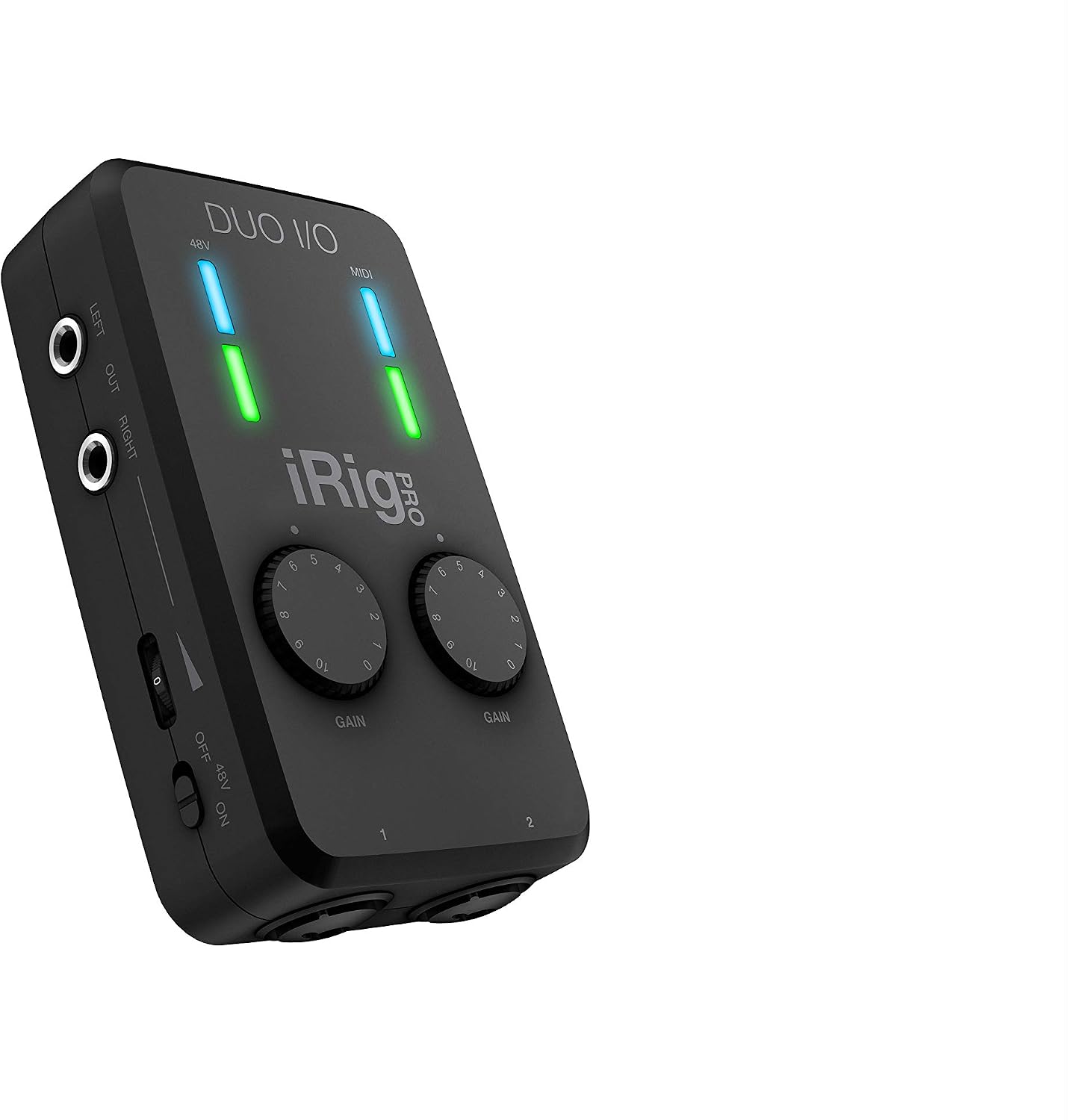 Visit on Amazon → Visit on Amazon →IK Multimedia iRig Pro Duo I/O |
Sends piano audio and MIDI to a computer | 3 | Only if someone records or takes lessons online |
The order matters more than the list. A student with a good action and cheap headphones will improve. A student with an expensive interface and a keybed that fights back will quit, and no amount of gear fixes that.
Should you buy the Roland FP-10?
Yes, if the student is going to keep going. The action is the reason. Graded hammer keys, a compact slab body, and enough dynamic range that a teacher can actually work on tone with a beginner. The speakers are small and the grand piano language on the box oversells them, so plan on headphones for real practice.
None of that changes my recommendation. This is the instrument I would put in front of a transfer student over the summer so they do not regress, and it is the one I would buy for a household that expects the piano to be used for more than one school year.
Should you buy the Donner DEP-07?
Yes, for a young beginner or a tight budget, with your eyes open. The kit is complete, it is the lowest price I would trust for 88 keys, and the tone list will keep a beginner curious. The keys are semi-weighted, so it is a starting point and not a destination.
Budget for a grippy pad under the pedal and a better stand within the first year, and you will get more out of it than the money suggests. Pair it with the adapter cable so the student can practice on headphones without waking the house, and you have a setup that carries a child through the first two years of lessons.