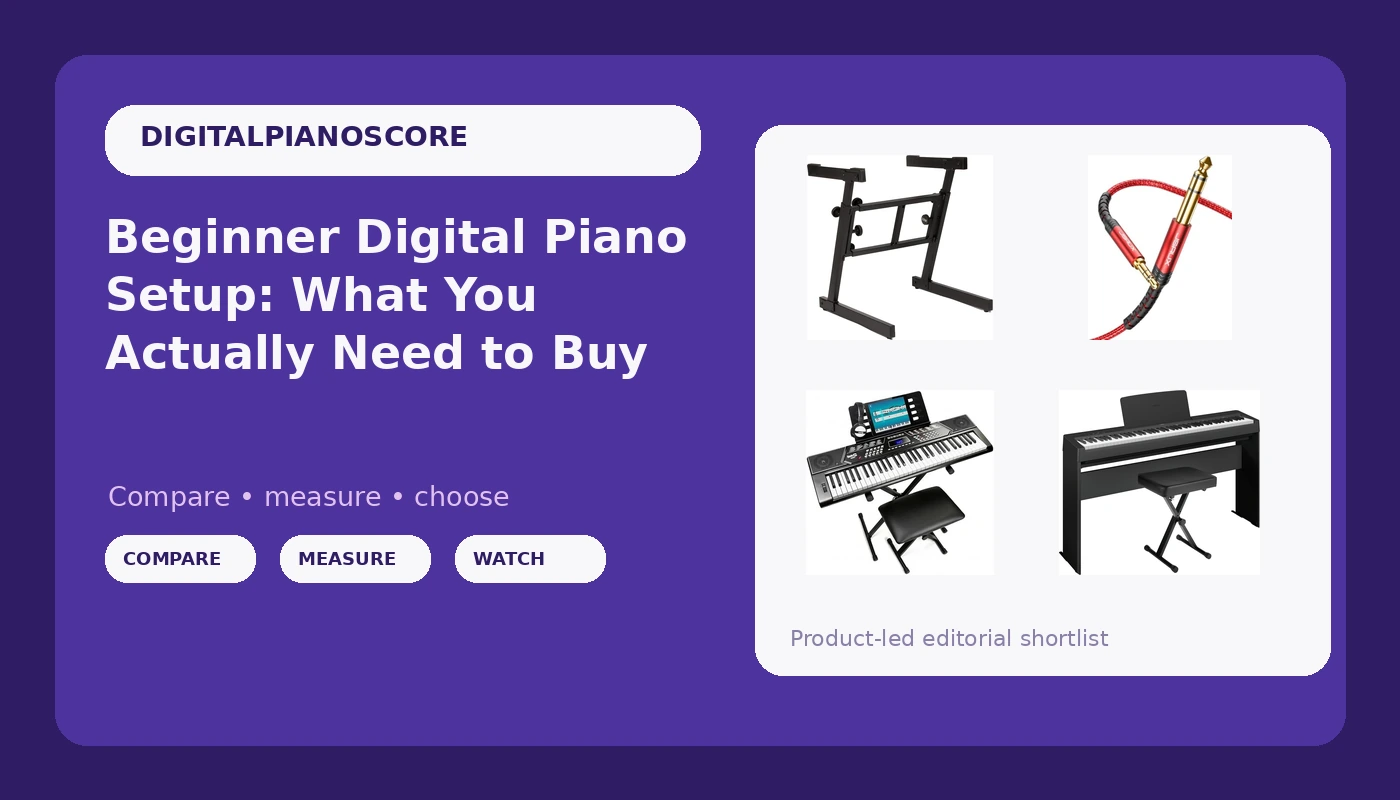
Most people building a beginner digital piano setup start with the wrong question. They compare sound engines, polyphony counts and app features, then discover three months later that the thing they practice on every night sits at the wrong height, slides across the floor, and fights their fingers on every fast passage. After 25 years of teaching, most of it in a home studio with 30 students a week, I can tell you what actually decides whether a student keeps playing: the action under their hands, the height of the keybed, and whether the pedal stays where they put it.
This article explains how the pieces of a first setup fit together and where the money in a starter kit actually goes. It covers one complete instrument bundle, one budget kit aimed at young beginners, a stand for slab pianos, and the small adapter cable that solves a mismatch most buyers do not discover until the headphones arrive.
Related: How Much Should You Spend on a First Digital Piano? →
Quick answer
A beginner digital piano setup needs three things that matter and one that does not. The instrument should have 88 weighted keys, because weighted action is what transfers to an acoustic piano later and what builds finger strength now. The stand should place the keybed at roughly the height of an acoustic upright, so posture and hand position carry over. The sustain pedal should stay put. Everything else in a kit, from headphones to a music rest, is convenience rather than foundation. A 61-key kit can carry a young child through a first year of lessons, but it is a keyboard rather than a weighted digital piano, and it will need replacing once the student starts playing repertoire that uses the full range.
4 useful options
| Model | Best fit | What stands out |
|---|---|---|
| Yamaha P-143 Digital Piano Bundle | A student who needs a real weighted action at home | 88 weighted keys with stand, bench, music rest and sustain foot switch in one bundle |
| RockJam RJ5061 61 Key Keyboard Piano Kit | A young first-timer testing whether lessons will stick | 61 keys with a stand, bench and headphones included |
| OnStage KS7350 Pro Heavy-Duty Folding-Z Keyboard Stand | A slab piano that arrived without furniture | Heavy-duty folding-Z design, black finish |
| JSAUX 3.5mm to 6.35mm Stereo Audio Cable 4FT | Matching a piano's 1/4-inch jack to 1/8-inch headphones or speakers | 4-foot male TRS cable, 1/4-inch to 1/8-inch |
The main instrument: Yamaha P-143 Digital Piano Bundle
This is the option I would point a transfer student toward when the family wants one decision instead of five. The important part is the 88-key weighted keybed, because that is the piece that determines whether a summer away from lessons costs the student real technique. The bundle also removes the most common first-week problem, which is a piano sitting on a dining table at chest height because nobody thought about a stand.
The trade-off is that bundle furniture is furniture, not equipment. The stand in a kit like this does its job, and the bench is the first thing I would expect a family to replace with something adjustable, because bench height decides forearm angle and forearm angle decides whether a student plays with tension. The included sustain foot switch is a switch rather than a proper pedal unit, and a switch that moves around under your foot is the single most common complaint I hear from beginners. Plan to upgrade the bench and the pedal within the first year. The instrument itself is the part you keep.
The starter kit: RockJam RJ5061 61 Key Keyboard Piano Kit
I want to be honest about what this kit is. It is a 61-key keyboard package, not a weighted 88-key digital piano, and that distinction decides who should buy it. For a six- to nine-year-old in a first year of group or private lessons, in a house where nobody is sure yet whether the interest will last, a 61-key kit with a stand, bench and headphones is a reasonable place to start. The included headphones solve the practice-in-the-evening problem immediately, which is worth more than people expect.
The limits arrive quickly. A 61-key range runs out of room as soon as the student reaches repertoire that uses the extremes of the keyboard, and an unweighted action does not build the finger independence that transfers to an acoustic piano. That is not a reason to avoid it, it is a reason to set a review date. When a teacher says the student is ready to work on real repertoire, that is the signal to move to an 88-key weighted instrument. If your child is already ten or older and reading music, skip this tier and go straight to weighted keys.
The stand: OnStage KS7350 Pro Heavy-Duty Folding-Z Keyboard Stand
Slabs are the smart buy for most people, and a slab means you have to solve the stand yourself. A stand is not a neutral accessory. A wobbly stand makes every passage feel less secure than it is, and it teaches students to play cautiously. A stand that sits too high or too low quietly rewrites their hand position. Stability and a height you can live with matter more than the look of the thing.
A folding-Z stand is the practical answer for a piano that has to move, whether that means between rooms, into a car for lessons, or against the wall when the room is needed for something else. It folds flat, which cabinet pianos cannot do, and that portability is exactly why the slab-plus-stand route wins on price and on moving day. The trade-off is that a folding stand gives you less of the resonance and furniture feel a cabinet provides, and if you never move the instrument, a fixed stand or a proper desk is the calmer long-term choice. This stand is for slabs, not for cabinet pianos that already have legs.
The cable: JSAUX 3.5mm to 6.35mm Stereo Audio Cable 4FT
Here is the mismatch. Digital pianos very often put a 1/4-inch headphone jack on the instrument, because that is the connector the music world standardized on, while most consumer headphones and small speakers end in a 1/8-inch plug. One of the two sides has to change, and it is better for the change to happen in a cable with molded ends than in a stubby screw-on adapter hanging off the piano's jack, where every bump puts leverage on the socket.
This is the least glamorous purchase in the setup and the one that gets used every single day, since most home practice happens through headphones. Buy the stereo version, not a mono cable, or you will hear only one side. Keep it in the piano's bag or taped to the stand so it does not walk off, and buy a second one if the piano ever leaves the house. If you already own 1/4-inch studio headphones, you may not need this at all, and that is fine. Buy the adapter that matches what you already have rather than the other way around.
Prices and availability may change. Product images, names, and retailer links are matched to verified listings. No current price, rating, stock status, or measured result is stated here without current evidence.
Why the action is the whole purchase
Graded hammer action is a spectrum, not a checkbox. Two instruments can both advertise weighted keys and feel nothing alike. What separates them is behavior at the extremes: how much control you have when you play softly, whether the key returns quickly enough for repeated notes, and whether the resistance stays consistent as you move from the front of the key to the back. A cheap weighted action tends to bounce, and it tends to get heavier or lighter as you play deeper into a piece, which is exactly the kind of inconsistency that makes a student think they are the problem when the instrument is.
Escapement and damper simulation are the details that make a digital action feel like a mechanism rather than a spring, and they are worth understanding when you read spec sheets, because they describe feel rather than sound. What you can safely ignore is the polyphony arms race. Nobody plays 256 notes at once, and a number printed on a box tells you almost nothing about whether an instrument is pleasant to sit at. Sample quality across reputable brands has largely plateaued. The differences people attribute to sound engines are usually differences in speaker voicing, and a good sample played through a thin speaker sounds like a good sample played through a pillow. Judge the action with your hands and the speakers with your ears, in that order.
Matching the setup to the player
The right answer depends less on budget than on who is playing and what happens in twelve months. Work through it in this order.
- Count the keys the repertoire needs. A first-year child can live inside 61 keys. Anyone playing real piano literature needs 88.
- Decide whether the action needs to transfer to an acoustic piano. If yes, weighted keys are non-negotiable, and unweighted keys become a dead end.
- Measure the practice space and the seated height before buying furniture. Keybed height is a posture decision, not a style decision.
- Check what your headphones and speakers actually plug into, then buy the adapter or cable that matches, in stereo.
- Set a review date. Write down what would make you upgrade, whether that is a key count, a teacher's assessment, or a recital.
What to buy first, and what to wait on
- Buy the instrument before the accessories. A great cable on a bad action is still a bad setup.
- Treat the stand as part of the instrument, not an afterthought. Height and stability change how the keys feel under the hand.
- Replace the bench and the pedal before you replace anything else in a bundle. Those are the two parts that quietly cost students technique.
- Buy the adapter cable early rather than improvising with whatever is in a drawer, and confirm it is stereo.
- Wait on speakers, apps and furniture upgrades until the student is practicing consistently. Practice habits decide what the next purchase should be.
Which option should you choose?
Choose the Yamaha P-143 Digital Piano Bundle when you want an 88-key weighted instrument and the surrounding basics in one purchase. Choose the RockJam RJ5061 61 Key Keyboard Piano Kit when a young beginner needs an inexpensive, headphone-friendly first year and you accept that it is a starting point rather than a long-term instrument. Choose the OnStage KS7350 Pro Heavy-Duty Folding-Z Keyboard Stand when you are buying a slab piano that has no furniture of its own and needs to stay stable or move. Choose the JSAUX 3.5mm to 6.35mm Stereo Audio Cable 4FT when your piano's 1/4-inch jack and your headphones or speakers do not match.
A caveat worth stating plainly: the details above come from the product listings and from how these categories generally work, not from a bench test of these specific units. Weighted actions vary within a model line, and the feel of any instrument is something only your own hands can settle. Where a listing does not state a specification, treat it as unknown rather than assumed.
The bottom line
A beginner digital piano setup succeeds or fails on three decisions: weighted 88 keys if the student is heading toward real repertoire, a stand that puts the keybed at a sane height, and a pedal that stays under the foot. The Yamaha bundle covers all three in one purchase and gives you a real action to build on. The RockJam kit is a sensible, low-risk first year for a young child, provided you treat it as a first year. The OnStage folding stand and the JSAUX adapter cable are the two small pieces that make a slab setup workable, and both cost far less than the frustration of a piano that wobbles or headphones that will not plug in. Buy the action first, the furniture second, and the extras only when practice proves you need them.