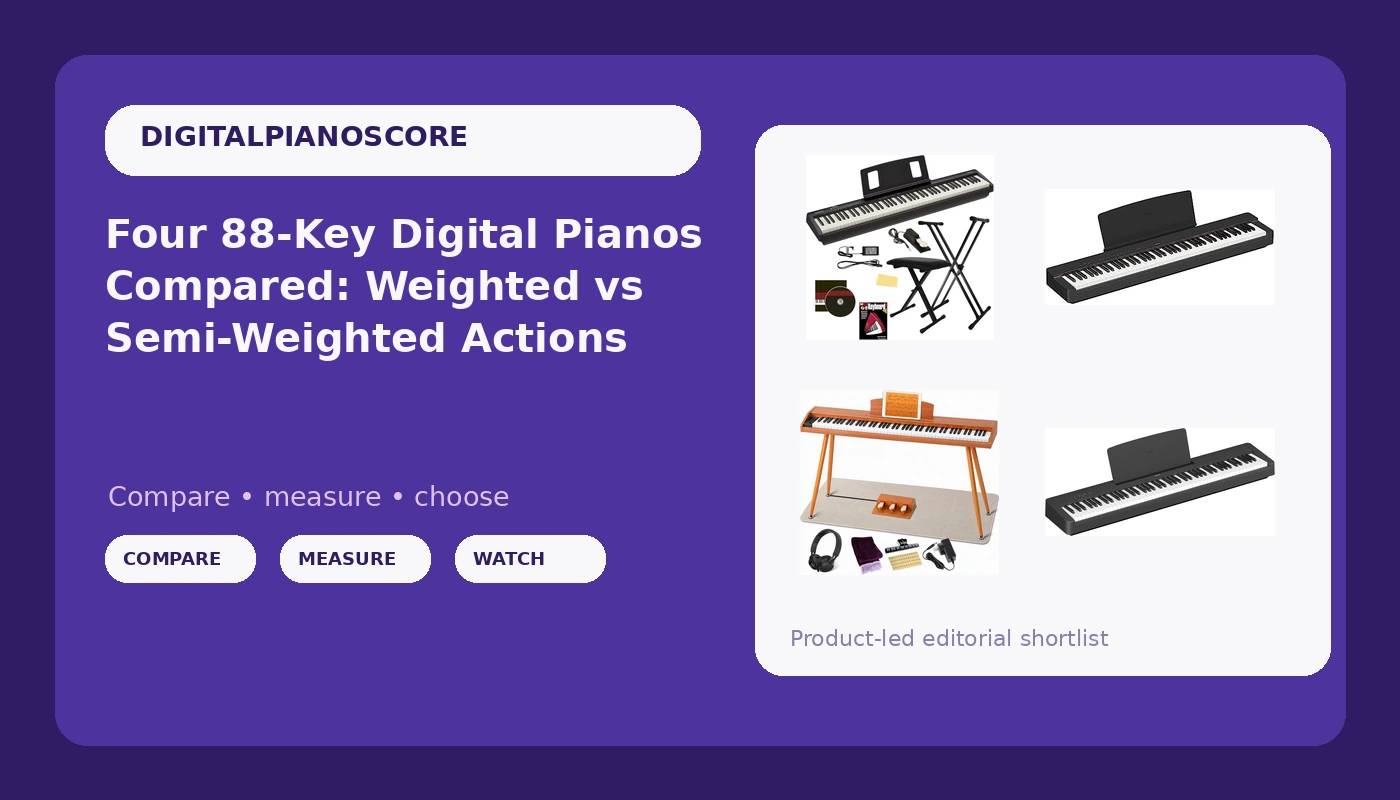
Most people shopping for an 88-key digital piano think they are choosing between brands. They are actually choosing between actions. The samples, the speaker voicing, the Bluetooth pairing, and the cabinet finish all sit downstream of the mechanism under your fingers, and that mechanism is the one part of the instrument you cannot upgrade later. I have taught piano for 25 years, and the students who quit in month three almost never quit because they lost interest in music. They quit because the instrument fought them every time they sat down. The four instruments below sit at four different points on that spectrum, and the differences between them come down to what kind of key you are pressing and what comes in the box.
Related: Best Digital Pianos for Beginners Under $1,000 →
Quick answer
An 88-key digital piano is worth buying when the action suits the music you want to play and the instrument fits where you actually practice. On that basis, the Roland FP-10 bundle covers the most ground as a first instrument, because it arrives with an adjustable stand, a bench, and a sustain pedal alongside the piano. The Yamaha P225B and the Yamaha P145BT are both weighted-key slabs, with the P145BT the more compact of the two and the one that adds Bluetooth. The UISCOM is a semi-weighted 88-key keyboard aimed at beginners, and it is the lowest-cost route to a full-width keyboard in this group. None of these four is a substitute for playing them, and the listing copy is where you confirm the action type.
Four useful options
| Model | Best fit | What stands out |
|---|---|---|
| Roland FP-10 88-Key Digital Piano - Black Bundle with Adjustable Stand, Bench, Sustain Pedal, Instructional Book, Online Lessons, Instructional DVD, and Austin Bazaar Polishing Cloth | A first instrument that has to be playable on day one | Ships as a bundle with stand, bench, sustain pedal, instructional book, online lessons, and an instructional DVD |
| Yamaha P225 88-Key Digital Piano with Weighted Keys, Portable Design, Keyboard, Music Rest, Sustain Foot Switch, and Built-In Speakers, Black (P225B) | Players who want weighted keys in a portable slab | 88 weighted keys, portable design, built-in speakers, and a music rest and sustain foot switch in the box |
| Yamaha 88-Key Digital Piano with Weighted Keys, Compact Design, Bluetooth, Keyboard, Music Rest, Sustain Foot Switch, and Built-in Speakers for Home Practice or Travel P145BT | Small rooms, shared walls, and Bluetooth pairing | Compact 88-key weighted design with Bluetooth, built-in speakers, music rest, and sustain foot switch |
| UISCOM Digital Piano Keyboard 88 Key Semi-Weighted for Beginners,Electric | The lowest-cost entry into 88 keys | Semi-weighted 88-key action described as aimed at beginners |
The complete bundle: Roland FP-10 88-Key Digital Piano - Black Bundle with Adjustable Stand, Bench, Sustain Pedal, Instructional Book, Online Lessons, Instructional DVD, and Austin Bazaar Polishing Cloth
The bundle is the reason this one leads the list for a true beginner. A slab piano at a similar price point usually leaves you buying a stand, a bench, and a pedal in separate orders, and the cheap versions of those three items are where a lot of first setups go wrong. A wobbly stand makes every passage feel unstable, and a bench at the wrong height puts a student's wrists below the keys for the whole lesson. What the bundle does not tell you is the action type, and that is the one specification I would confirm in the listing before ordering. If the description does not state the action clearly, that is a question worth asking the seller, because a digital piano with 88 keys can still be built several different ways.
The step-up portable: Yamaha P225 88-Key Digital Piano with Weighted Keys, Portable Design, Keyboard, Music Rest, Sustain Foot Switch, and Built-In Speakers, Black (P225B)
This is the shape most of my transfer students end up with, and for good reason. Weighted keys plus a body that can be carried means the instrument can move between a bedroom, a living room, and a lesson, and it can go in a car when the family moves. The trade-off is that a slab needs a stand, and a stand is a separate purchase unless you already own one. It also means the piano lives on a table or a stand rather than in a cabinet, which some households consider a feature and others consider clutter. The sustain foot switch in the box is a switch, not a full damper pedal, so if you play repertoire that depends on half-pedaling, plan on upgrading that piece of the kit later.
The compact Bluetooth slab: Yamaha 88-Key Digital Piano with Weighted Keys, Compact Design, Bluetooth, Keyboard, Music Rest, Sustain Foot Switch, and Built-In Speakers for Home Practice or Travel P145BT
Bluetooth on a piano gets dismissed as a gimmick, and in a lesson studio it sometimes is. On a home instrument, it is genuinely useful: it lets a student play along with a backing track or a metronome app without a cable running across the room, and it lets a parent route audio without hunting for an adapter. The catch is latency and stability, and that varies by device and by app, so I would treat Bluetooth as a convenience rather than a reason to buy. What matters more here is the compact footprint. If the only wall available for a piano is narrow, or the instrument has to come down between practice sessions, a smaller 88-key body solves a real problem.
The entry-level option: UISCOM Digital Piano Keyboard 88 Key Semi-Weighted for Beginners,Electric
Semi-weighted is the phrase that matters in this listing, and it is worth being precise about what it means. A semi-weighted key uses a spring and added mass to give the key more resistance than a synth-action keyboard, but it does not use a hammer mechanism to replicate the leverage of an acoustic piano key. For a young beginner who needs to learn note names and hand position, that can be enough for a first year. For anyone preparing for graded exams or playing repertoire that depends on dynamic control, it is a compromise, and it is the compromise that most often shows up as uneven tone in the middle of a piece. It is the least expensive way into a full 88-key layout in this group, and it should be bought with clear eyes about that.
Prices and availability may change. Product images, names, and retailer links are matched to verified listings. No current price, rating, stock status, or measured result is stated here without current evidence.
What weighted, semi-weighted, and synth action actually mean
These three terms get used loosely in marketing copy, so here is the plain version. A synth-action key is a spring-loaded plastic key with very little resistance. It returns fast and it is easy to play for hours, which is why it dominates keyboard work in pop and electronic music. A semi-weighted key adds mass and resistance to that same basic spring design. It feels heavier than a synth key without being a hammer mechanism. A weighted or hammer action uses a physical lever, often with a graded weight, to mimic the way an acoustic piano key pivots and how its resistance changes as you press deeper.
Graded is the next word to understand. On an acoustic grand, the bass keys feel heavier and the treble keys feel lighter, because the hammers are different sizes. Digital makers imitate that with graded weighting. The quality of that imitation is a spectrum, not a checkbox, and it is the single biggest difference between a cheap weighted action and a good one. Cheap weighted actions tend to bounce and to feel inconsistent from key to key. Better ones let you control tone with finger speed, which is the whole point.
Two more terms are worth knowing because they appear in product descriptions. Escapement is the small notch of resistance you feel near the bottom of a key's travel on an acoustic grand, and some digital actions reproduce it. Key repetition speed is how quickly a key returns to rest so you can strike it again, and it is what separates an action that handles fast repeated notes from one that stutters. Neither term tells you whether an action feels right to you. Only playing it does.
What the box does and does not include
A slab piano almost always ships with less than a beginner expects. The listings above are unusually clear about it, which helps. A music rest and a sustain foot switch are standard inclusions on the two Yamaha models here. The Roland bundle goes further and includes a stand, a bench, and a pedal. The UISCOM listing is the sparest of the four.
Here is what to check before you order anything. First, does the box include a stand, and if not, does the desk or table you plan to use put the keys at a height where your forearms are roughly parallel to the floor. Second, what kind of pedal is included. A foot switch is an on-off device. A damper pedal with continuous sensing is a different piece of hardware, and half-pedaling requires it. Third, is there a power supply in the box, or does the instrument run on batteries. Fourth, where is the headphone jack. On the front edge is convenient. On the back panel means you will be reaching around the instrument every time you practice at night.
- Decide whether the instrument has to move. If it does, a slab plus a folding stand beats a cabinet every time.
- Confirm the action type in the listing copy. If the word weighted is absent, assume it is not.
- Play the same short passage on each candidate, ideally something with a slow section and a fast one.
- Budget for the accessories that matter: a stable stand, a proper bench, and a damper pedal if your repertoire needs one.
- Think about year two, not month one. The instrument that gets practiced is the one with the action you enjoy.
Practical guidance before you buy
- Set a bench height where your forearms sit roughly level with the keys. Most bundled benches are fixed height, and a cushion or a different bench solves more problems than a new piano does.
- Test key repetition with repeated notes in one hand rather than a scale. Scales hide a slow-returning action; repeated notes expose it.
- Check that the sustain pedal has a way to grip the floor or a rug. A pedal that slides mid-phrase is worse than no pedal.
- If you plan to practice with headphones at night, confirm the jack position and whether a 1/4-inch adapter is needed for your headphones.
- Treat Bluetooth as a bonus, not a requirement. If it drops during a lesson, a cable is the fallback, so keep one in the bag.
- For a child under ten, prioritize a stable stand and correct bench height over extra sounds and rhythms.
Which option should you choose?
Choose the Roland FP-10 88-Key Digital Piano - Black Bundle with Adjustable Stand, Bench, Sustain Pedal, Instructional Book, Online Lessons, Instructional DVD, and Austin Bazaar Polishing Cloth when you want a complete first setup in one order and you would rather not assemble a kit from four separate purchases. Choose the Yamaha P225 88-Key Digital Piano with Weighted Keys, Portable Design, Keyboard, Music Rest, Sustain Foot Switch, and Built-In Speakers, Black (P225B) when weighted keys are the priority and the instrument needs to be portable. Choose the Yamaha 88-Key Digital Piano with Weighted Keys, Compact Design, Bluetooth, Keyboard, Music Rest, Sustain Foot Switch, and Built-In Speakers for Home Practice or Travel P145BT when space is tight and Bluetooth pairing would genuinely get used. Choose the UISCOM Digital Piano Keyboard 88 Key Semi-Weighted for Beginners,Electric when the budget is the binding constraint and the player is in the first year of lessons.
One caveat applies to all four. The listings here state what ships in the box and, for the Yamaha models, that the keys are weighted. They do not establish how any of these actions feels under your hands, and no description substitutes for playing one. Confirm the action type and the included accessories in the current listing before you order.
The bottom line
The action is the piano. Everything else is a feature you can work around. If you are buying for a beginner and you want the shortest path from delivery to a real practice routine, the Roland FP-10 bundle removes the most friction because the stand, bench, and pedal arrive together. If you already own a stand and you want weighted keys in something portable, the two Yamaha slabs are the natural comparison, and the choice between them comes down to footprint and whether Bluetooth earns its place in your routine. If the budget simply will not stretch, the UISCOM gets 88 keys under a beginner's hands, and it should be treated as a starting point rather than a destination. Whatever you pick, plan the second purchase now: a bench at the right height and a pedal that stays put will do more for your playing than the next tier of piano.