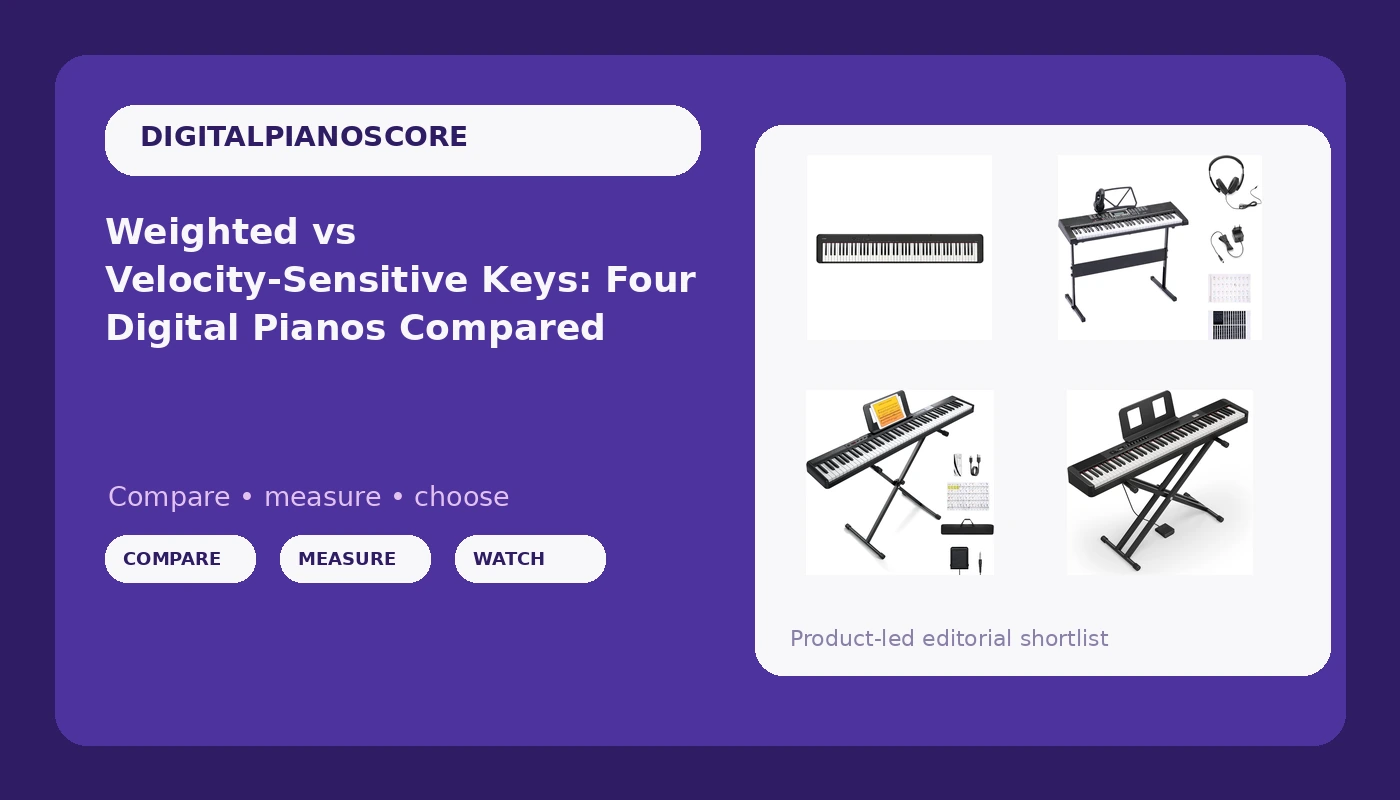
Most first-time buyers shop for a digital piano for beginners by listening to the sound and end up deciding with their eyes, comparing tone counts and preset lists. The action is what you actually live with. In the entry-level range, sample quality has largely converged, and the meaningful differences sit in the key mechanism, the speaker voicing, and what ships in the box alongside the instrument. The four models below cover the realistic spread of that market: a Casio slab with a scaled hammer action, two 88-key Donner packages aimed at beginners, and a compact 61-key board from Amazon Basics that is a keyboard rather than a piano. Knowing which category you are actually shopping in is most of the decision.
Related: Weighted Keys vs Synth Action: What Beginners Should Know →
Quick answer
If the instrument will be someone's main practice piano, prioritize an 88-key weighted action and treat every other feature as secondary. The Casio CDP-S160 is the most direct starting point in this group, because its scaled hammer action is designed to reproduce the graded feel of an acoustic piano. The Donner DEP-20 Lite gives you a full 88-key weighted layout with a stand, sustain pedal, and wireless MIDI included. The Donner DEP-1 is an 88-key package aimed at the lowest entry point, but its keys are velocity-sensitive rather than weighted, which is a structural distinction rather than a marketing one. The Amazon Basics 61-key keyboard belongs to a different category: a reasonable first instrument for a young child, not a substitute for a piano.
Four useful options
| Model | Best fit | What stands out |
|---|---|---|
| Casio CDP-S160 | Players who want an acoustic-like action first | 88 weighted keys with scaled hammer action, Duet Mode, USB-MIDI, slim chassis |
| Donner DEP-20 Lite | Beginners who want a complete weighted setup in one purchase | 88 weighted full-size keys, stand and sustain pedal included, LCD, wireless MIDI audio, 185 tones |
| Donner DEP-1 | Tight budgets and students who need to move the instrument | 88 velocity-sensitive keys, stand, sustain pedal, carrying case, keyboard stickers |
| Amazon Basics 61-key keyboard | Very young beginners and casual play | 61 full-size keys, built-in speakers, built-in songs for learning |
The action-first pick: Casio CDP-S160
The phrase that matters in that description is scaled hammer action. Scaled means the resistance is graded across the keyboard, heavier toward the bass and lighter toward the treble, which is how an acoustic piano behaves because its strings and hammers get physically larger on the left side. A hammer action also has more inertia than a spring, and that inertia is what trains you to control tone with finger speed instead of simply pressing harder. Duet Mode is the second thing worth noticing, because it is the feature that makes a single instrument workable for a lesson: two people, two halves of the keyboard, one set of speakers. USB-MIDI means the piano can talk to teaching apps and recording software over a wire rather than a wireless connection that may or may not hold. What this model does not give you is furniture: no cabinet, no bench, no floor pedal. For most households that is a feature, not a gap.
The weighted bundle: Donner DEP-20 Lite
This is the option to look at when the buyer wants one order to cover everything and does not want to research a stand separately. The trade-off is the usual one for bundles: the included stand and pedal are serviceable rather than good, and the pedal in particular is the part most likely to be replaced within a year. The tone count of 185 tells you almost nothing about how the piano sounds playing actual repertoire; a large library is useful for exploring, and most of those sounds will never be touched by someone working through a method book. What does matter is that the keys are full size and weighted, because that is the part that transfers to an acoustic instrument later. Wireless MIDI audio is a convenience worth testing early, since wireless connections are the first thing to misbehave in a lesson setting. Keep a USB cable on hand as the fallback.
The low-cost 88-key package: Donner DEP-1
Read the key description carefully here, because this is where the two Donner models separate. Velocity-sensitive keys measure how hard and how fast you strike, and they change volume accordingly, but they do not carry the inertia of a hammer. For a first year of lessons, that is workable, and the carrying case makes this the practical choice for a student who has to move the instrument between rooms or between homes. For anyone who also plays an acoustic piano, the lighter return is the thing that shows up as uneven playing, and the gap becomes obvious the moment a piece calls for repeated notes at speed. The stickers are a genuine help for a young beginner learning note names and a distraction for anyone who already reads music. If the goal is strictly a low-cost 88-key practice instrument that travels, this package covers it; if the goal is to build hand strength that transfers, the weighted options above do more of that work.
The compact starter: Amazon Basics 61-key keyboard
Sixty-one keys covers most beginner method book repertoire and nothing beyond it. Serious piano literature regularly uses the full range of an 88-key instrument, and a student who outgrows five octaves will hit that wall within a couple of years. That is not a reason to avoid this keyboard; it is a reason to be honest about what it is for. For a seven-year-old testing whether piano holds their attention, or for an adult who wants to pick out melodies and chord progressions without committing to a slab and a stand, this is the cheapest way to find out. The built-in learning songs are a real feature at this level, because a beginner practicing alone needs something to play along with. Expect the key feel to be light and spring-like, expect the speakers to be small, and judge it on whether it gets used.
Prices and availability may change. Product images, names, and retailer links are matched to verified listings. No current price, rating, stock status, or measured result is stated here without current evidence.
How key action differs at this level
Three terms get used interchangeably in listings and they do not mean the same thing. Velocity-sensitive means the key senses how fast it is struck and changes volume in response; it says nothing about weight. Weighted means the key resists your finger with mass or a spring, which is what builds strength. Scaled or graded hammer action means the resistance varies across the keyboard, heavier at the bass end and lighter in the treble, the way a grand piano behaves because its hammers and strings are physically larger on the left.
A spring-loaded key returns to rest in a way that many transfer students describe as bouncy. A hammer action, even a modest one, carries more inertia, and that inertia is what teaches you to control tone with finger speed rather than force. If you only ever play one instrument, the difference is invisible. If you alternate between a digital and an acoustic, the digital action is what keeps your hand in shape between lessons.
Repetition speed matters more than raw weight once a player reaches intermediate repertoire. When a passage moves into repeated notes, a slow-returning key caps your tempo no matter how well you know the music. The practical test at this price point is simple: play a five-note trill on a single key and listen for whether the notes stay even.
Escapement and damper simulation are generally absent below the premium tier. Their absence is felt mainly by advanced players, and a beginner does not need them. Weighted and graded is the bar to clear.
What the spec sheet will not tell you
Polyphony is the most oversold number on any listing. Nobody plays 256 notes at once. What matters is whether the note you are holding disappears when the sustain pedal is down during a dense passage, and entry-level instruments handle ordinary repertoire without trouble.
Tone counts follow the same logic. An instrument with 185 tones is not better than one with a dozen if you play piano repertoire. The extras exist for exploration and their quality varies.
Speaker voicing is where the real difference between brands lives. Two instruments can share nearly identical sample sets and sound completely different because one has a larger cabinet and a more open amplifier. A three-inch speaker cannot reproduce the low end of a concert grand no matter what the box claims. Headphones will tell you far more about sample quality than built-in speakers ever will.
Wireless audio and MIDI are convenience features. They are excellent when they work and maddening when they drop mid-lesson, so a wired connection is worth having as a backup. Check for USB-MIDI, because that is what lets an instrument talk to teaching apps and recording software without an adapter.
Finally, pedals. Most beginner packages ship with a small switch-style sustain pedal that slides across the floor. That is not a flaw in any one brand; it is what the price point allows.
- Decide whether the buyer needs an 88-key piano or a 61-key keyboard, and be honest about the answer.
- Read the key description word by word, separating velocity-sensitive from weighted and from scaled hammer action.
- Play a slow chord progression and a fast trill, and listen for evenness rather than volume.
- Bring headphones and test the sound through them, since that is where the sample quality shows.
- Inventory the box before buying: stand, pedal, case, and plan for what will need replacing.
What to plan for after the box arrives
- Budget for an adjustable bench. Seat height decides whether the wrists stay level, and a dining chair is almost always too high.
- Replace the included sustain pedal with a heavier, non-slip model. Sliding pedals ruin pedaling technique.
- Buy closed-back headphones for apartment practice. They reveal sample quality that small speakers hide.
- Place the instrument on a hard, level surface rather than a rug, and keep the stand from rocking.
- Set a practice schedule before the piano arrives, because the instrument only pays off if it gets played.
Which option should you choose?
Choose the Casio CDP-S160 when the priority is the most piano-like action in this group and the buyer already has a stand, bench, and pedal or is willing to buy them. Choose the Donner DEP-20 Lite when the goal is a full 88-key weighted instrument that arrives as a complete setup in a single purchase. Choose the Donner DEP-1 when the budget is the binding constraint and the instrument has to move between locations, accepting a lighter key feel in exchange. Choose the Amazon Basics 61-key keyboard when the buyer is a young child or a casual player who needs to find out whether piano sticks before spending on a full-size instrument.
None of these is a permanent answer. A weighted 88-key action is the part of the purchase that determines how far a student can go on it, and everything else can be upgraded later. Specifications and included accessories on listings change over time, so confirm the current key description and box contents on the retailer page before ordering.
The bottom line
The action is the piano. If one of these instruments will be the main practice tool in a household, the Casio CDP-S160 and the Donner DEP-20 Lite are the two that put a weighted 88-key action at the center of the purchase, one as a slim slab and one as a complete set. The Donner DEP-1 covers the same key count with a lighter, velocity-sensitive feel and adds a carrying case, which makes it the traveling option. The Amazon Basics 61-key keyboard is a first instrument for a child, not a practice piano for a serious student, and treating it as the latter is the most common mistake in this price range. Pick the category first, then the model.