Most people evaluate a digital piano by pressing one key, hearing a pleasant sample, and reaching for a card. That is not a digital piano action test. It is a speaker test with a keyboard attached to it.
I have taught piano for twenty-five years and owned twelve digital pianos, from a two-hundred-dollar starter to a slab that cost more than my first car. The instrument that decides whether a student keeps practicing is not the one with the biggest sample library. It is the one whose action lets them shape tone with finger speed. If a key only offers quiet and loud, a ten-year-old learns that hitting harder is the same thing as playing better, and that habit takes a year to unlearn.
This is the test I run before an instrument is allowed into my studio. It takes about twenty minutes in a store or in your own living room, and it needs nothing but your hands and three pieces you already know.
Why you should trust me
I run a home studio in Seattle with thirty students a week plus a recording schedule. Every instrument that comes through the door gets the same three pieces: the same Bach prelude, the same Chopin nocturne, and a blues improvisation in whatever key the student has been avoiding that month. I keep notes on repetition speed, on how a key returns after a fast trill, and on whether the tone steps up evenly as I press deeper. When transfer students come back in September with collapsed hand position and a habit of hammering, the culprit is usually the action waiting at home, not the student.
I cover instruments with 88 weighted keys only. No arrangers, no synths, no controllers.
How I picked and how I tested
The two instruments below are the reference points I use when a parent asks me what a decent action actually feels like, because between them they cover the two ways people buy: everything in one box, or a slab you build around. I play the same three pieces on both, at the same bench height, with the same headphones, and I check the same list in the same order.
That list is downweight feel, key return speed, dynamic consistency from pianissimo to forte, escapement feel, pedal behavior, speaker voicing at conversation volume, and where the headphone jack lives. Two of those have nothing to do with sound, and they are the two that ruin the most practice sessions.
The two instruments I hand people when they ask what good feels like
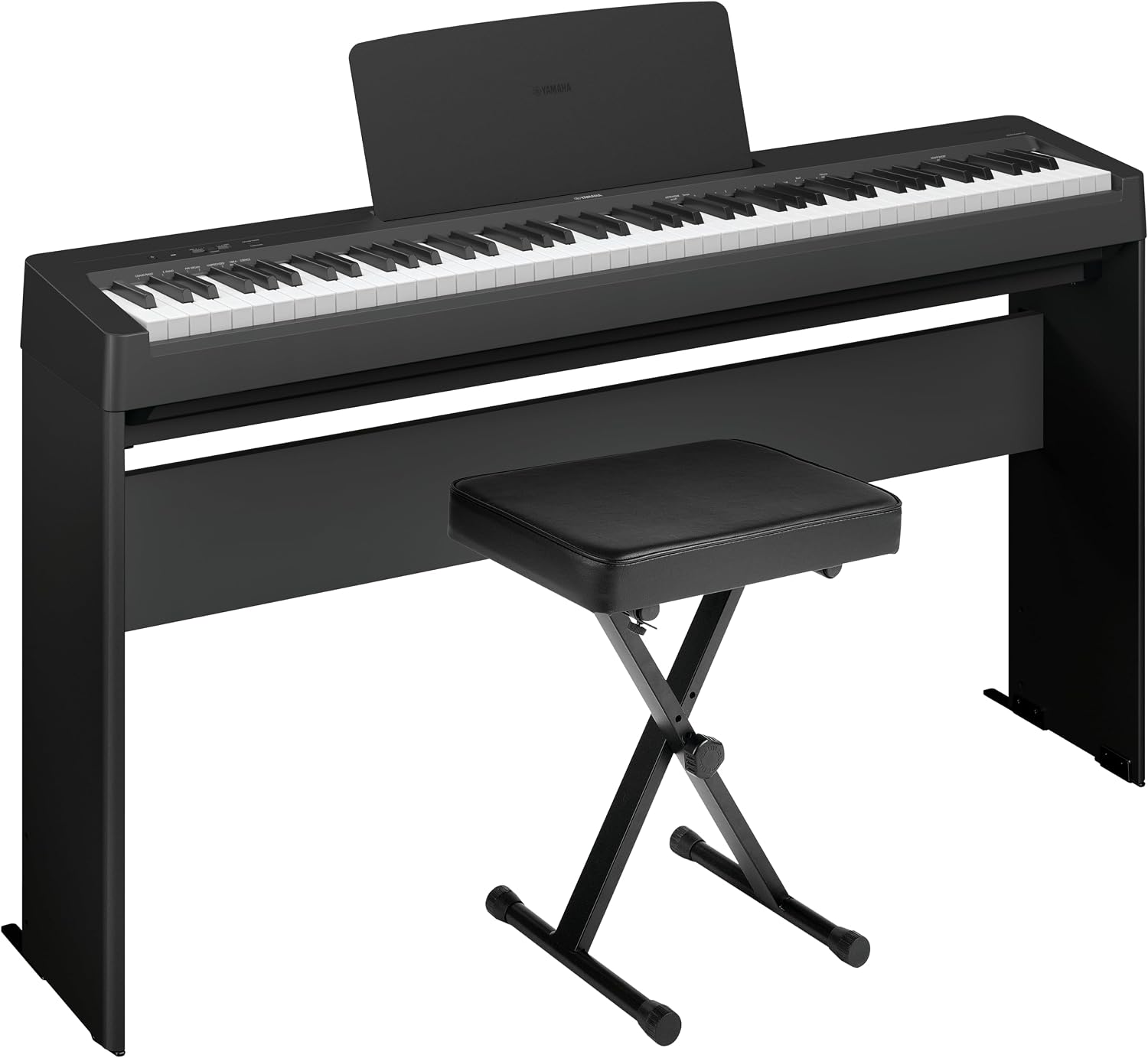
The all-in-one pick: Yamaha P-143 Digital Piano Bundle, Includes 88-Key Weighted Musical Keyboard, Stand, Bench, Music Rest, and Sustain Foot Switch (P143LXB)
 Visit on Amazon →
This is the package I point a parent toward when nobody in the house wants to assemble anything, because it arrives as a complete practice corner: an 88-key weighted keyboard, a stand, a bench, a music rest, and a sustain foot switch. That matters more than it sounds. Half the students who quit in month two quit because the keyboard was sitting on a dining table at the wrong height and the pedal kept sliding under the couch.
The action is the part I care about here, and it is the part I use this instrument to demonstrate. Press a key slowly and the tone steps up in usable increments rather than jumping from whisper to shout, which is exactly what you want a beginner to feel under their fingers. What I tell every parent who buys this bundle is the same thing I tell them about every bundle: the included bench and foot switch are starter pieces. Budget for a heavier pedal unit and a proper bench later. The piano itself is not the weak link.
Anyone buying for a child, or for an adult returning after twenty years, should start their shopping here.
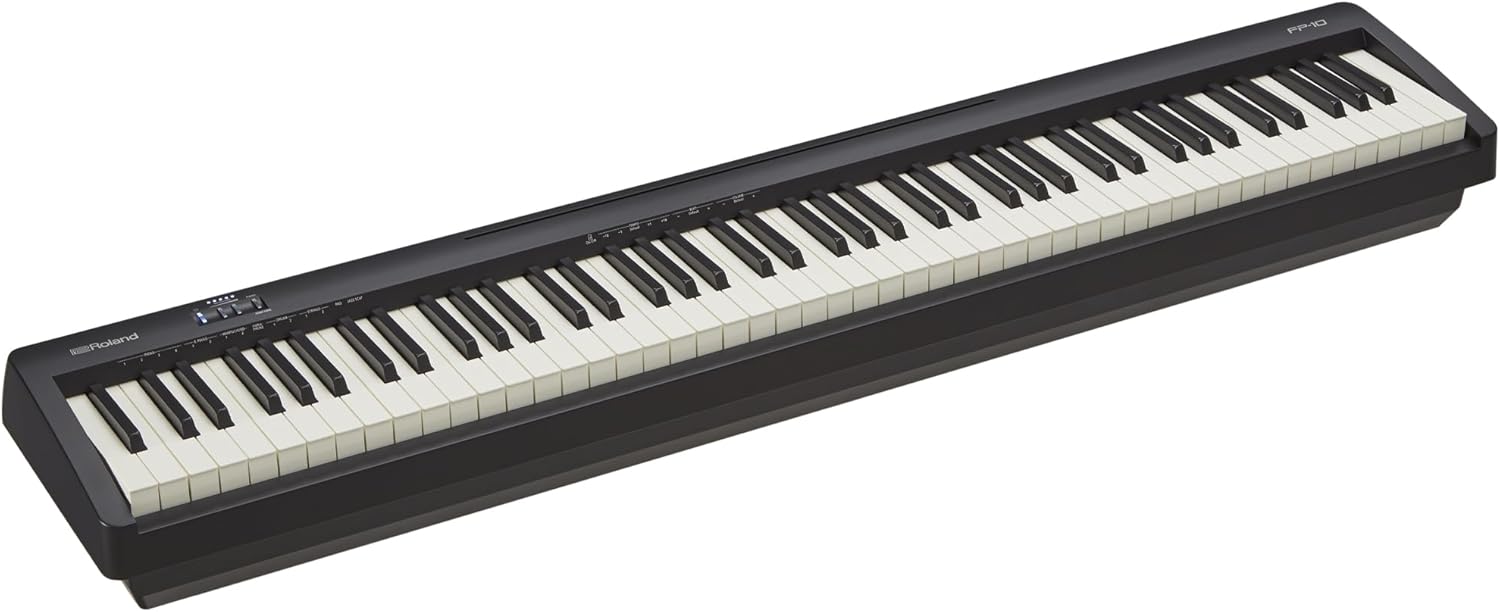
The slab pick: Roland FP-10 Compact 88-Note Digital Piano
 Visit on Amazon →
This is the one I recommend when the piano has to move: apartments, dorm rooms, a car trunk on moving day, a keyboard that lives in a closet and comes out for lessons. It is a slab, which means no cabinet, no built-in stand, and no furniture you pay a thousand extra dollars for. You supply the stand and the bench.
What I use it to demonstrate is key repetition. Play a fast repeated note and listen for whether the key comes back under your finger in time for the next strike or lags behind and forces you to slow down. This instrument stays with you on repeated notes, and that is the single quality that separates a practice tool from a toy. It is also small enough that a student can carry it to a lesson, which means the piano they practice on is the piano their teacher hears.
Anyone in a small apartment, or anyone who moves every couple of years, should look here first.
The actual test, step by step
Now the part you came for. Do these in order, on whatever instrument you are considering, and write down what you find. Twenty minutes.
Step one: Sit at the right height. Elbows level with the keys, forearms roughly parallel to the floor. If the store bench is a folding chair, ask for an adjustable one. You cannot judge downweight from a bad seat, and half of what people call a heavy action is actually a low chair.
Step two: Press one key, slowly. Start as softly as you can and increase pressure until you reach a comfortable forte. Listen for the number of distinct volume steps you pass through. A good action gives you a smooth ramp. A cheap one gives you two or three plateaus, and you will hear the tone jump between them.
Step three: Play the same note twenty times fast. Not loud, just even. Listen for whether each note sounds identical or whether some disappear. Notes that vanish are keys that did not return in time. That is repetition speed, and no sample library can hide it.
Step four: Play a slow phrase and watch your volume. Take eight bars of anything lyrical and try to hold a steady dynamic through the whole phrase. If the piano gets louder as you play deeper into the piece, the action is fighting you, and this is the flaw that ruins the most practice sessions because students blame their own hands.
Step five: Test the bottom of the key. Press a key all the way down, very slowly, and feel for the point where resistance changes near the bottom of the travel. That subtle notch is damper and escapement simulation, and its presence is one of the clearest signals that you are playing a serious action rather than a spring.
Step six: Listen at conversation volume. Play with the internal speakers turned down to about the level you would use at nine at night with a family asleep upstairs. Every digital piano sounds impressive loud. What you need to know is whether the low end disappears and the midrange turns to cardboard at low volume. Speaker voicing is what you are actually paying for in this price range, not sample count.
Step seven: Work the pedal. Put your foot on the sustain pedal and play something with real pedaling. Then slide your foot sideways on purpose. If the pedal skates across a wood floor, plan on a proper pedal unit or a strip of grip tape. A sustain pedal that wanders mid-phrase is a small thing that becomes a rage every single evening.
Step eight: Find the headphone jack by touch. Sit in playing position and reach for it without looking. If it is on the back panel, you will be standing up and reaching around the instrument every time you want to practice quietly, which is every night. Jacks on the front or the far left edge are the ones that get used.
What your notes should tell you
If the action passed steps two through five, the instrument is worth considering and the rest is preference. If it failed step two or step four, walk away no matter how good the demo song sounded, because you will spend the next two years working around it.
Write down your findings while you are standing there. Every piano feels similar an hour later, and the one you remember as "fine" is usually the one you played last.
The competition and why it lost
The big cabinet consoles, the ones that look like a small upright in the living room, are lovely furniture and they are what I recommend to a household that wants the piano to be part of the room. They are not part of this guide because you cannot carry one home, and the action you are testing is often the same mechanism as the slab version with a heavier cabinet around it. You are paying for the cabinet.
The 61-key arrangers that get sold next to the real instruments are not part of this guide either. Sixty-one unweighted keys are fine for a hobbyist playing pop chords and useless for anyone learning to control tone with finger weight.
The stage slabs at the top of the price curve are wonderful and out of scope for most of the people reading this. If you are gigging weekly, you already know what you want.
What this all costs
The all-in-one bundle puts the keyboard, stand, bench, music rest, and foot switch on one line, which is why I send beginners toward it. The slab costs less up front and then asks you to buy a stand, a bench, and a pedal separately, so the gap between the two narrows fast once you are honest about the accessories. Check current Amazon price on both before you decide, and add the cost of whatever the box does not include.
Then do the arithmetic that actually matters. A piano you practice on five nights a week for three years is somewhere around eight hundred sessions. If the action is good, you get eight hundred sessions that build technique. If the action is bad, you get eight hundred sessions of compensating, and you pay a teacher like me to undo them.
The test takes twenty minutes. Do it in the store, before the box comes home. Your hands will tell you the truth faster than any spec sheet, and the instrument that feels right at step two is the one you will still want to sit down at in February.