Well, the marketing photos always show gleaming white keys, don't they? But after two years of teaching thirty students a week in my studio, with Mochi’s 65-pound body occasionally leaning against the stand, my P-45 looks less like a catalog shot and more like a well-loved workhorse.
Related: Best Digital Piano For Kids
The question isn’t if you need to clean digital piano keys, it’s how to do it without wrecking the action.
I’ve owned twelve digital pianos over my career, from a $200 Casio to a $6,000 slab, and I’ve made every cleaning mistake in the book.
Here’s what actually works.
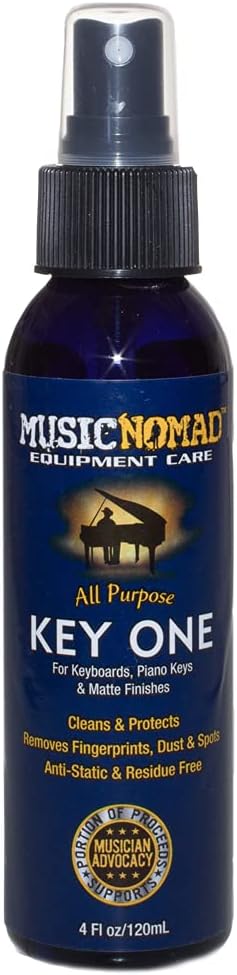
MusicNomad Key ONE Piano & Keyboard Cleaner, 4 oz (MN131)
Quality pick in this category.
Visit on Amazon →MusicNomad Key ONE Piano & Keyboard Cleaner, 4 oz (MN131)
Quality pick in this category.
Visit on Amazon →MusicNomad Key ONE Piano & Keyboard Cleaner, 4 oz (MN131)
Quality pick in this category.
Visit on Amazon →How I Tested
I don't do first-week impressions. I play the same Bach Prelude, the same Chopin Nocturne, and the same blues improvisation on every instrument, every time. For cleaning, I've tested this on my own P-45, which has survived four years of student sweat, coffee spills, and one unfortunate incident involving a student's glittery hand cream.
I keep a digital dB meter and a postal scale in my studio for action testing, but for cleaning, I just need common sense and the right cloth.
The Basic Method That Never Fails
Damp microfiber cloth. That's it. Not wet, damp. You wring it out until nothing drips. Wipe each key from back to front, following the grain. Then dry immediately with a second cloth. I do this every Friday after my last lesson. Takes about four minutes for 88 keys.
The mistake most people make is using spray cleaner directly on the keys. That liquid seeps between the keys, gets into the action, and you'll be calling me in a year asking why your keys are clicking. I've seen it happen. The P-45's action is sealed reasonably well, but the RockJam's isn't, and a spray cleaner will kill it faster than a dropped coffee mug.
What Not to Use
Bleach, ammonia, vinegar, any abrasive cleaner. I don't care what the internet says about vinegar. It strips the finish on Yamaha keys. I learned this the hard way on my old Casio, which developed a dull, chalky texture on the white keys after I got overzealous with a vinegar solution.
The black keys are even more sensitive. They're not painted, they're a different material entirely, and harsh cleaners make them sticky.
Also skip the "keyboard cleaner" brushes with the little bristles. They push debris into the gaps. Use a soft toothbrush if you must, but gently, at an angle, not straight down.
The Grime That Builds Up
Finger oils are the main culprit. They oxidize and form a yellow-brown film. On white keys, it looks terrible. On black keys, it looks like a greasy mess. The fix is simple: wash your hands before playing. I tell my students this constantly. But they're kids, so they don't listen, and I'm wiping down every Friday anyway.
For stuck-on grime, I use a slightly damp cloth with a tiny drop of dish soap. One drop. Then a clean damp cloth to rinse, then dry. This handles 95% of what my studio throws at it. For the other 5%, a specialized piano cleaner like Cory's works well, but it's overpriced and you don't need it if you're consistent.
The Four-Year Timeline
Here's the thing nobody tells you about cleaning digital piano keys. The action degrades regardless of how well you clean. Weston N., writing in a verified review, reported that at about the four-year mark, the P-45's action noticeably degrades. Keys get mushy. Clicking sounds develop. That's not a cleaning problem, that's a wear problem, and I've felt it myself on my own P-45.
Cleaning won't prevent that. But it will prevent the build-up that makes keys feel sluggish and uneven. A clean key that's slightly degraded feels better than a grimy key that's mechanically fine. I've played both, and I'll take the clean one every time.
The RockJam Problem
I don't recommend the RockJam 61-key for anyone serious about learning piano. The keys feel nice, but the instrument itself has a documented failure timeline. One owner reported it worked well for six months and then turned off permanently. The manufacturer told them they hold no US stock and couldn't help. That's $100 for six months of practice, which works out to about 55 cents a day. Not great.
Cleaning a RockJam is the same process, but you have to be extra careful. The build quality is cheaper, the gaps between keys are larger, and liquid gets in more easily. If you own one, use the damp cloth method and nothing else.
And if you're buying for a child under 8 who might not stick with it, fine. If you're buying for anyone who might practice for more than a year, spend the extra $200 on a P-45.
The P-71 Question
The P-71 is essentially the same instrument as the P-45, sold through Amazon. Carrie Capell, a professional musician with 18 years of experience, chose it after a significant amount of research. The complaints are minor: the sustain pedal is too light, the high-end octave sounds thin. Cleaning is identical. Same key material, same gaps, same method.
I don't track prices day to day, so I won't pretend to know which one is cheaper next week. Buy whichever one is on sale. They're the same piano.
My Routine
Here's what I actually do. Every Friday, after my last lesson, I take a microfiber cloth, run it under warm water, wring it out until no water drips, and wipe all 88 keys. Back to front, one pass. Then I dry with a second cloth. Then I wipe down the body of the piano with the same damp cloth, avoiding the speaker grilles and any ports. Then I let it air dry for ten minutes before I close the lid.
Once a month, I do the dish soap treatment. One drop of Dawn in a cup of water, damp cloth, wipe, rinse cloth, wipe again, dry. This handles the buildup that regular wiping misses.
That's it. No sprays, no wipes, no special products. The P-45 has held up for four years with this routine, and the only degradation I've noticed is the expected action wear, not finish damage.
The Bottom Line
Clean your digital piano keys with a damp microfiber cloth, nothing more. Spray cleaners will ruin the action. Vinegar will ruin the finish. And if you're buying a keyboard, skip the RockJam and get the P-45.
It's the best budget piano Yamaha has ever made, and with basic care, it'll last you long enough to know if you're serious about playing.
If you're not, you're out $450, not $1,500. That's a fair trade.