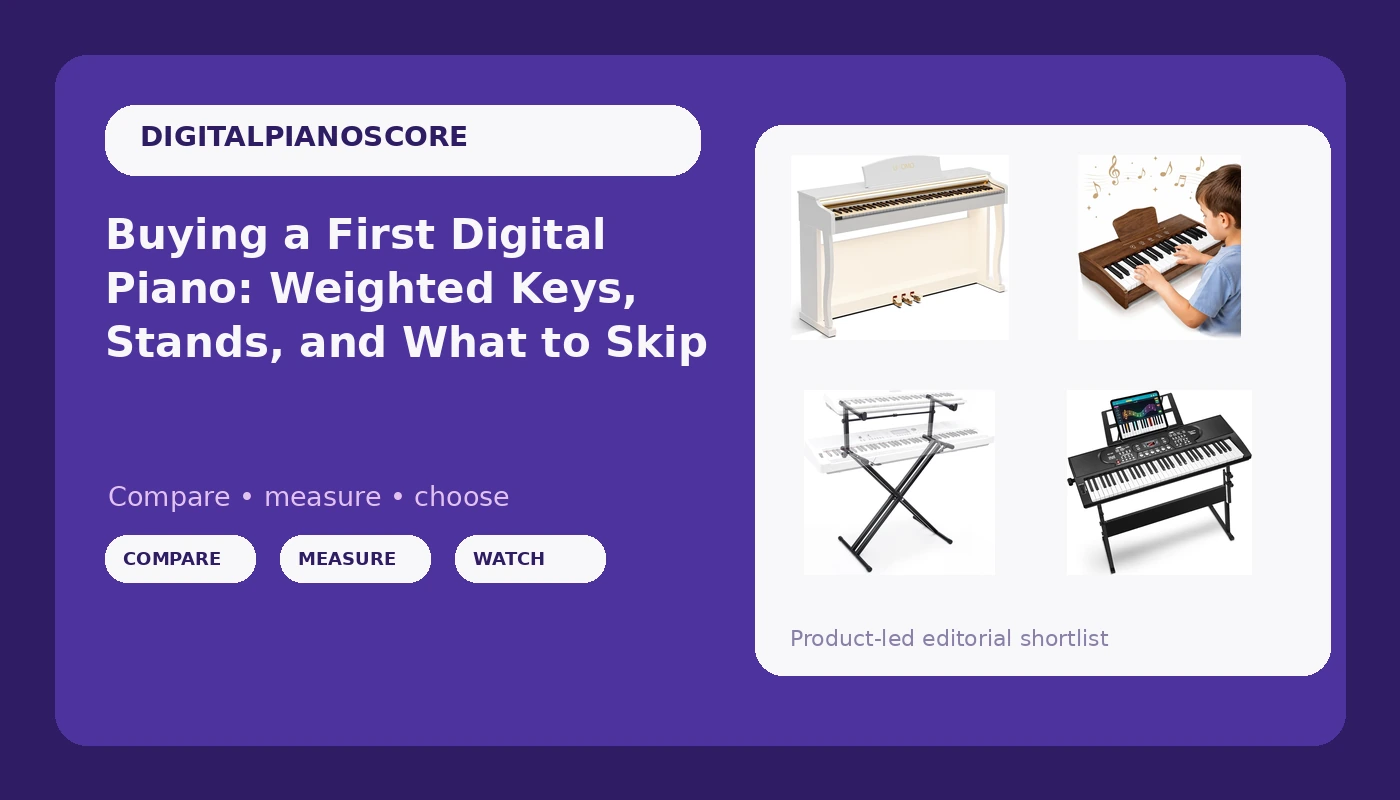
Related: Best Digital Pianos for Small Apartments: Weighted Keys Without the Cabinet
Every September the same email lands in my inbox: the teacher says we need a piano at home and I have no idea what to buy. I have taught 30 students a week out of a home studio in Seattle for 25 years, and I have owned a dozen digital instruments, from a cheap slab I bought in my twenties to a console I still regret selling. Here is the short version of what I tell those parents. Choosing a digital piano for beginners is an action decision first and a sound decision second, and almost nobody shops that way.
The action is the piano. Graded hammer action is a spectrum, not a checkbox, and the cheap end of that spectrum bounces in a way that teaches bad habits. A student who practices on a springy keyboard learns to press keys. A student who practices on a weighted action learns to control tone with finger speed, and that is the whole skill.
Speaker quality matters more than sample library size. A great sample played through a bad speaker sounds like a great sample played through a pillow. Polyphony numbers are marketing, and nobody plays 256 notes at once.
I will say up front that three of the four items below are not instruments I would keep in my own studio. I cover instruments with 88 weighted keys, and a 61-key board and a 37-key toy are not that. But parents ask me about all of them every single year, and a guide that only recommends the expensive answer is not useful to a family in a 600 square foot apartment. So here is the honest version.
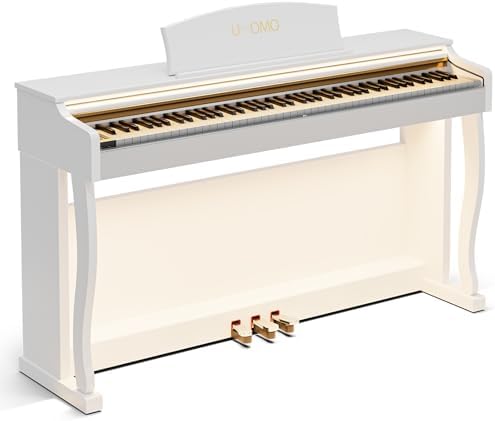
Best Overall: UMOMO U-732 88 Weighted Key Digital Piano
This is the one I would point a transfer student to. Eighty-eight weighted keys with hammer action, full size keys, an adjustable light, a stand in the box, and a glossy white finish that reads as furniture rather than gear.
The key count is not a luxury. Students meet the full range of the keyboard somewhere in their second or third year, and a student who has never played the bottom two octaves at home is learning the geography of the instrument in pieces. If you can only get one thing right on this list, get the 88 keys.
Hammer action is the second thing. It is what lets a player control volume by how fast the key goes down rather than by how hard it is pressed, and it is the difference between a practice tool and a toy with black and white buttons. I cannot tell you how this particular action feels from a product page, and I will not pretend otherwise. What I can tell you is that hammer action in the name is a real filter: it rules out the spring-loaded boards that make a student's fingers lazy.
The adjustable light is a small feature that turns out to matter more than it sounds. Half my students practice in a corner of a living room after dinner, and a keyboard you cannot see is a keyboard you do not play. Glossy white is a taste decision, and it will show fingerprints. If the piano lives in a sunlit room, think about that.
One caution before you order: check what else is in the box. The stand is included here, which is genuinely useful, but I have never met a sustain pedal that shipped with a budget kit and stayed on the floor. Budget for a replacement pedal and a bench you can sit at for 45 minutes. That is the advice I give every family, and it has never once been wrong.
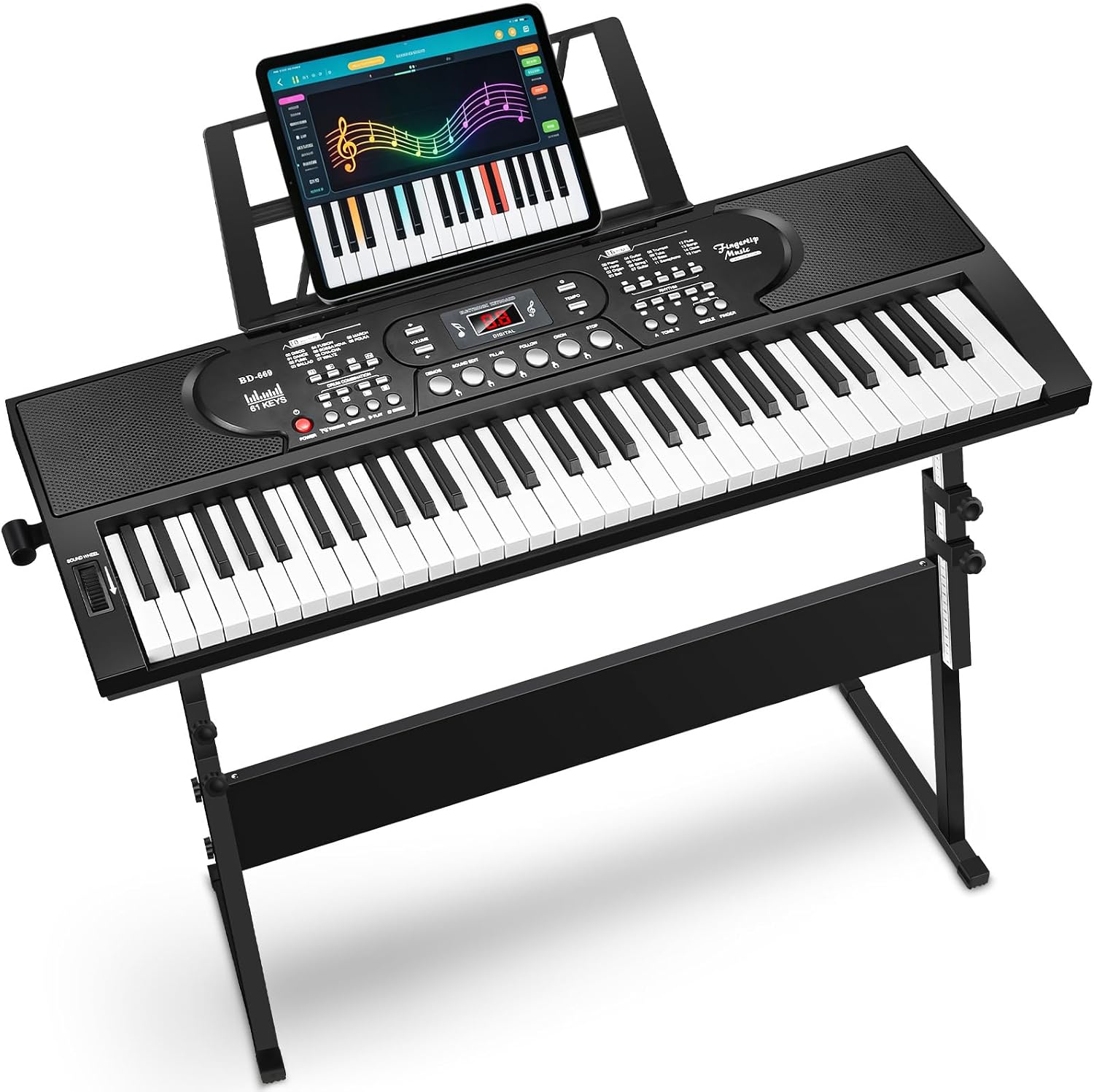
Best Starter Kit: 61 Key Keyboard Piano with Stand
I do not usually review 61-key boards, and I want to be straight with you about why. Sixty-one keys is about five octaves. That covers the first two years of nearly every method book in print, and it does not cover the third. The first time a student meets a piece that walks down to the bottom of the keyboard, the notes are simply not there.
So why mention it at all? Because it is portable, it ships with a stand, and it is light enough that a kid can carry it to a lesson or a friend's house. For a seven or eight year old in a small apartment, a board that can be moved is a board that gets played, and a piano that stays in the case gets sold by spring.
If this is the instrument, here is how I would set it up. Put it on the included stand at a height where the forearms are roughly level with the keys, not angled up. Sit at it the way you would sit at a piano, with feet on the floor, not on a bed with the board across your knees. Half of what looks like a technique problem in a young student is a furniture problem.
Treat it as a two year instrument and plan the upgrade now. When the range runs out, you will already know whether the kid is serious, and that is worth more than guessing on day one.
Best for the Kid in the House: Kids Piano Keyboard, 37 Keys
This is a toy, and I mean that as a compliment. It is aimed at ages three and up, it has 37 keys, touch control buttons instead of protruding knobs, built in songs and rhythms, and a wood cabinet in dark brown.
The reason I like it in a house with an older student is simple. The four year old wants to be where the action is. If the only instrument in the room is the one they are not allowed to touch, they will find a way to touch it. A small board of their own, on the floor or on a low bench, buys the older student twenty uninterrupted minutes, and twenty uninterrupted minutes a day is how progress actually happens.
Touch controls are the detail I would single out. Protruding buttons on a toy get pressed, leaned on, and broken. Flat panels survive.
Do not buy this expecting it to teach reading or technique. It will not, and no toy at this size will. What it can do is put the sound of a keyboard in the room before formal lessons start, and that is not nothing.
The Stand That Solves a Two-Instrument House: Double Keyboard Stand, 2-Tier
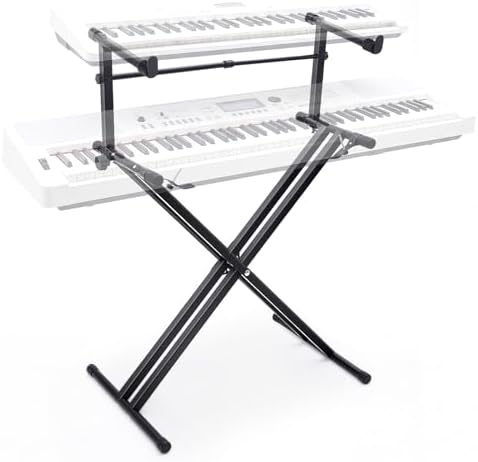
Two tiers, adjustable, X-style, sized for 54, 61, or 88 key instruments. This is the answer for the household where the 88-key lives at the bottom and a lighter board sits above it, which is exactly the setup I run in my studio when a student needs to hear two sounds at once.
Two rules for X-style stands. First, put the heavier instrument on the bottom tier. Weight low means stability, and stability is the entire point of a stand. Second, check the height of the top tier against your seated eye line. If you have to look up to read the music, you will stop looking at the music, and then you will stop reading.
An X-style frame will flex a little under a heavy hand. That is the trade you make for something that folds flat and moves in a car. A furniture stand or a cabinet is more solid, and it is also a piece of furniture you pay for and then have to move. For most families with two instruments and one room, the folding frame wins.
The four options side by side
| Product | Keys | What it is | Stand | Best for | Price |
|---|---|---|---|---|---|
 Visit on Amazon → UMOMO U-732 |
88, weighted | Hammer action, adjustable light, glossy white | Included | Transfer students, returning adults, full repertoire | $429.99 |
 Visit on Amazon → 61 Key Keyboard Piano Kit |
61 | Portable, kit with stand | Included | First two years of method books, small rooms | $79.99 |
 Visit on Amazon → Kids Piano Keyboard |
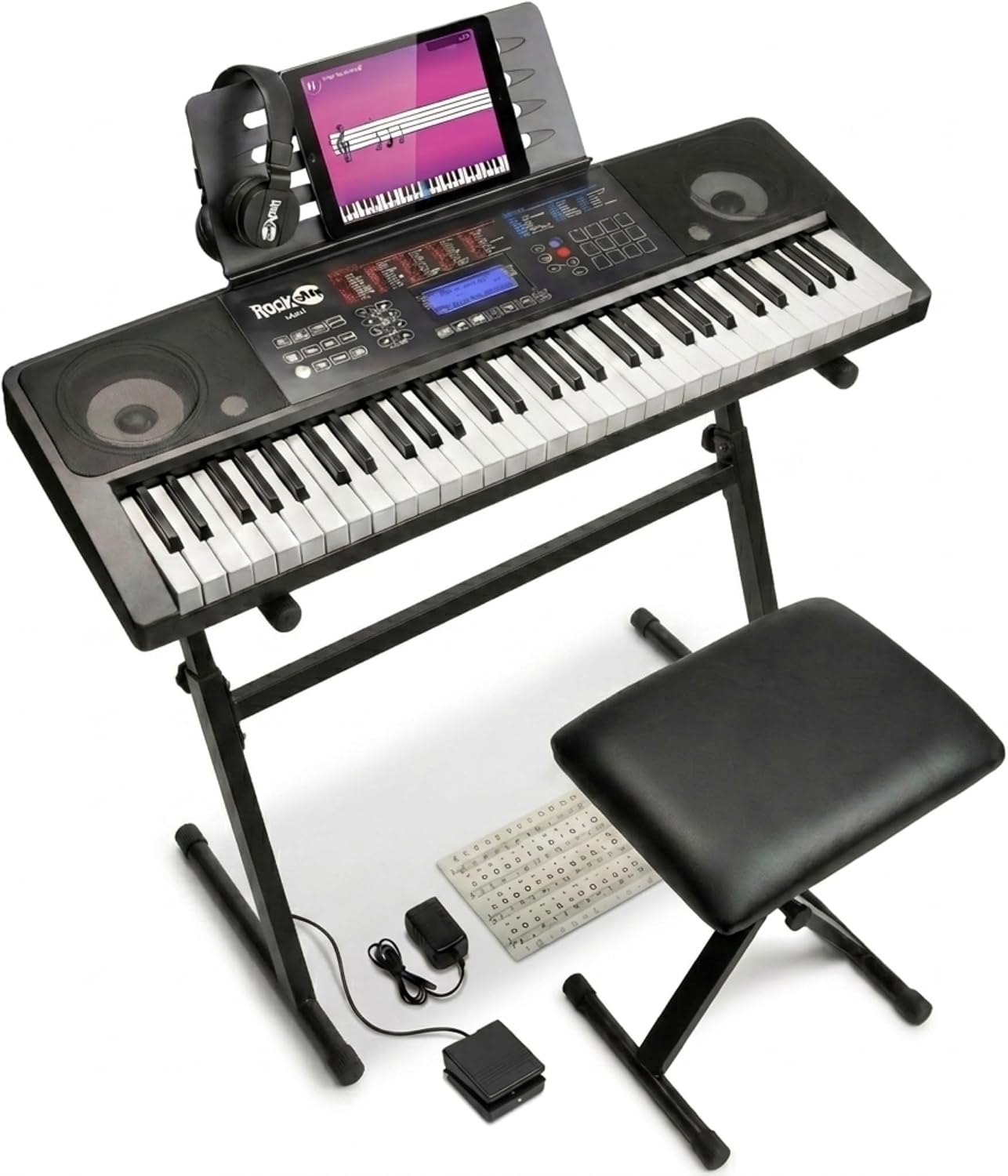
37 | Wood toy, touch controls, built in songs and rhythms | Not included | Ages 3 and up, second instrument in the room | Check current Amazon price |
 Visit on Amazon → Double Keyboard Stand |
Fits 54, 61, 88 | Two tier, adjustable, X-style | Is the stand | Two instruments in one room | $62.99 |
How I judge an instrument before I recommend it
I do not own all four of these items and I am not going to pretend I ran them through a lab. What I can give you is the checklist I have used on a dozen instruments of my own and the same one I hand parents before they spend money.
I play the same three pieces on anything I am evaluating: the Bach prelude I have played since I was fifteen, a Chopin nocturne with a lot of dynamic shading, and a blues improvisation where I repeat notes fast. The Bach tells me whether the action is even across the keyboard. The Chopin tells me whether I can shape a phrase with finger speed or whether the instrument only knows loud and soft. The blues tells me about key repetition, which is the thing cheap actions get wrong and the thing that makes a student sound clumsy when they are not.
Then I check the boring details. Where is the headphone jack? If it is on the back of the unit, you will be reaching behind the piano every night, and that gets old in a week. Does the sustain pedal stay where you put it, or does it slide across a wood floor mid phrase? Is the stand at a height where a ten year old can sit properly, or does it assume an adult?
When I cannot play an instrument in person, I read the listing for four things: key count, whether the action is weighted and hammer based, whether a stand is included, and whether the thing is furniture or portable. Those four answers decide most of the purchase.
What each tier actually gets you
At the 88-key tier you get range and an action worth practicing on. That is the tier where the instrument stops being a compromise and starts being a piano, and it is where I would put every dollar a family can spare.
At the 61-key tier you get portability and a low entry price, and you pay for it in range. Two years, maybe three, and then you are shopping again.
At the 37-key tier you get a child who feels included in the music in the house. That is worth the money, and it is not the same thing as a lesson instrument.
And a stand is a stand, until you own two keyboards. Then it becomes the difference between a studio and a pile.
Should you buy the UMOMO U-732?
Yes, if the player is past the first method book. It is the only item here with 88 weighted hammer action keys, full size keys, and a stand in the same box, which means a transfer student can keep playing real repertoire at home over the summer instead of losing ground. Check the box contents for the pedal and budget for a bench, the way I tell every family to.
Should you buy the 61 Key Keyboard Piano kit?
It is a reasonable first instrument for a seven or eight year old in a small apartment on a tight budget, and a bad choice for a twelve year old who already reads music. Sixty-one keys, portable, stand included. Buy it knowing it is a two year instrument, and start saving for the upgrade now.
Should you buy the Kids Piano Keyboard?
Yes, as a toy for a three to five year old in a house where someone else is practicing. Thirty-seven keys, touch controls, built in songs and rhythms, wood cabinet. It will not teach technique and it is not trying to.
Should you buy the Double Keyboard Stand?
Only if two instruments share a room. Put the heavy one on the bottom, check the top tier against your seated eye line, and accept a little flex in exchange for a frame that folds flat. One instrument, one room, and a solid stand is the better buy.