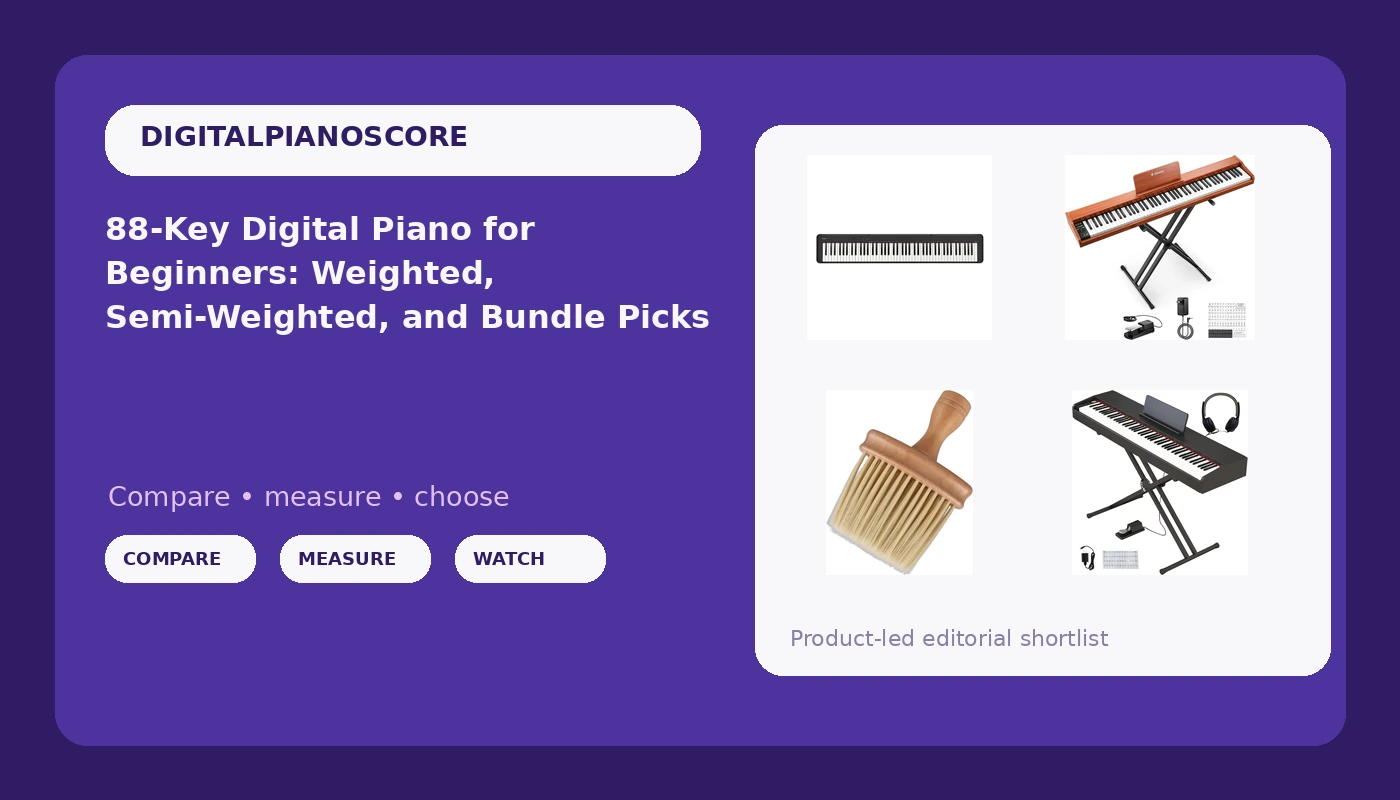
Choosing an 88-key digital piano for beginners is a decision you live with for years, which is why it feels harder than the price tag suggests. Most first-time buyers arrive with the same three questions: are weighted keys worth paying more for, does a bundle that includes a stand and pedal save anything real, and how much of what the box promises survives contact with daily practice? The four items here sit at different points on that spectrum: a scaled hammer action slab, a complete starter bundle with accessories, a semi-weighted 88-key keyboard built for the lightest touch, and the small wooden brush that keeps the keytops and the gaps between them clean. This explainer covers what each one is for, and where each one stops being the right answer.
Related: Digital Piano Action Weight Explained →
Quick answer
There is no single correct purchase, because these four products solve four different problems. If graded hammer action and a slim, portable body matter most, the Casio CDP-S160 is the instrument in this group that carries a scaled hammer action keyboard and Duet Mode. If you would rather have the accessories settled in one order, the Donner DEP-1S bundle includes a stand, stickers, and a sustain pedal, along with recording and Bluetooth. If you want the lightest key resistance and the smallest commitment, the semi-weighted 88-key keyboard is designed for exactly that. The cleaning brush is not an instrument; it is the accessory that keeps whichever instrument you choose playable and free of dust.
4 useful options
| Model | Best fit | What stands out |
|---|---|---|
| Casio CDP-S160 88-Key Weighted Digital Piano | Students who need piano-like resistance | Scaled hammer action, Duet Mode for two players, USB-MIDI, slim slab body |
| Donner DEP-1S 88-Key Beginner Digital Piano | First-time buyers who want everything in one order | Velocity-sensitive 88-key keyboard, recording, Bluetooth, chord function, stand, stickers, sustain pedal included |
| Digital Piano 88-Key Semi-Weighted Keyboard | Lightest touch and lowest commitment | Semi-weighted keys across a full 88-key layout |
| Keyboard Cleaning Brush | Anyone who wants the keys to stay clean | Wooden double-sided brush, anti-static, ultra soft, works on keytops and gaps |
Weighted action pick: Casio CDP-S160
Weighted action is the feature that decides whether a beginner keeps playing, and the CDP-S160 is the only instrument in this group whose listing states a scaled hammer action. Scaled means the hammers are graded: heavier at the low end, lighter as you move up the keyboard, which is how an acoustic piano behaves. Duet Mode matters more than buyers expect, because it splits the keyboard into two equal ranges so a teacher and a student, or a parent and a child, can sit side by side at one instrument. USB-MIDI means the piano can drive notation and learning apps. Built-in speakers mean you can practice without headphones, though headphone practice is what most apartment players end up doing. The trade-off is accessories: a slim slab at this level typically arrives without a stand or a proper pedal, so budget for both.
Complete starter bundle: Donner DEP-1S
The DEP-1S takes the opposite approach: instead of asking you to assemble a setup, it arrives as one. The bundle includes a stand, piano stickers, and a sustain pedal, which covers the three things a first-time buyer otherwise has to shop for separately. The keyboard is velocity-sensitive across all 88 keys, so dynamics respond to how hard you play, though the listing does not describe the action as hammer-weighted. Recording and Bluetooth are built in, and the chord function is aimed at players who want accompaniment while they learn. Treat Bluetooth as a convenience rather than a reason to buy; it is nice to have when it works and irrelevant when you are practicing scales. The retro wood color is a style choice. The trade-off is that a bundle is only as good as its weakest piece, so if the stand or pedal ever disappoints, replacing that single item is straightforward.
Light-touch starter: Digital Piano 88 key Semi-Weighted Keyboard For Beginner
Semi-weighted keys sit between a springy synth action and a true hammer action. There is resistance, and it is consistent from key to key, but there is no hammer mechanism to push against, so the finger strength a student builds here transfers only partly to an acoustic piano. That makes this the right choice for a specific buyer: someone who is not yet sure the instrument will stick, someone working with limited space or budget, or someone who wants a second keyboard for casual playing. It is not the right choice for a student preparing for graded exams on an acoustic instrument, and it is not the right choice if you already know you want the feel of a real piano. For a first instrument that has to prove itself before you spend more, the trade-off is reasonable.
Upkeep extra: Keyboard Cleaning Brush
Dust is the quiet enemy of a digital piano. It settles into the gaps between keys, works its way toward the key contacts over time, and turns into a grey film on the keytops that no amount of wiping with a sleeve fixes. A wooden, double-sided, anti-static brush with ultra soft bristles is the low-cost tool for that job: the soft side for keytops, the narrow side for the gaps and the edges of the case. The same brush handles dust on a laptop keyboard, a guitar fretboard, or the faders of a synthesizer. It is a small addition to the same order and the one most likely to be forgotten, which is exactly why it belongs there.
Prices and availability may change. Product images, names, and retailer links are matched to verified listings. No current price, rating, stock status, or measured result is stated here without current evidence.
Weighted, semi-weighted, and unweighted: what the words actually mean
Action is the mechanism between your finger and the sound, and it is the part of a digital piano that determines whether the instrument builds good habits or bad ones.
A hammer action uses weighted hammers that pivot when you press a key. The weight gives you something to push against, and that resistance is what lets you control dynamics with finger speed rather than with a volume knob. Graded or scaled hammer actions make the low keys heavier than the high keys, mirroring the longer, thicker strings at the bass end of an acoustic piano. Escapement, the slight release point near the bottom of the key travel on a grand piano, is simulated on some higher-end actions and is not something to expect at entry level.
A semi-weighted action uses springs or light weights. Keys return quickly and feel even, and the light resistance is comfortable over long practice sessions, but the link between finger speed and volume is looser.
An unweighted or synth-style action is essentially a spring-loaded switch. It is fine for organ parts and synth lines, and it is the wrong tool for building piano technique.
None of these categories is a single fixed thing. Weighted is a spectrum, and two instruments that both say weighted can feel very different under the hand.
The specs that matter after the first month
Polyphony, the number of notes an instrument can sound at once, gets more attention than it deserves. A player with two hands and a sustain pedal rarely needs more than a few dozen notes at a time. A generous number is nice to have and a small number is a genuine limitation on layered sounds, but it is not the spec that decides whether you enjoy practicing.
Speakers decide more. Modest samples through a well-voiced speaker system can sound better in a living room than a large sample library through a thin, boxy speaker. Listen for whether the midrange stays clear with the pedal down, and whether bass notes sound like notes rather than thumps.
The sustain pedal is the second thing to evaluate. A pedal that slides across the floor mid-phrase is worse than no pedal at all, because it trains you to chase it.
Check where the headphone jack sits. A jack on the front or the side is usable in a lesson or a late-night session; a jack on the back panel means reaching around the instrument every time.
Then think about the stand. A slab on a light X-style stand moves when you play with any force, and wobble is the fastest way to make a beginner self-conscious.
- Decide whether you need piano-like resistance. For classical repertoire or exam preparation, choose a weighted action. If you are testing whether the hobby sticks, a semi-weighted keyboard is a reasonable first step.
- Count the accessories you would otherwise buy. A stand, a pedal, and stickers add up, so a bundle that includes them can be the simpler purchase.
- Budget for the whole setup rather than the instrument alone, and leave room for a better pedal and a stable stand later.
- Check your practice conditions. Apartment players need a headphone jack within reach and a volume control that behaves at low levels. Shared rooms need a stand that does not rattle.
- Plan the maintenance. A soft brush and a dry cloth cost little and keep dust out of the key gaps.
Setting up the instrument so you actually practice
- Put the piano where you will see it. An instrument in a closet does not get played; one in the corner of the room you use every day does.
- Set the bench height so your forearms sit roughly level with the keys, and sit far enough forward that your elbows are not pinned to your sides.
- Get a stable stand early. Portability is useful, but steadiness is what makes daily practice comfortable.
- Keep the sustain pedal anchored. A grip strip under the pedal, or a pedal with a weighted base, stops the slide across a hard floor.
- Keep headphones within reach, so a late session never becomes a reason to skip one.
Which option should you choose?
Choose the Casio CDP-S160 when you want graded hammer action and Duet Mode in a slim, portable body, and you are willing to add a stand and pedal separately. Choose the Donner DEP-1S when you want a single order that covers the instrument, the stand, the pedal, and the stickers, with recording and Bluetooth included. Choose the Digital Piano 88 key Semi-Weighted Keyboard when you want the lightest touch and the smallest commitment, and you accept that it is a starting point rather than a substitute for a weighted action. Add the Keyboard Cleaning Brush to whichever order you place.
None of the listings here states a measured key weight, a measured speaker output, or a tested long-term reliability record, and no product in this group should be called the quietest, the fastest, or the most durable on the strength of a product page. If a specific action weight or a specific pedal response matters to you, play the instrument in person before you commit, or buy from a seller whose return window you are comfortable using.
The bottom line
For a beginner buying an 88-key digital piano, the action is the part of the instrument that shapes technique, and it is worth prioritizing over sample counts, Bluetooth, or app support. The Casio CDP-S160 is the option here that states a scaled hammer action, which is the closest thing in this group to an acoustic feel. The Donner DEP-1S is the option that removes the accessory shopping list. The semi-weighted keyboard is the low-commitment entry point for a player who is not yet sure how far this will go. The cleaning brush costs little and keeps whichever instrument you choose in playing condition. Buy the action you can afford, add a stand that does not move and a pedal that stays put, and put the instrument somewhere you will walk past it every day.