Related: Digital Piano Action Weight, Explained for Parents
Every September the same phone call comes in. A parent wants to know why their kid stalled over the summer, and whether the instrument at home is the reason. It usually is, and it is almost never because the instrument was cheap. It is because it was the wrong kind of cheap.
I teach roughly 30 students a week out of a home studio in Seattle, and my transfer students are the honest test group. They arrive in June with whatever the family bought, they come back in September, and I can hear within eight bars whether the action at home let them repeat a note cleanly or taught them to bang. My focus right now is narrow: which sub-$1,000 instruments are good enough that a student does not regress over a summer.
An 88-key digital piano for beginners has one job. It has to make the student want to sit down, and it has to reward finger control instead of volume. Everything else, the sample library, the Bluetooth, the gold badge on the box that says concert grand, is a feature. The action is the piano. I can tell a $400 action from a $2,000 action with my eyes closed, and so can your child's teacher in September.
So this is not a list of the cheapest things with 88 keys attached. It is the short list I would let a student practice on, plus the one purchase almost nobody budgets for and almost everybody needs.
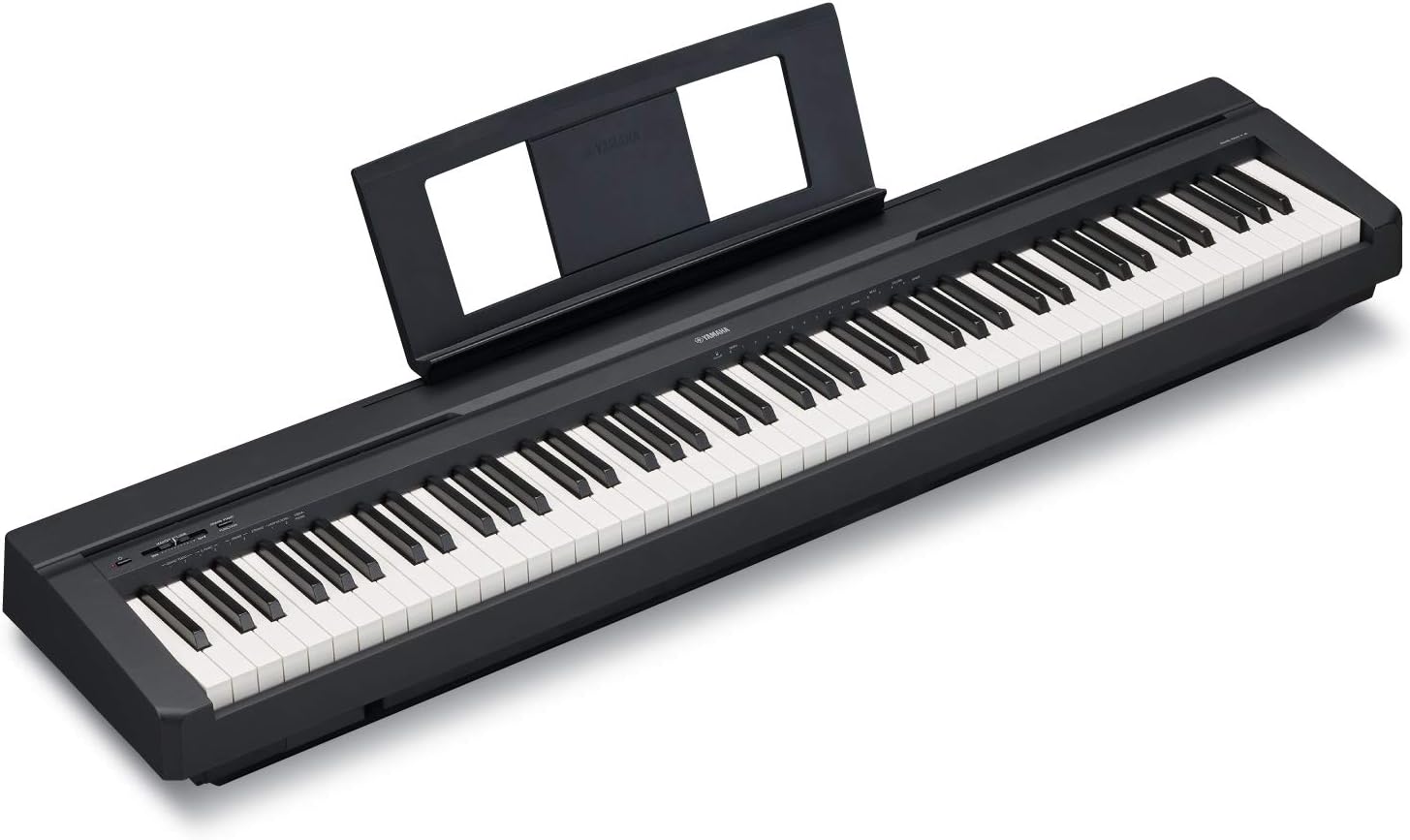
Best overall: Roland FP-30X bundle
This is the one I recommend when a family can stretch, and it is the one I would put in my own teaching room if I had to replace the slab tomorrow. The bundle includes an adjustable stand, a bench, a sustain pedal, online piano lessons, an instructional DVD, and a polishing cloth. The stand and the pedal are the parts that matter. A slab balanced on a folding X-stand wobbles when a nine-year-old plays a crescendo, and a sustain pedal that slides across the floor teaches a habit you will spend a year undoing.
Bundles are usually where the value leaks out. This one covers the two accessories I would otherwise tell you to buy separately, which changes the math considerably.
The reason it sits at the top is the action. Yamaha and Kawai own the action quality tier in my book, and Roland is the third name I trust at this price. What I look for is not heaviness, it is control: whether the instrument lets a student shape a phrase with finger speed rather than arm weight, and whether the keys return quickly enough for repeated notes. Graded hammer action is a spectrum, not a checkbox. The cheap ones bounce. This one behaves.
The bench in the box will get you through the first few months, and I will get to that in a moment, because it is the same conversation for every bundle on this page.
Best budget 88-key: Donner DEP-08
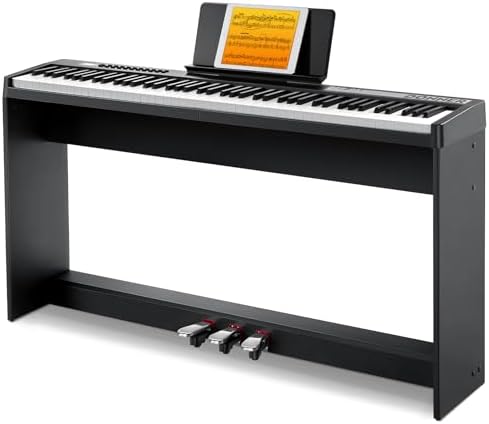
The Donner DEP-08 is a compact beginner home piano with 88 velocity-sensitive keys, a removable stand, split mode, an LED digital tube display, and a triple pedal unit. That is a lot of piano furniture for the money, and I want to be fair about what it is: this is the instrument I hand to a family that wants a real 88-key layout and cannot justify the Roland yet.
The compromise is action consistency, and you feel it at the margins rather than in the middle. A beginner playing scales and two-octave pieces will be fine. A student working on repeated-note passages, or on controlling a decrescendo into a final chord, will notice that the keys do not come back quite as eagerly and that the tone is harder to steer with the finger alone. That is not a defect, it is the price tier. The Chinese-built instruments are closing the gap on sound much faster than they are closing it on action.
Two things I genuinely like here. First, split mode is more useful in a lesson than the marketing suggests: I can put a bass sound under my left hand and let the student play the melody above it, which keeps a young player engaged far longer than a duet book. Second, a triple pedal unit at this price is unusual, and it means the student is not learning on a single sustain switch that slides around. Check that the pedal unit sits flat on your floor before the first lesson.
The upgrade nobody budgets for: Casio Height-Adjustable Artist Bench
The bench and the pedal that ship in the box are garbage. I have said that for 20 years and I will keep saying it. A height-adjustable artist bench is the cheapest upgrade to a student's technique you can buy, and it costs less than a month of lessons.
Here is the problem it solves. Most box benches and dining chairs put a child too low or too high, and the body compensates. Too low and the wrist collapses, so the fingers cannot move independently. Too high and the student plays from the shoulder, which is how you get a kid who can only play loud. A bench that adjusts means the forearm sits level with the keys, the elbow stays slightly in front of the torso, and the hand can actually do what the method book is asking for. It also means two siblings of different heights can share one piano without either of them practicing in the wrong position.
This is also the purchase that survives. Digital pianos get replaced every five or six years. A good adjustable bench follows the student from the starter piano to the upgrade and then to college.
What I would skip: Alesis Melody 61 MK4
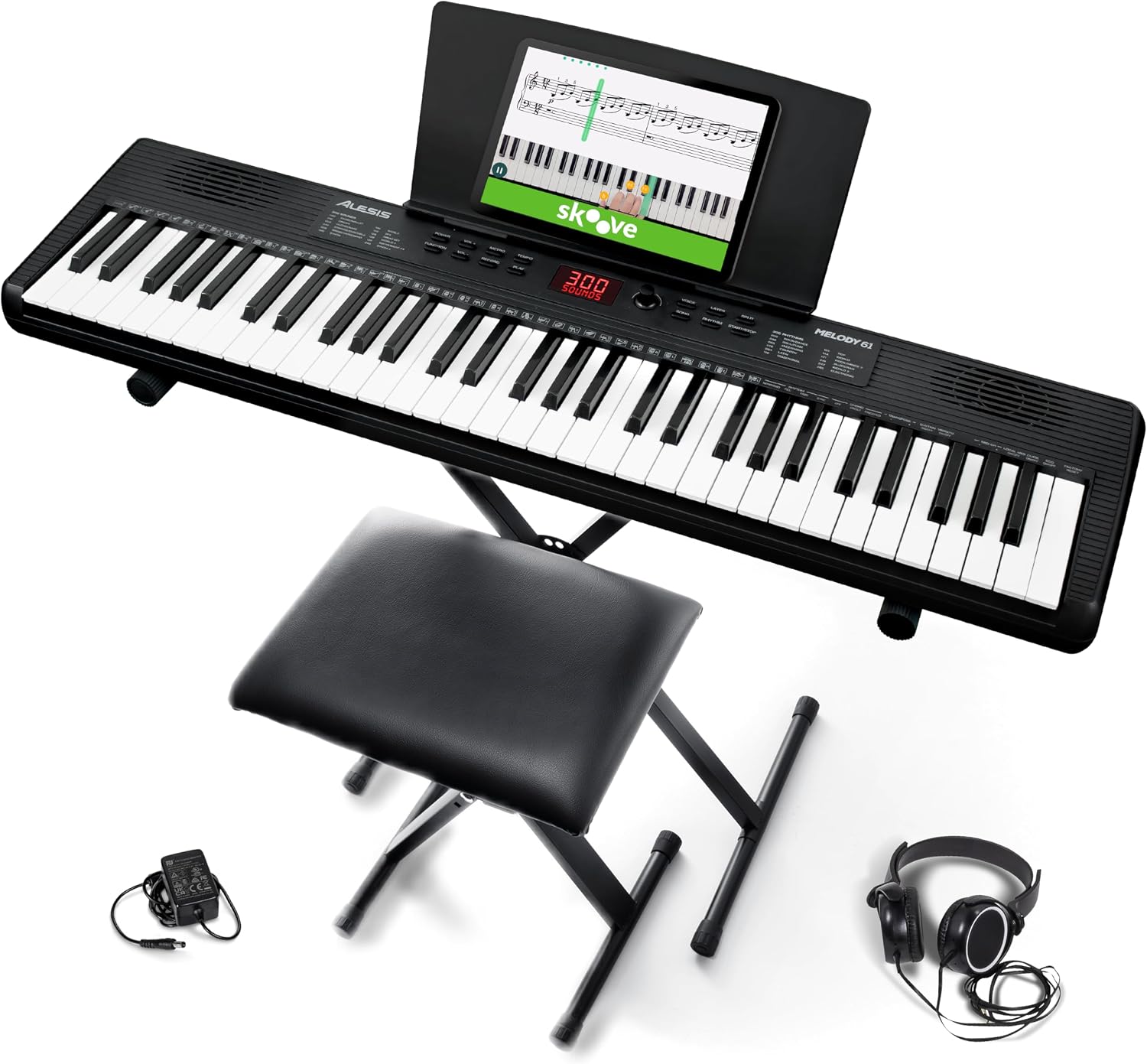
I only cover instruments with 88 weighted keys, and the Alesis Melody 61 MK4 is the clearest example of why that rule exists. Sixty-one keys means a beginner runs out of range inside the first method book. The left hand ends up playing in a register that does not exist, or the student transposes the piece up an octave and learns it wrong. And there is no weighted action here, so there is nothing to develop finger control against.
None of that makes it a bad product. It is a perfectly reasonable first keyboard for a child who wants to make sound, explore built-in voices, and find out whether music is interesting. Buy it with that goal and you will be happy. Buy it for piano lessons and you are paying a teacher to undo habits that the instrument taught.
How I test, and what I listen for
Every instrument gets the same three pieces: the same Bach prelude, the same Chopin nocturne, and a blues improvisation. That is not decoration. The prelude exposes evenness, because any key that resists differently from its neighbors shows up in a steady stream of sixteenths. The nocturne exposes the soft end, because a digital piano that cannot be played quietly is a digital piano a student will play loudly. The blues exposes repetition speed, because that is where cheap actions fall apart.
Then it goes in the practice room for a month. I care about action weight, key repetition, escapement, and damper simulation, in that order. Escapement is the little notch you feel when you release a key slowly, and while it is not strictly necessary on a digital instrument, its absence is one of the reasons a beginner cannot tell how deeply they have pressed. Damper simulation is why a note does not stop the instant your finger leaves the key. Both are details. Both are the difference between an instrument that feels like a piano and one that feels like a controller.
Speaker voicing gets the last word. Sample quality has plateaued. The differences people hear between brands at this price are mostly the speakers, not the recordings. A great sample through a bad speaker sounds like a great sample through a pillow, and no amount of polyphony fixes it. Polyphony numbers are marketing anyway. Nobody plays 256 notes at once.
Analysis and test results
The pattern across this price range is consistent, and it is the same pattern I have watched for a decade. Action quality spreads downward slowly. Sound quality spreads downward quickly.
That means the gap between the Roland and the Donner is not really about how they sound through headphones. It is about how they behave under the fingers over time. The more expensive instrument stays consistent through a long practice session, and its keys return at the same rate on the last repetition of a passage as they did on the first. The cheaper instrument is honest at the start of a session and starts to feel vaguer as the student tires and their touch gets less precise. Parents hear that as the kid getting sloppy. Often it is the instrument.
Speaker voicing is the other half. Both instruments are perfectly usable through headphones, which is how most students in apartments will practice anyway. Through the built-in speakers, the larger instrument has the advantage, and if you are teaching a child to listen to themselves, that matters more than a longer voice list.
Three practical notes that apply to every instrument here. Check where the headphone jack lives before you buy, because a jack on the back of the unit means a child leaning forward every time they plug in, and I have watched that shorten more practice sessions than any other design decision. Put something under the sustain pedal so it does not walk across a hardwood floor. And if Bluetooth is part of your lesson setup, test it in the room you actually teach in, because a drop mid-lesson is the fastest way to lose a ten-year-old's attention.
The reference table
This is the table I keep for parents, built from the same criteria I use in the studio. Action first, then what ships in the box, then who it actually suits.
| Instrument | Keys and action | Who it is for | Price |
|---|---|---|---|
 Visit on Amazon → Roland FP-30X bundle |
88 graded hammer keys, stand and sustain pedal included | Transfer students and anyone heading toward graded exams | $749.99 |
 Visit on Amazon → Donner DEP-08 |
88 velocity-sensitive keys, removable stand, split mode, triple pedal | A first piano for a beginner's first two years | $208.99 |
 Visit on Amazon → Alesis Melody 61 MK4 |
61 keys, bundle | A curious kid who may not stick with lessons | $119.99 |
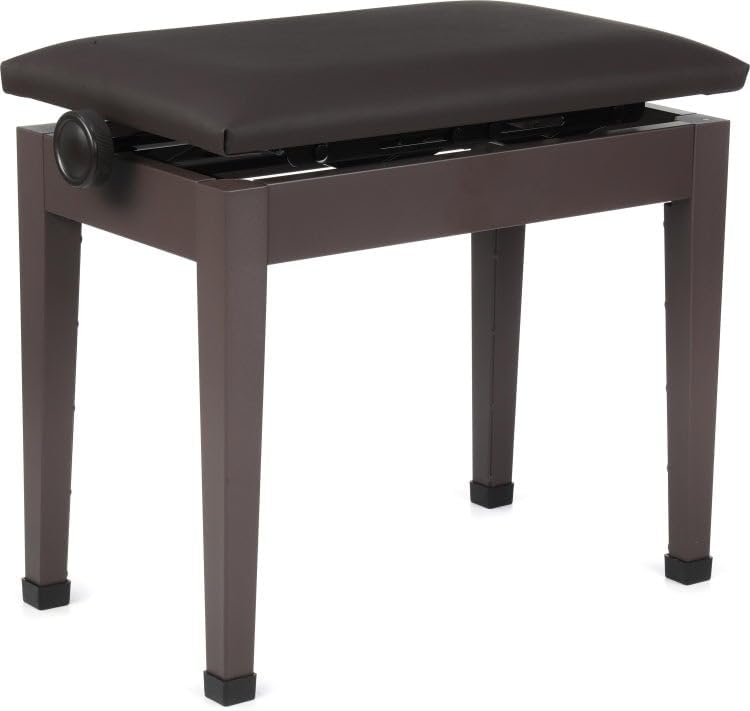 Visit on Amazon → Casio Height-Adjustable Artist Bench |
Bench, not an instrument | Every household with a growing student | $219.99 |
Read that table the way I do: the middle column is the decision, and the last column is the least interesting thing about any of it.
Should you buy the Roland FP-30X bundle?
Yes, if the family can stretch to it. It is the instrument I trust to carry a transfer student through a summer without losing ground, and the bundle covers the stand and the sustain pedal, which are the two items that usually leak value out of a cheap setup. The action is consistent, it lets a student control tone with finger speed rather than volume, and it does not get louder as you play deeper into a piece. That last one sounds like a small thing. It is the thing that decides whether a student learns dynamics or learns to bang.
The bench in the box is a starting point, not the finish line. Plan on replacing it within a year, and plan on keeping the piano.
Should you buy the Donner DEP-08?
For a beginner's first two years, yes, with realistic expectations. You get 88 velocity-sensitive keys, a removable stand, split mode, an LED digital tube display, and a triple pedal unit, which is a great deal of piano for the money. What you give up is action consistency at the margins, and margins are where technique lives.
If the student is aiming at graded exams in three years, spend the difference and buy the Roland instead. If the goal is a solid, honest instrument for a first method book and a lot of happy playing, this will do the job.
Should you buy the Casio Height-Adjustable Artist Bench?
Yes, and before the piano if you have to choose. Every summer I watch a student play from the wrong height and compensate with their shoulders, and every September I spend a month undoing it. The instrument gets the attention. The bench does the quiet work, and it is the only purchase on this page that will still be with the student a decade from now.