Most people shopping for an 88-key weighted digital piano are solving a problem that has almost nothing to do with features. Someone in the house needs to practice, the instrument has to fit a real room and a real budget, and it has to feel good enough that sitting down at it is not a chore. The spec sheets do not help much here. Two instruments can both advertise 88 keys and a graded hammer action and still feel nothing alike under the fingers, because "weighted" describes a range of mechanisms rather than one standard. This guide separates the decisions that change how a piano plays from the ones that only change how it photographs, and it covers the accessories that keep an instrument in playing condition between lessons.
Related: How to Build a Practice Corner Students Actually Use →
Quick answer
If the player is working on real repertoire, build the setup around a hammer-action instrument such as the Casio CDP-S160, which pairs an 88-key scaled hammer action with USB-MIDI and built-in speakers. If the player is a beginner learning where the notes live, or wants a light, synth-style response, a semi-weighted 88-key model covers that ground at a lower entry point. Neither is a substitute for a regulated acoustic action, and if the piano lives out in a room rather than in a case, a fitted dust cover is worth adding at the same time.
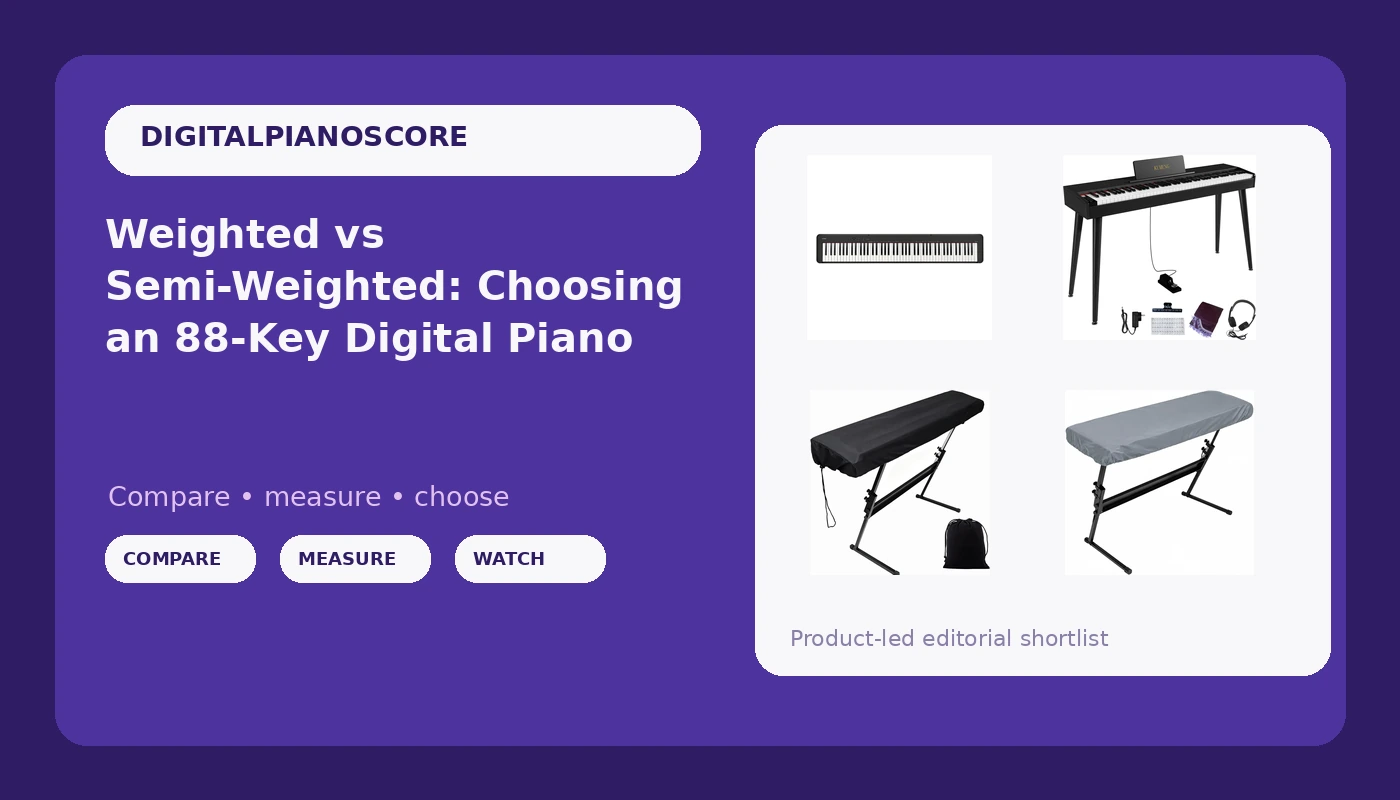
Four useful options
| Model | Best fit | What stands out |
|---|---|---|
| Casio CDP-S160-88-Key Weighted Digital Piano with Scaled Hammer Action Keyboard | Duet Mode for Students | Realistic Feel, Slim & Portable | Built-In Tones, Effects, USB-MIDI, Speakers | Black | Students moving into graded repertoire | Scaled hammer action, duet mode, USB-MIDI, built-in speakers |
| Digital Piano 88 Key Semi Weighted Keyboard, Electric Piano | Beginners and light-touch players | 88-key layout with a semi-weighted action |
| 88 Key Keyboard Cover for Casio Privia PX-S1100 2021-present, Heavy Duty 210D Oxford Waterproof Digital Piano Protective Dust Cover with Adjustable Bottom Drawstring | Owners who want a plain, hard-wearing cover | 210D Oxford shell, waterproof finish, adjustable bottom drawstring |
| 88 Key Piano Keyboard Cover for Casio Privia PX-S1100 2021-present, 210D Oxford Waterproof Digital Piano Dust Cover with Silver Coating, Adjustable Drawstring & Storage Bag | Owners who want a coated cover plus a bag | 210D Oxford with silver coating, drawstring, storage bag |
The practice instrument: Casio CDP-S160
The action is the instrument. Everything else on this piano is a feature layered on top of it, and the scaled part of scaled hammer action is the detail worth understanding: the lower keys carry more resistance than the upper ones, the way an acoustic piano's longer bass strings need more energy to move. That gradient is what lets a student learn to control tone with finger speed instead of volume with arm weight. Duet mode matters more than it sounds like it should. When the keyboard splits into two halves, a teacher and a student can sit side by side at one instrument, which is how most transfer students actually get corrected in real time.
The trade-offs are the usual slab compromises. The onboard speakers are small, so the sound is honest but limited in a way that has nothing to do with the sample library. Headphones solve that, and the USB-MIDI connection means notation and learning apps can see what the student plays. The boxed sustain pedal is a starting point rather than a destination, and the stand and bench are yours to choose. Budget for those at the same time as the piano, not three months later.
The light-action alternative: semi-weighted 88-key electric piano
Semi-weighted does not mean unweighted. The keys carry some resistance rather than flopping under bare springs, but they do not reproduce the leverage of a hammer, so the key returns faster and asks less of the finger. For a young beginner learning note names and hand position, that is a reasonable place to start, and it is the reason this category exists at a lower entry point than hammer-action instruments. The same lightness is the limitation. A student who practices on semi-weighted keys and then plays an acoustic at a lesson will find that the acoustic asks for more weight than they have been giving, and pieces that felt controlled at home can sound uneven on the teacher's instrument.
There is a fair use case for it beyond beginners. Players who mainly want to sketch ideas, follow along with a method book, or play casually at a light touch will not miss hammer action. If the plan is graded exams or serious repertoire, put the money toward the hammer-action option instead and accept a smaller feature list.
Cover option one: heavy duty Oxford dust cover
Dust is the slow problem with any digital piano that lives out on a stand. It settles into key gaps, into the felt at the front rail, and into the speaker grilles, and it takes a surprising amount of cleaning to get back out. A fitted cover solves that in one motion, and the 210D Oxford shell here is the heavier of the two fabrics in this article, with a waterproof finish and a drawstring along the bottom edge that keeps the whole thing from sliding off when someone brushes past.
The important caveat is the fit. This cover is listed for the Casio Privia PX-S1100 from 2021 onward, not for every 88-key instrument. If your piano is a different model, check the listed dimensions against your own case measurements before ordering, because a cover that is too loose collects dust underneath and one that is too tight is a wrestling match every night.
Cover option two: silver-coated cover with storage bag
This is the same cover idea with two additions. The silver coating gives the fabric a reflective outer surface, which is the part that matters if the piano sits near a window or under a lamp that stays on for hours. The storage bag answers a small but real annoyance: a cover that has no home ends up crumpled on the floor, on the bench, or behind the instrument, which is exactly where it will pick up the dust it was bought to keep off the keys.
Both covers are protective fabric, not hard cases. Neither is meant for transport, stacking, or a move in the back of a car. They are for the instrument that stays where it is put, and the difference between them comes down to whether you want the coating and the bag or prefer the plainer heavy duty shell.
Prices and availability may change. Product images, names, and retailer links are matched to verified listings. No current price, rating, stock status, or measured result is stated here without current evidence.
What "weighted" actually means at each price
The word weighted shows up on listings at every price, which is why it is nearly useless on its own. There are three broad mechanisms behind it. A synth or spring action returns the key with a light, even push and asks almost nothing of the finger. A semi-weighted action adds some resistance to that push, usually through a lighter spring or a small added mass. A hammer action puts a physical lever under the key, so the finger is moving weight rather than compressing a spring, and that is the mechanism that behaves most like an acoustic piano.
Within hammer actions, the meaningful distinctions are gradation, repetition, and escapement. Gradation, sometimes called scaling, is the bass-to-treble weight difference described above. Repetition is how quickly a key can be played again before it fully returns, which is what trills and fast repeated notes expose. Escapement is the small release point some actions build in near the bottom of the key travel, mimicking the moment an acoustic hammer leaves the string. A student who has never played a well-regulated grand will not miss escapement, but a student preparing for one will notice its absence over months rather than minutes.
Two numbers get more attention than they deserve. Polyphony is the maximum number of simultaneous notes the engine can generate, and it is a marketing figure more often than a practical one; the audible limit is almost always what the player's ten fingers and a sustain pedal can actually hold. Sample library size is similar. What people describe as a brand's "sound" is usually speaker voicing, the tuning of the small drivers and cabinet, which is why the same sample set can sound warm in one instrument and thin in another. Good samples through a small speaker sound like good samples through a pillow.
Matching the action to the player and the room
- Decide what the piano is for. Exam repertoire, jazz improvisation, and casual play lead to different actions, and the answer changes the budget more than any feature list will.
- Split the budget honestly: instrument first, then stand, bench, and a pedal worth keeping, then the cover. A cover bought later often never gets bought.
- Play a slow chromatic scale from the bottom of the keyboard to the top and listen for the weight change. Then play a slow trill and a repeated note to feel how quickly the key comes back.
- Check where the headphone jack and power inlet sit before you commit to a stand. A jack on the rear panel is awkward in a tight corner and worse when the piano is against a wall.
- Measure the space, including the depth of the stand and the clearance for the lid or cover. Slim slabs are forgiving, but a keyboard that hangs over the edge of a desk will get played less.
Setting the instrument up so it gets played
- Put the piano where people walk past it. An instrument in a spare room becomes a piece of furniture within a month.
- Replace the boxed sustain pedal early. A pedal that slides across a hard floor is the fastest way to ruin a student's legato.
- Use duet mode for the first months of lessons if the piano offers it, because hearing the student alongside you is more useful than hearing them alone.
- Keep a cover on the instrument if it lives out in the room, and check the listed fit against your specific model before ordering, since covers are cut for particular cases.
- Route headphones to the front if you can, or add an extension, so nobody has to reach behind the piano mid-lesson to plug in.
Which option should you choose?
Choose the Casio CDP-S160-88-Key Weighted Digital Piano with Scaled Hammer Action Keyboard | Duet Mode for Students | Realistic Feel, Slim & Portable | Built-In Tones, Effects, USB-MIDI, Speakers | Black when the player is working toward graded repertoire or will sit at an acoustic piano regularly, and the hammer action plus duet mode will earn their keep. Choose the Digital Piano 88 Key Semi Weighted Keyboard, Electric Piano when the player is a beginner exploring the layout, or wants light keys for casual playing and idea sketching. Choose the 88 Key Keyboard Cover for Casio Privia PX-S1100 2021-present, Heavy Duty 210D Oxford Waterproof Digital Piano Protective Dust Cover with Adjustable Bottom Drawstring when you own that model, want the plainest hard-wearing fabric, and have no need for a storage bag. Choose the 88 Key Piano Keyboard Cover for Casio Privia PX-S1100 2021-present, 210D Oxford Waterproof Digital Piano Dust Cover with Silver Coating, Adjustable Drawstring & Storage Bag when the piano sits near a window or lamp and you want the coating plus somewhere to put the cover when it comes off.
One caveat applies to all four. Action quality and fabric feel are not things a listing can prove, and the covers are cut for one specific model line, so confirm the fit and buy where returns are straightforward. None of these is a substitute for playing the instrument before you commit if a shop near you stocks it.
The bottom line
The action decides whether an instrument gets practiced, and the accessories decide whether it stays in condition to be practiced on. A hammer-action 88-key digital piano such as the Casio CDP-S160 is the right starting point for a student who will eventually play on an acoustic, while a semi-weighted 88-key model is a sensible, lighter alternative for a beginner or a casual player who does not need hammer resistance. If the piano lives out in a room, add a fitted cover sized to your actual model, and treat the stand, bench, and pedal as part of the purchase rather than afterthoughts. Buy the action first, protect it second, and the rest of the setup can wait.