Related: Weighted Keys and Sample Size: What Actually Changes Your Playing
I have taught out of a home studio in Seattle for 25 years, and every September a parent asks me the same question: can my child start on the cheap keyboard we already own? The honest answer is that it depends on what the instrument is for, and that is the reason this digital piano buying guide exists. I have owned a dozen digitals over my career, from a plastic slab I bought in my twenties to the cabinet piano in my teaching room now, and the gap between the good ones and the bad ones has almost nothing to do with the feature list on the box.
Here is what I tell every family: the action is the piano. Samples, speakers, Bluetooth, app connectivity, all of it is a feature layered on top of a mechanism. If the mechanism fights you, you will not practice, and an instrument that does not get practiced is furniture. That single idea sorts the four instruments in this guide faster than any spec sheet, because they are not four versions of the same thing. They are four different jobs.
Two of them are the same piano in two finishes. One is a production tool that makes no sound by itself. One is a first-contact instrument for a child who has never touched a key. Buying the wrong one is not a matter of taste. It is a matter of the instrument not being able to do the job you bought it for.
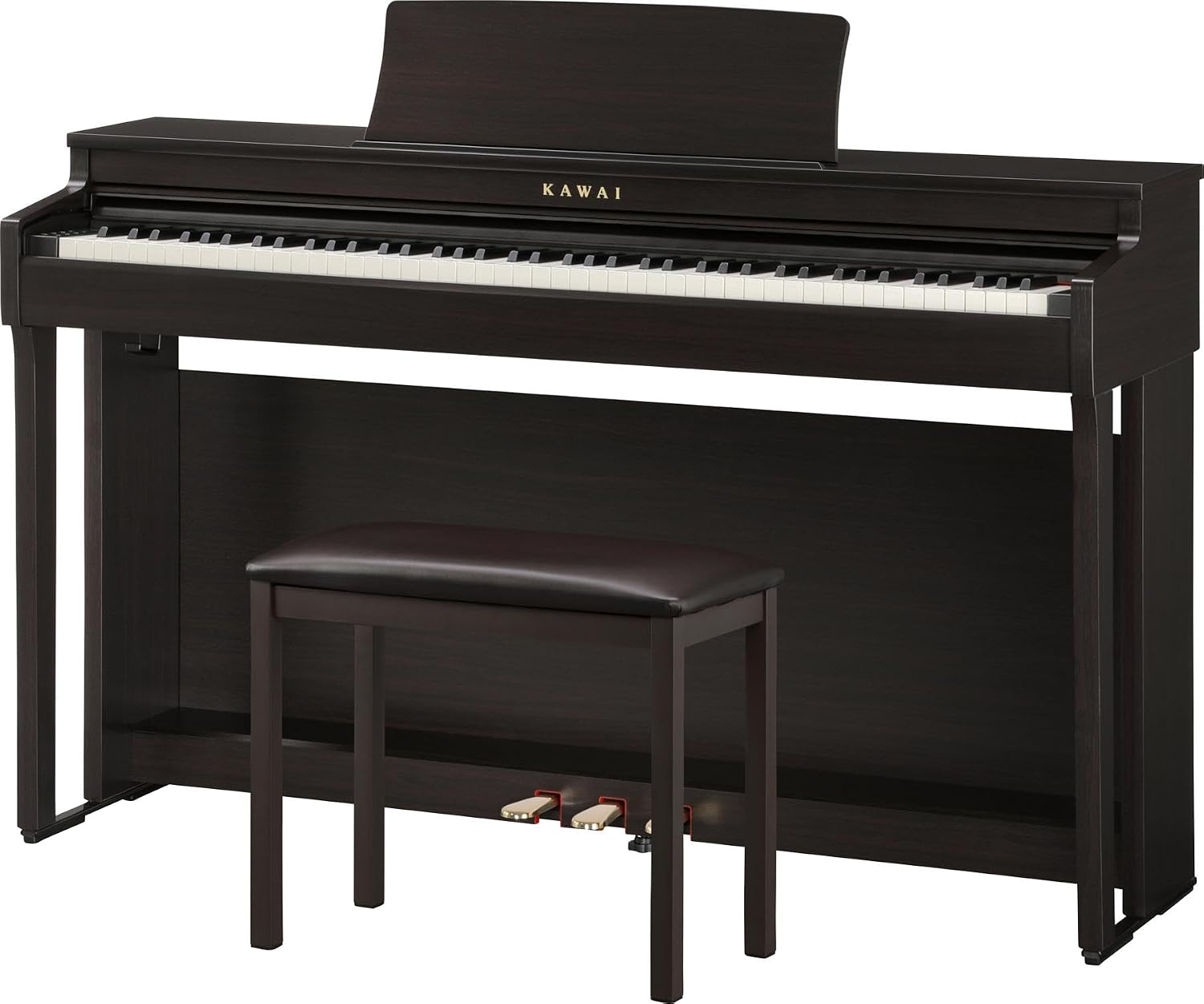
Best Overall: Kawai CN201 Digital Piano
If you are buying one instrument to learn on, this is the one. The CN201 is a cabinet piano, which means the keyboard, the sound system, and the pedals live in one piece of furniture that stands where an upright would stand. That matters more than people expect. A cabinet instrument sits at the right height, it does not creep across the floor when you push into a chord, and the pedals are where your foot expects to find them instead of dangling on a cable under a folding stand.
Kawai has spent decades on key mechanism, and it shows in how the instrument responds when you play the same phrase at five different volumes. My bias is well documented among my students: Yamaha and Kawai own the action tier, and everyone else is chasing them. When I sit down and play the opening of the Bach prelude I use for every evaluation, what I am listening for is whether I can shape a crescendo with finger speed alone. On a cheap action, volume changes arrive in steps, and a student who learns on that develops a habit of banging. On a good action, the tone follows the finger, and the student learns control without being lectured about it.
The speakers are the second reason this sits at the top. A cabinet has room for a real sound system, and the difference between a decent sample played through a cabinet and the same sample played through a thin portable chassis is the difference between a piano and a recording of a piano. You notice it most in the lower half of the keyboard, where small speakers simply cannot move enough air. Sample quality has plateaued across the industry; what you are hearing between brands is speaker voicing, not better recordings.
None of that makes this a small decision, and I will not pretend it is the right answer for a seven-year-old's first month. It is the right answer for the family that has already decided piano will be part of the house for the next ten years.
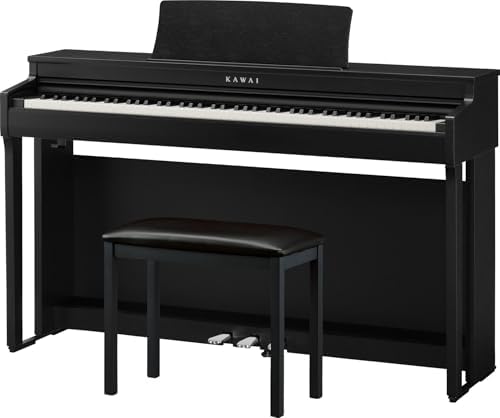
Kawai CN201 in Satin Black: The Same Instrument, A Different Room
This is the same piano as the one above, finished in satin black, and I am covering it on its own because the finish question comes up in every September of my life. Rosewood reads warmer and sits better in a room with wood floors and warm light. Satin black disappears into a corner and matches almost any modern furniture. If you are buying for a living room that guests actually see, pick the finish that matches the room, because you will look at it every day for a decade.
If it is going into a studio, a bedroom, or a teaching room, save yourself the deliberation and take the black one. Every other consideration, the action, the speakers, the pedals, the way the instrument responds to finger speed, is identical between the two listings. There is no performance difference to weigh.
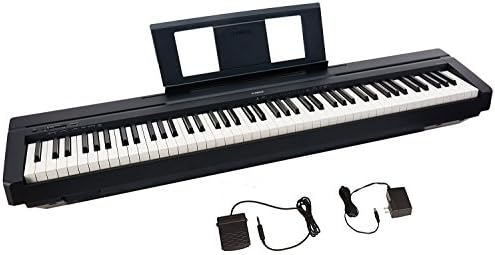
Best for Production: Arturia KeyLab Essential 61 mk3
This one is not a piano and I want to be blunt about that, because students buy it expecting one. The KeyLab Essential 61 mk3 is a MIDI controller: 61 keys, nine encoders, nine faders, a modulation wheel, a pitch bend wheel, and eight pads, plus an all-in-one software package that does the actual sound making. Plug it into a computer and you have a serious production surface. Unplug it and you have a keyboard-shaped object that is silent.
For a student who is writing music, layering parts, and living inside a DAW, that is exactly the right tool. Faders under your left hand while you ride a string line, pads for drums, encoders mapped to the synth you are shaping: the workflow gets fast once you set it up, and the 61-key span is the sweet spot for a desk. It is long enough for two-handed parts and short enough to sit under a monitor without eating the whole surface.
For a student who is learning to play piano, it is the wrong purchase, and no amount of software will fix that. A synth-action controller does not teach finger control. I have watched transfer students arrive with three years of controller playing and no idea how to produce a quiet note, because the key they learned on had one dynamic answer. If your goal is production, buy this. If your goal is the piano, buy the Kawai, and add a controller later when you start recording.
Best First Instrument for a Child: 61 Key Portable Keyboard Piano
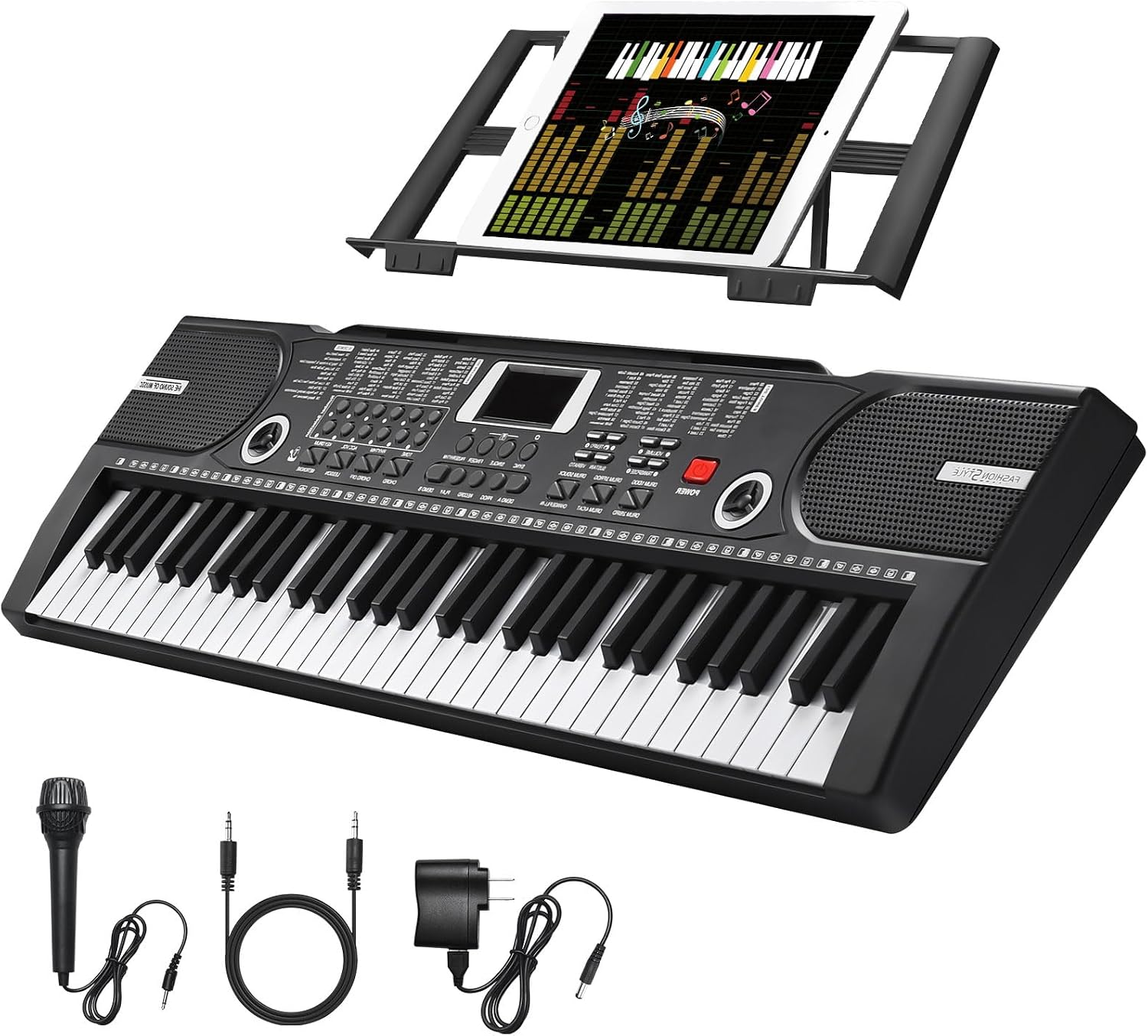
Now the opposite end of the market. This is a portable electronic keyboard with built-in speakers, a microphone, a sheet music stand, 100 voices, and 100 rhythms. It is not a piano. The keys are light, the tone is what it is at this level, and a student who spends two years here will arrive at a real instrument with habits to unlearn.
I still recommend instruments like this one, for a narrow reason: it answers a question cheaply. Does the child come back to it on day four without being told? If yes, you have your answer and you can start saving for something with a real action. If the keyboard is under the bed by week three, you have learned the same thing for far less than a cabinet piano would have cost you. The microphone and the rhythm section are not features I care about musically, but they are the reason a seven-year-old switches the thing on in the first place, and switching it on is the only thing that matters at that stage.
Buy it as a trial, not as a piano, and say that out loud when it arrives: this is how we find out whether you love this, and if you do, we will get you something with weighted keys. My transfer students who regress over a summer almost always regress on something like this, not because the keyboard is evil, but because nobody ever told them it was temporary.
How I evaluate a digital piano
Every instrument that comes through my studio gets the same three pieces: the Bach prelude I have played since I was a teenager, a Chopin nocturne for pedal and touch, and a blues improvisation to see whether the thing makes me want to keep playing. That last one is the real test. A digital piano is a practice tool first. If it does not make you want to sit down, it has failed, no matter what the box claims.
Then I look at four things, in this order:
- Action. Can I control volume with finger speed, or does the instrument decide for me? Does the key return fast enough for repeated notes?
- Sound through the speakers, not through headphones. Headphone tone is easy. Speaker tone is where cabinet instruments earn their money and where thin chassis get exposed.
- Pedal behavior. Does the sustain pedal hold the way a damper should, and does it stay where my foot left it?
- The accessories in the box. Assume the bench and the pedal that ship with any instrument are placeholders and budget for replacing them.
I do not quote polyphony numbers, because nobody plays 256 notes at once. I do not care how many voices are listed on the front of the box, because a student will use three of them. What I care about is whether a ten-year-old can produce a soft note on purpose, and whether the instrument rewards that effort.
What the differences actually come down to
Cabinet versus slab is the biggest fork in this whole category, and it is not really about sound. A cabinet piano is furniture you pay extra for, and what you get in return is a fixed height, a stable pedal position, and a speaker box large enough to move air. A slab plus a good stand wins on price and on moving day, and I say that as someone who has carried both up a flight of stairs. If you move every two years, think hard about the cabinet.
Action quality is a spectrum, not a checkbox. Graded hammer action appears on instruments at wildly different levels of refinement, and the cheap versions bounce. What separates them is consistency: a good action behaves the same in the middle of a long piece as it did in the first bar, and a bad one gets heavier or louder as you tire. That is the failure mode my students feel first and complain about last, because they assume the problem is their hands.
The marketing is the part I would throw in the bin. Claims about concert grand samples coming out of small speakers are fiction, and the number of built-in voices is a shopping-list item, not a musical one. Bluetooth that drops mid-lesson is worse than no Bluetooth at all. Judge the instrument by the mechanism under your fingers and the sound coming out of the cabinet, and ignore everything else on the box.
The digital piano reference table
This is how the four instruments sort out by job rather than by price. Read the middle column first: if the job does not match what you are buying for, the rest of the row does not matter.
| Instrument | What it is | Best for | What it is not | Price |
|---|---|---|---|---|
 Visit on Amazon → Kawai CN201 Digital Piano, Premium Rosewood |
Cabinet digital piano | A student or adult who will practice for years | A casual purchase or a first-month trial | $1,999.00 |
 Visit on Amazon → Kawai CN201 Digital Piano, Premium Satin Black |
The same cabinet piano, black finish | Rooms where the instrument should disappear | Anyone expecting different internals | $1,999.00 |
 Visit on Amazon → Arturia KeyLab Essential 61 mk3 |
MIDI controller, 61 keys, 9 encoders, 9 faders, 8 pads | Producers working in a DAW | Anyone who wants sound without a computer | $269.00 |
 Visit on Amazon → 61 Key Portable Keyboard Piano |
Portable keyboard, speakers, microphone, 100 voices, 100 rhythms | Finding out whether a child will stick with it | Piano technique or graded exams | $49.99 |
The pattern in the table is the pattern I see in my studio every year. Families either buy the trial instrument and never upgrade, or they buy the serious instrument and use it for a decade. The expensive mistake is the middle path: a mid-priced portable that is neither a real practice instrument nor a cheap experiment.
Should you buy the Kawai CN201?
Yes, if piano is going to be part of your house for the long haul. It is the only instrument in this guide that I would put in a practice room, and it is the one I would send a transfer student home with. The action lets you control tone with finger speed, the cabinet speakers carry the low end, and the pedals stay put. Choose rosewood if the room is warm and wooden, satin black if it is not.
Should you buy the Arturia KeyLab Essential 61 mk3?
Yes, if you are producing music rather than studying piano. Sixty-one keys, nine encoders, nine faders, eight pads, and a software package is a genuinely capable desk setup, and it will not lie to you about what it is. Just do not buy it hoping it will teach your hands to play softly. It will not, and no plugin will.
Should you buy the 61 key portable keyboard?
Yes, as a trial for a young beginner, and only with the expectation set in advance that it is temporary. It has speakers, a microphone, a sheet music stand, 100 voices, and 100 rhythms, and it will tell you within a month whether a child actually wants this. If the answer is yes, start saving for the Kawai. If the answer is no, you spent the least amount of money it is possible to spend to find out.