Related: Best Digital Pianos for Small Apartments
Every June I lose a few students to summer, and every September I find out which ones regressed. The pattern is never the teacher. It is the instrument at home. A family buys a 61-key keyboard in June with springy keys and no weight behind them, and by September the kid's hands have learned to smash instead of shape. That is the entire argument for an 88-key weighted digital piano, and it is why I keep a very short list of sub-$1,000 slabs I am willing to put my name behind.
I teach 30 students a week out of a home studio in Seattle and I have owned 12 digital pianos over 25 years, from a $200 thing I gave away to a slab that cost more than my first car. I only cover instruments with 88 weighted keys. No synths, no arrangers, no 61-key toys dressed up with a "grand piano" badge. If it does not make a student want to sit down and practice, it failed, no matter what the spec sheet says.
This guide is about two slabs at the bottom of the price curve and the two accessories that should ride in the same cart. One of them is the piano I hand to transfer students. The other is the one I hand to families who need everything in one box.
Best Overall: Casio CDP-S160
The CDP-S160 is an 88-key weighted digital piano with scaled hammer action, and that phrase is doing all the work here. Scaled means the low end feels heavier than the top end, the way a real action does, because the hammers on a real piano get bigger as you go down. A lot of budget instruments put the same resistance on every key, which trains a student to play the bass like a xylophone.
It also ships with Duet Mode, which splits the keyboard into two equal ranges. That sounds like a gimmick until you are the parent sitting on the bench beside a 9-year-old playing the same exercise an octave up. For teaching at home, it is the single most useful feature in this price bracket.
What I care about is repetition. When I sit down at a new slab, I play the same Bach prelude I have played for 30 years, then the same Chopin nocturne, then I improvise a blues for five minutes. The Bach tells me whether the action returns fast enough for ornaments. The Chopin tells me whether I can control tone with finger speed instead of volume. The blues tells me whether I can live with the thing for three hours. A good action lets you play softer by moving your fingers faster, not by pressing lighter. A cheap action gets louder the deeper you press, and there is no way to phrase around that.
The CDP-S160 is the instrument I recommend when a student's parents say the word "apartment." It is not a grand piano. Nothing at this price is. But it will not teach bad habits, and that is the whole job.
Best Value: Donner DEP-08
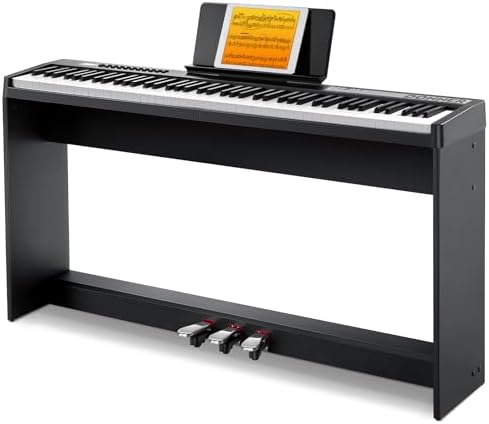
The Donner DEP-08 is the other half of the conversation. It is a velocity-sensitive 88-key digital piano with a removable stand, Split Mode, an LED digital tube display, and a triple pedal unit in the box. Check current Amazon price.
Velocity-sensitive means the keyboard reads how fast you strike a key and changes the volume and tone accordingly. That is the minimum bar for anything a student touches, and plenty of cheap keyboards fail it. The DEP-08 clears the bar, and it does it while including the stand and the pedals that most manufacturers make you buy separately.
Split Mode is the useful feature here, and it is a cousin of Duet Mode. You can assign a bass sound to the left hand and a piano or string sound to the right, which is a genuinely good way to get a beginner comfortable with two hands doing two jobs. The LED tube display is not a touchscreen and does not pretend to be, but it is readable from the bench without leaning forward.
Here is where I slow down. The bundled stand and the bundled pedals are the first things to think about replacing, and that is not a knock on Donner specifically. It is true of almost every all-in-one beginner package. A stand that wobbles when a kid plays a fortissimo teaches the student to hold back, and a sustain pedal that slides across a hardwood floor mid-phrase is its own small tragedy. Budget for a solid stand and a pedal with a grip plate within the first year.
The action is where the real gap lives. Brand-name actions at this price are more consistent from unit to unit. Budget actions can vary, so if you can play the actual instrument before it ships, or buy from a seller with a painless return window, do that. It is not a dealbreaker at this price. It is just the thing to know going in.
How I test a slab before it earns a spot in the studio
I do not trust a spec sheet, and neither should you. Here is the routine, and it is the same one I run whether the instrument costs $400 or $4,000.
First, action weight. I want resistance that feels like it is pushing back against my finger, not like it is swallowing it. I keep a kitchen scale for weighing keys and a dB meter for speaker output, because my ears lie to me after an hour of teaching.
Second, key repetition. I play repeated notes at speed. If the key cannot return before my next strike, trills turn to mush, and every piece with an ornament exposes it.
Third, escapement and damper feel. Real actions have a slight notch as the hammer escapes. Simulating it well is the difference between an instrument that feels alive and one that feels like a rubber mat.
Fourth, speaker voicing. Sample quality across the industry has plateaued. The differences most people hear between two brands at the same price are the speakers and how they are voiced, not the samples. A great sample through a bad speaker sounds like a great sample through a pillow.
Fifth, I just live with it. An hour of scales, a lesson with a 10-year-old, a late-night practice session with headphones. The headphone jack on the back of a unit is a pet peeve of mine, and I will mention it every single time.
What the specs actually mean
Polyphony is marketing. Nobody plays 256 notes at once, and the number that matters is how the instrument handles pedal-down passages, where sustained strings stack up. Anything in this price range handles a Chopin nocturne fine.
"Concert grand samples" from a pair of small onboard speakers is a claim I have stopped taking seriously. It is not a lie exactly. It is a sample of a concert grand, played through a speaker the size of a coffee cup. Judge the instrument on what it sounds like in your living room, not on the name of the piano it was recorded from.
USB-MIDI is the feature to check for, especially if the student wants to use a teaching app or a notation program later. It is a plain, dependable connection. Wireless is convenient until it drops mid-lesson, and then it is the worst thing in the room.
The 88-key digital piano reference table
This is the short list I keep for parents and transfer students. Action first, everything else second.
| Product | Action | Best for | Notes |
|---|---|---|---|
 Visit on Amazon → Visit on Amazon →Casio CDP-S160 |
Weighted, scaled hammer action | Students moving off a 61-key keyboard | USB-MIDI, Duet Mode, built-in tones and effects, slim and portable |
 Visit on Amazon → Visit on Amazon →Donner DEP-08 |
Velocity-sensitive, 88 keys | Families who want stand and pedals in one box | Split Mode, LED digital tube display, removable stand, triple pedal |
 Visit on Amazon → Visit on Amazon →Stretchy 88-key dust cover |
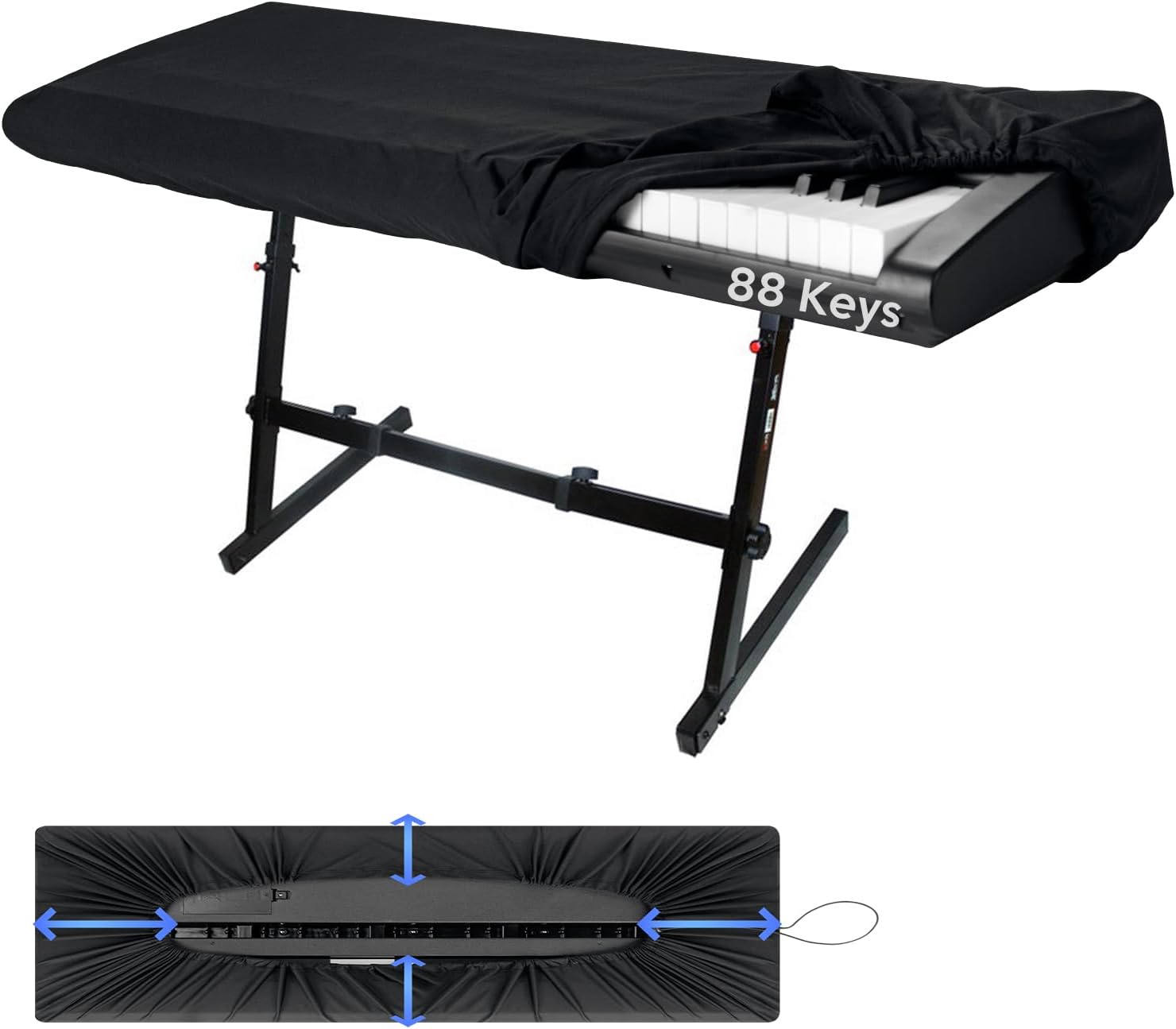
Accessory | Any slab that lives near a window or a cat | Elastic hem with cord lock, fits 88-key bodies |
 Visit on Amazon → Visit on Amazon →AGVEE 6.6ft Lightning MIDI cable |
Accessory | iPhone and iPad practice apps | 8 pin to USB-B, 6.6 ft |
The dust cover that keeps a slab clean
A digital piano is a dust trap. Felt strips, key gaps, and speaker grilles collect everything, and once grit works its way under the keys, the action starts to feel gritty. This stretchy 88-key cover pulls over the whole body and locks down with an elastic cord. Check current Amazon price. It is the cheapest way to protect the part of the instrument you cannot repair yourself.
If your slab sits in a room with a window open in summer, this is not optional. It is also the difference between a keyboard that still looks like furniture in five years and one that looks like a garage sale.
The MIDI cable that makes practice apps work
Most of my students practice with a phone or tablet propped on the music stand, and a Lightning MIDI cable is what connects the two. This one is 6.6 feet, 8 pin to USB-B, which covers the run from a slab on a stand to a device on the desk. Check current Amazon price.
Six and a half feet is the right length. Shorter and you are dragging the phone off the stand when you turn a page. Longer and you are tripping over a coil on the floor.
Should you buy the Casio CDP-S160?
Yes, for most people reading this. The scaled hammer action is the reason. It is the part of a digital piano you cannot upgrade later, and it is the part that decides whether a student develops touch or just volume. Duet Mode makes it useful for a parent on the bench, USB-MIDI keeps the door open for apps and notation software, and the slim body means it can live in a small apartment without becoming a piece of furniture you have to negotiate around.
It will not feel like a grand piano. Nothing under a thousand dollars does. It will feel like a serious practice instrument, and that is what a student actually needs between lessons.
Should you buy the Donner DEP-08?
Yes, if the budget is the deciding factor and you want the stand and the pedals in the same box. Velocity-sensitive 88 keys, Split Mode for two-hand work, a readable LED display, and a removable stand make it a complete first setup rather than a keyboard plus a shopping list.
Just plan for the second purchase. The stand and the pedals that ship in a bundle like this are the weak links, and replacing them within the first year is normal, not a sign you bought wrong. If you can stretch to the Casio, stretch. If you cannot, the DEP-08 will still get a beginner through the first two years of lessons, and that is a real thing to be able to say about a slab at this price.