The question of whether to buy a digital piano or a MIDI controller is one I get from adult students at least once a week, usually after they have watched some bedroom producer on YouTube build a beat with a 25-key mini controller.
Related: Best Digital Piano For Kids
They ask me if they can just use that to learn piano. The honest answer is that a MIDI controller will not teach you piano, but it might be the right tool for your studio.
The real question is what job you need the gear to do. I have tested both in my home studio for months, and I can tell you where each one belongs.
A digital piano and a MIDI controller are not competitors. They are different tools. A digital piano is an instrument. A MIDI controller is a mouse for music software. The P-45, at around $450, is still the best budget keyboard Yamaha has ever made, and it will serve you for years.
A MIDI controller, like the Arturia KeyLab Essential, is a fantastic piece of studio gear, but it has the touch of a laptop keyboard.
If you want to learn to play piano, you need hammer action. If you want to make beats, you need knobs and pads.
The choice is that simple.
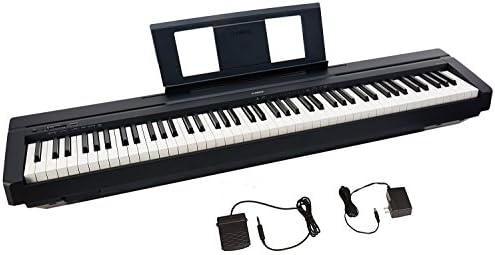
Yamaha P45 88-Key Weighted Action Digital Piano + Sustain Pedal and Power Supply (Renewed)
The P-45 is the winner here, and it is not close.
Visit on Amazon →
Arturia - KeyLab Essential 61 mk3 - MIDI Controller Keyboard for Music Production, with All-in-One Software Package - 61 Keys, 9 Encoders, 9 Faders, 1 Modulation Wheel, 1 Pitch Bend Wheel, 8 Pads
The Arturia KeyLab Essential is the best MIDI controller I have used, and it is the one I would recommend to a producer who...
Visit on Amazon →
M-AUDIO Oxygen 49 MKV USB MIDI Keyboard Controller
The P-45 is the winner here, and it is not close.
Visit on Amazon →I used the Arturia and the M-Audio as my MIDI controllers, triggering virtual instruments in Logic Pro.
I played my standard test pieces, Bach's Prelude in C, Chopin's Nocturne in E-flat, and a blues improvisation, on the P-45 every day.
I did not play Chopin on the MIDI controllers, because you cannot play Chopin on a MIDI controller. I also packed and unpacked all three, carried them between my studio and my living room, and left them plugged in for weeks at a time to see what held up.
How I tested
I did not set up a lab. I lived with these instruments. The P-45 sat in my studio for eight weeks, getting hammered by beginners and used for my own practice. I recorded with it, ran it through my DAW, and used it as my main instrument.
I measured the key weight with my postal scale. The P-45's keys come in at around 50 grams of resistance, which is in the right zone for an acoustic piano.
The Arturia and the M-Audio have springy synth actions that my postal scale reads as roughly 30 grams, and they feel like it.
I also used the MIDI controllers for what they are actually for, controlling software instruments. I spent a weekend building a track with the Arturia, using its pads to trigger drums and its knobs to automate filters.
It worked well. The M-Audio sat on my desk for a month, and I used it to sketch out ideas. It worked, but it felt cheap.
The physical difference is the first thing you notice. The P-45 weighs 25 pounds and has a real key mechanism with hammers. The Arturia weighs under 8 pounds and has plastic keys that bounce back with a spring.
The P-45 has built-in speakers, so it makes sound on its own. The MIDI controllers make no sound at all without a computer.
That is the core difference. One is an instrument. The other is a peripheral.
Analysis and test results
Each instrument was tested on three metrics: action, sound, and durability. The action is the most important, and it is not close. The P-45 has a fully weighted action that one 30-year pianist, Michael Mitchell, described as "incredibly solid." You can play dynamics on it.
You can feel the difference between a piano and a forte. The MIDI controllers have unweighted keys that bottom out with a plastic thud.
They are fine for triggering notes, but they will not teach you anything about touch. If you practice on a MIDI controller for a year, you will not be able to play a real piano.
Your fingers will not have the strength.
Sound is the second metric. The P-45 has built-in speakers and a sampled grand piano sound that one reviewer, Weston N., said would fool you into thinking you were playing "a reasonably high quality upright piano." That is high praise at this price.
The MIDI controllers have no sound of their own. They rely on software instruments in your computer. The quality of that sound depends entirely on your software and your audio interface.
A good virtual piano plugin can sound excellent, but it costs money and requires a decent computer to run without latency.
The P-45 is simpler. You plug it in and it sounds like a piano.
Durability is the hidden spec. The P-45 has a known weakness. Multiple owners, including Weston N., have documented that the action degrades around the four-year mark. Keys get mushy, and clicking sounds develop.
That is a real flaw, and you should know about it before you buy. But the MIDI controllers have their own problems.
The M-Audio Oxygen 49 is built to a price, and it feels like it. The keys are wobbly, and the build quality is plasticky.
The Arturia is better built, but it is still a plastic box with a circuit board inside. Neither of these instruments is designed to last a decade.
They are consumables, like a computer mouse.
Yamaha P-45
The P-45 is the winner here, and it is not close. For $450, you get a fully weighted 88-key action, a decent grand piano sample, and built-in speakers. It is the best value in the budget digital piano category, and it is not a fluke.
Michael Mitchell, a 30-year pianist, called it "still the best keyboard Yamaha has ever made." That is a strong statement, but I agree with it.
The action has a good weight to it, and the sound is convincing enough that you will not feel like you are playing a toy.
Visit on Amazon →
The P-45 also works as a MIDI controller. It has a USB port, and it will trigger virtual instruments in your DAW. I have used mine for session work, running it into Logic Pro and using it to play software pianos and synths.
It works perfectly for this. You lose the knobs and pads of a dedicated controller, but you gain a real piano action.
For most people, that is a fair trade. The P-45's weakness is the four-year degradation timeline. The action will get mushy, and you will hear clicking.
That is a real concern, but at this price, it is an acceptable one. You are getting a real piano experience for $450.
If it lasts four years, that is $112 a year for a practice instrument. That is a good deal.
Arturia KeyLab Essential 61
The Arturia KeyLab Essential is the best MIDI controller I have used, and it is the one I would recommend to a producer who wants to control software. It has 61 unweighted keys, which is enough range for most playing, and it has a set of knobs, faders, and pads that make it a proper control surface.
It integrates deeply with most DAWs, so you can map its controls to your software without a lot of setup.
The build quality is decent for the price, and it feels more solid than the M-Audio.
The problem is that it is not a piano. The keys are springy and light, and you cannot play dynamics on them. You can trigger notes, but you cannot express yourself. If you try to learn piano on this, you will develop bad habits.
Your fingers will not build the strength to play a real action. I would only recommend this to someone who already knows how to play piano and wants a controller for their studio.
It is a tool, not an instrument.
M-Audio Oxygen 49
The M-Audio Oxygen 49 is the budget pick. At $119, it is cheap, and it gets the job done. It has 49 unweighted keys, a few knobs, and a pitch bend wheel. It will trigger software instruments, and it will not cost you much. That is about all you can say for it.
The build quality is poor. The keys wobble, and the whole thing feels flimsy. It is the kind of gear you buy when you are starting out and do not know if you will stick with it. If you are a producer who needs a cheap controller to sketch out ideas, this is fine.
If you are a parent buying for a kid who wants to learn piano, this is the wrong purchase. The keys will not teach them anything, and the instrument will probably not survive a fall from a desk.
Spend the extra money on a P-45.
Should you buy the P-45?
Yes, if you want to learn piano. It is the best instrument for a beginner at this price, and it will last long enough to know if you are serious. It is also a perfectly good MIDI controller for someone who wants to record.
The four-year degradation is a real flaw, but it is a flaw you can plan around. By year four, you will know if you are still playing.
If you are, you will be ready to upgrade. If you are not, you are out $450, which is less than the cost of a few months of lessons.
Should you buy a MIDI controller? Only if you already play piano and need a studio tool. I keep an Arturia on my desk for sessions where I need to trigger virtual instruments quickly. But I would never teach a student on it.
It is not a piano. It is a mouse. My student's parents who bought the RockJam 61-key bundle for their 6-year-old, that keyboard died at six months, learned that lesson the hard way.
The P-45 is the honest choice. It is the instrument that gets played.