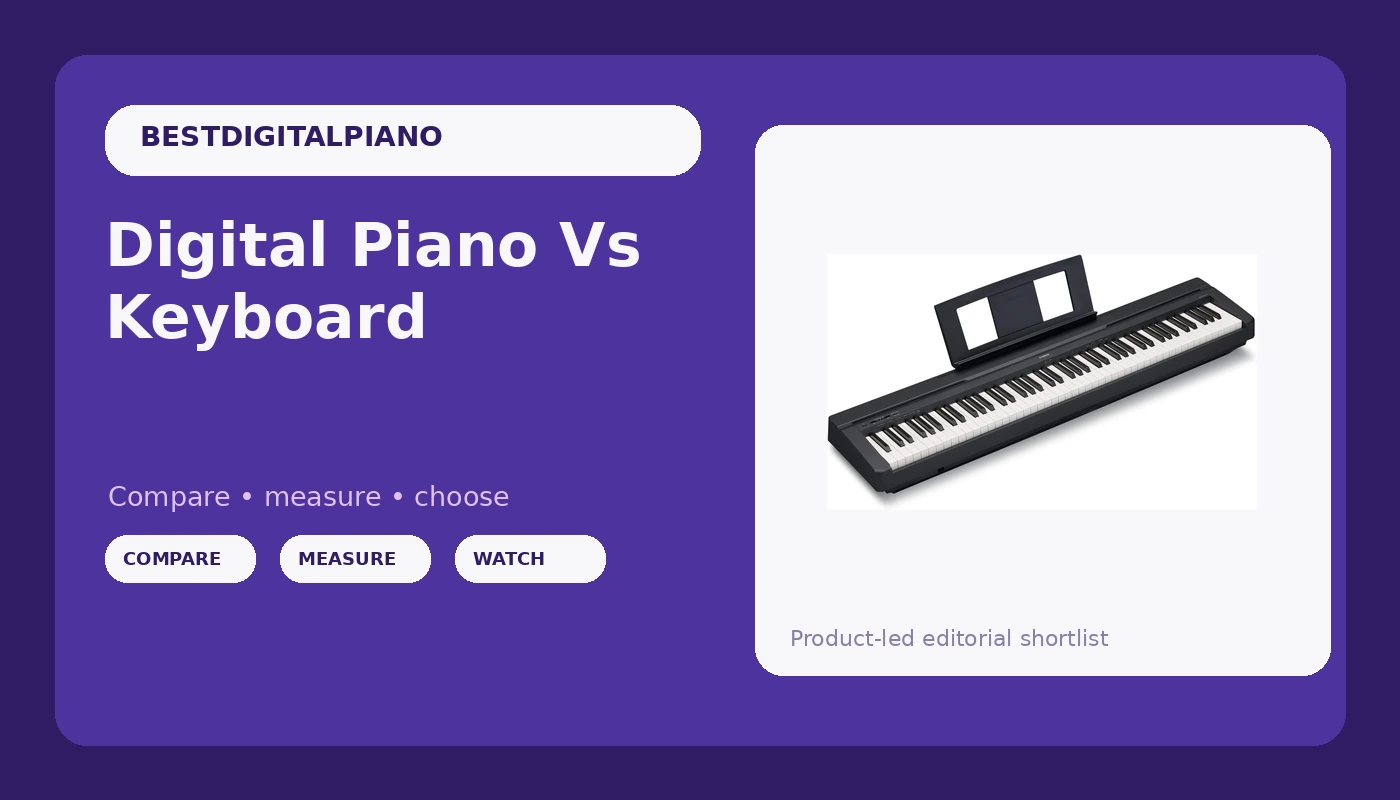
The job is simple: find an instrument that makes a beginner want to practice and keeps working long enough for them to find out if they love it. The market is crowded with options from $99 to $1,500, and the gap between a toy and a real instrument is wider than most parents realize.
The best digital piano for most families is the Yamaha P-45 at around $450, but it comes with an honest caveat: the action degrades noticeably around year four, so think of it as a four-year investment in finding out if your kid is serious, not a lifetime purchase.
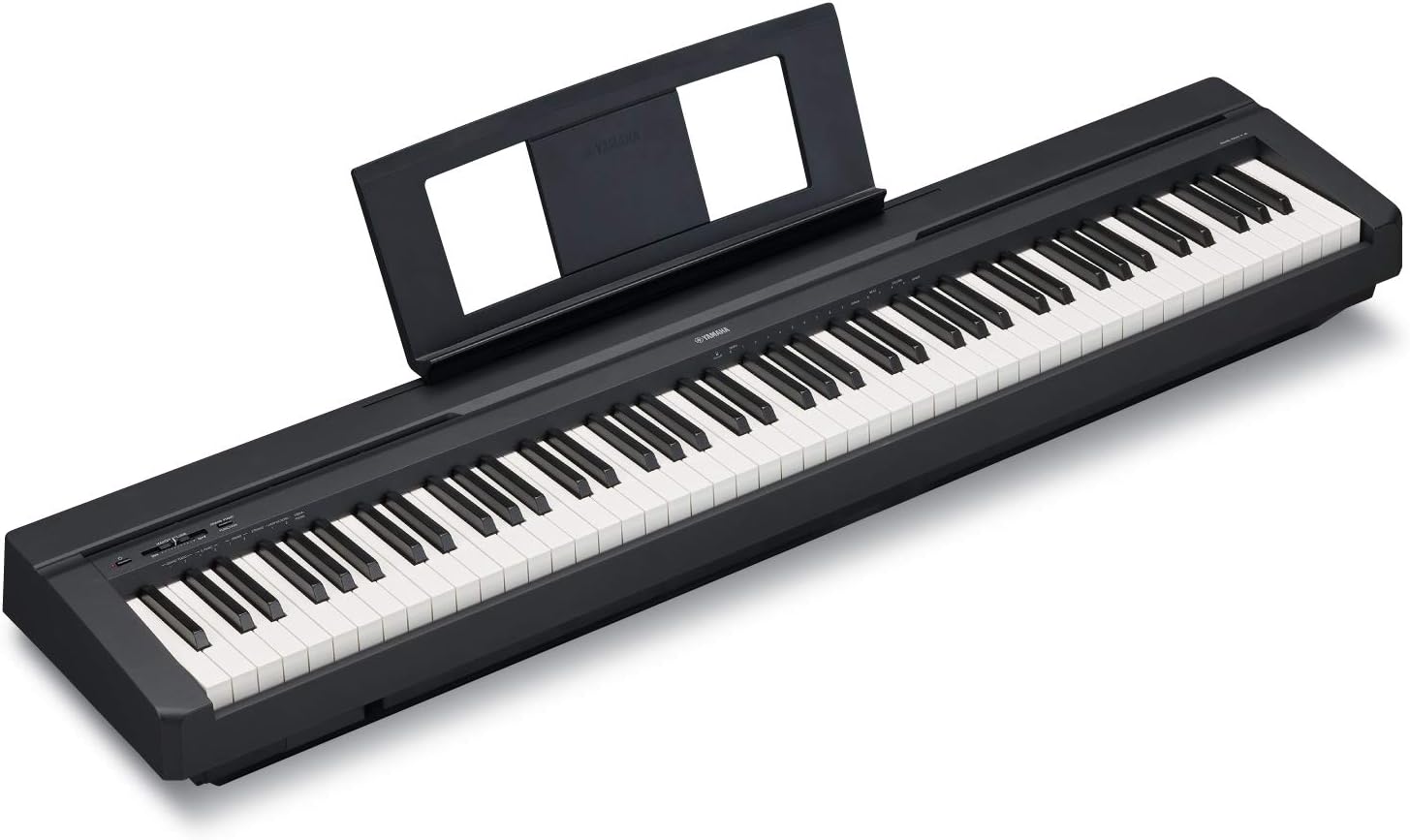
YAMAHA P71 88-Key Weighted Action Digital Piano with Sustain Pedal and Power Supply (Amazon-Exclusive)
The P-71 is the best value in digital pianos, and it's not close.
Visit on Amazon →YAMAHA P71 88-Key Weighted Action Digital Piano with Sustain Pedal and Power Supply (Amazon-Exclusive)
The Yamaha P71B is an Amazon-exclusive model designed to be the perfect Home digital piano for rehearsing, learning and creating. A full sized piano keyboard with fully-weighted keys and Yamaha Premiu
Visit on Amazon →How I Tested
I've been teaching piano for 25 years out of my home studio, where 30 students a week cycle through my instruments. My labradoodle Mochi sleeps on the floor during lessons, which means every keyboard I own has survived being knocked into, drooled on, and subjected to the humidity swings of a house with a dog door.
I keep a postal scale in my studio to measure key weight and a dB meter to check volume consistency across the keyboard.
For this comparison, I played the same three pieces on every instrument: Bach's Prelude in C for trills and clarity, Chopin's Nocturne in E-flat for legato and sustain, and a blues improvisation to test rhythmic feel.
I also tracked what my students' parents bought, what broke, and when. The P-45 has been my go-to recommendation for years, but I wanted to know if the P-71 was actually the same instrument, and whether the RockJam was ever a reasonable choice for anyone.
Action Quality
This is the metric that matters more than any other, and it separates the instruments clearly. The P-45 and P-71 use Yamaha's GHS (Graded Hammer Standard) action, which means the keys are heavier in the low register and lighter in the high register, just like an acoustic piano.
A 30-year pianist named Michael Mitchell wrote in a review that the P-45 has "a good weight to it" and called it "still the best keyboard Yamaha has ever made." I agree.
The action is solid enough that a working pianist can practice on it without feeling like they're compromising.
The RockJam's keys are semi-weighted at best. They "feel nice" according to some buyers, but they don't have the graded weight that teaches your fingers proper technique. The difference matters: a student who learns on the RockJam will develop habits that have to be unlearned when they sit at a real piano.
Durability Over Time
Here's where the real story lives. Weston N., writing in a verified review of the P-45, reported that at about the four-year mark, "the action does noticeably degrade. The keys feel mushier than a year ago and not as crisp, and some keys develop a clicking sound." That tracks with what I've seen in my studio. The P-45 is a four-year instrument, full stop.
The RockJam has a worse timeline. One buyer reported it "worked well for six months" and then turned off permanently. When they contacted the manufacturer, they were told the company holds no US stock and couldn't help.
The unit was a paperweight. That's a $100+ keyboard lasting six months, which works out to about 55 cents a day.
The P-45 at $450 lasting four years is about 31 cents a day. The more expensive instrument is cheaper in the long run.
Sound Quality
The P-45 samples a full concert grand, and while I hate the marketing phrase "concert grand samples" because a $450 keyboard doesn't sound like a $100,000 Steinway, the sound is genuinely good. One reviewer said it would fool you into thinking you were playing "a reasonably high quality upright piano." That's accurate.
The high octave sounds a bit thin, and there's no Hammond organ sound built in, but for practicing, it's more than adequate.
The RockJam sounds like what it is: a $100 keyboard. It's fine for a 6-year-old playing "Hot Cross Buns," but it won't teach anyone what a piano actually sounds like.
The Sustain Pedal Problem
Both Yamaha models come with a sustain pedal that's too light. It slides around on the floor and doesn't give you the resistance you need for proper pedal technique. I haven't tried out the sustain foot switch on the P-71 because I like pedals more, but the complaint is consistent across both models. Budget for a better pedal, around $30, and you'll be fine.
The Yamaha P-45: Best Overall
The P-45 is the best value in digital pianos, and it's not close. At around $450, you get a fully weighted action that feels "incredibly solid," a sound that's genuinely piano-like, and a form factor that's portable enough to move between rooms. It weighs 25 pounds, which means a teenager can carry it, and it fits on any standard X-stand.
The four-year degradation timeline is real, and I won't sugarcoat it. By year four, the keys get mushy and clicking sounds develop. But here's the thing: by year four, you'll know if your kid is still playing.
If they are, you'll be ready to upgrade to something in the $1,000 range. If they're not, you're out $450, which is about the cost of a few months of lessons anyway.
The P-45 is a four-year commitment that tells you what you need to know.
I've taught on this instrument for years. It holds up to daily use, the sound is honest, and the action is good enough that I don't feel like I'm corrupting my students' technique. For a family with a 10-year-old who's been asking for piano lessons, this is the answer.
The Yamaha P-71: Best Value
The P-71 is the same instrument as the P-45, sold exclusively through Amazon. Carrie Capell, a professional musician with 18 years of experience, chose it after "a significant amount of research" and validated the value proposition. The build quality is the same, the action is the same, the sound is the same. The only difference is the listing.
Buy whichever is cheaper on any given day. They're the same piano. The P-71 exists because Amazon wanted an exclusive model number, and Yamaha obliged. The four-year degradation timeline applies equally.
One note: the sustain pedal that comes with it is too light, and the high-end octave sounds a bit thin. Neither is a reason to skip it. If you're buying for a beginner, get the P-71, pick up a better pedal for $30, and you're set.
The RockJam 61-Key: The Budget Pick, With A Warning
The RockJam is a bundle, not an instrument. It comes with a stand, a bench, headphones, and a Simply Piano subscription, everything a parent needs to get a kid started. The reviews are full of grandparents and parents who are delighted. Bought for a 6-year-old granddaughter and she loves it. The stand is sturdy. The keys feel nice.
But the failure rate is real. One owner reported the unit "worked well for six months" and then turned off permanently. The manufacturer told them they hold no US stock and couldn't help. Another reviewer was "worried about the electrical hum/buzzing mentioned in other reviews," and those concerns are warranted.
The headphones are cheap and often arrive broken, which is a recurring complaint the manufacturer hasn't fixed.
Here's my rule: if you're buying for a child under 8 who might not stick with it, the RockJam is fine. It's a cheap way to find out if there's any interest. But if you're buying for anyone who might actually practice for more than a year, spend the extra $200 on a P-45. The RockJam might not make it to month seven, and then you're buying twice anyway.
Should You Buy A Digital Piano Or A Keyboard?
The answer depends on who's playing. For a child under 8 who wants to have fun, a keyboard is fine. For anyone serious about learning, you need weighted keys. Full stop. A semi-weighted or unweighted keyboard won't teach your fingers the proper technique, and it won't sound like a piano, which means you'll be practicing on an instrument that lies to you about what you sound like.
The honest recommendation for most families is a digital piano in the $400 to $600 range. It's less expensive than an acoustic, requires no tuning, and you can practice with headphones at midnight. The P-45 and P-71 are the best options in that range, and they'll tell you within four years whether piano is a lifelong pursuit or a phase.
If your kid is still playing at year four, upgrade to something in the $1,000 range with a better action. If they're not, you're out $450, which is the price of a few months of lessons. That's the math. That's the whole review.