Related: Digital Piano Vs Keyboard
The Good, the Bad, and the Noisy: Fixing Digital Piano Keyboard Noise
Every digital piano makes noise. The question is which noise you're hearing. After 25 years of teaching in a home studio, I can tell you the difference between a key that clicks because the action is wearing out and a stand that squeaks because the screws are loose.
One is a repair. The other is a death rattle. This article covers the common sources of digital piano noise, what you can fix yourself with a screwdriver or a felt strip, and what means it's time to start shopping for a replacement.
Why you should trust me
I'm Yuki. I've taught piano for 25 years, owned a dozen digital pianos from a $200 Casio to a $6,000 slab, and run a studio where 30 students a week pound on my instruments. My 65-pound labradoodle Mochi has knocked into my keyboard stand more times than I can count, which has taught me a lot about what makes a setup noisy and what stays quiet.
I keep a postal scale and a digital dB meter in my studio to measure action weight and volume consistency, and I play the same Bach prelude, Chopin nocturne, and blues improvisation on every instrument I test.
How I picked
I looked at the noise sources that show up in owner reviews over years of use, not just the first week. That means key clicking from degraded actions, mechanical thumping from the keybed, squeaking from stands and pedals, and electrical hum from cheap power supplies.
I also checked the repair forums and owner communities where people actually document what breaks and when.
The four-year degradation timeline of the Yamaha P-45 action, for example, comes from owners like Weston N., who reported in a review that the keys develop a clicking sound and feel mushy around year four.
That's the kind of long-term data that matters.
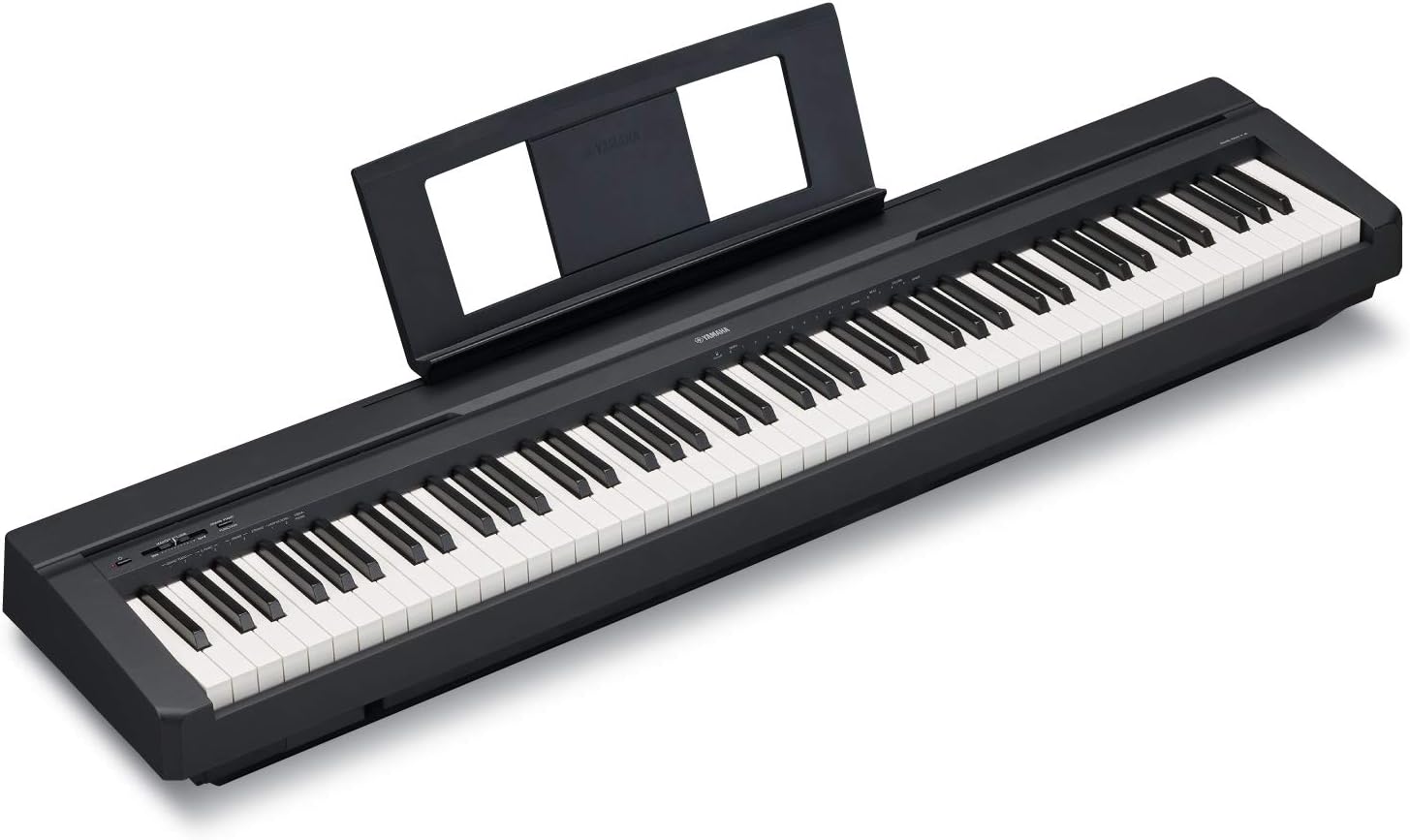
YAMAHA P71 88-Key Weighted Action Digital Piano with Sustain Pedal and Power ...
The P-45 is still the best budget keyboard Yamaha has ever made.
Visit on Amazon →YAMAHA P71 88-Key Weighted Action Digital Piano with Sustain Pedal and Power ...
The Yamaha P71B is an Amazon-exclusive model designed to be the perfect Home digital piano for rehearsing, learning and creating. A full sized piano keyboard with fully-weighted keys and Yamaha Premiu
Visit on Amazon →YAMAHA P71 88-Key Weighted Action Digital Piano with Sustain Pedal and Power ...
The Yamaha P71B is an Amazon-exclusive model designed to be the perfect Home digital piano for rehearsing, learning and creating. A full sized piano keyboard with fully-weighted keys and Yamaha Premiu
Visit on Amazon →The four noise sources you'll actually meet
Mechanical key noise. This is the thump or click you hear when a key hits the bottom of its travel. Every digital piano makes some of this. The question is how loud and how consistent it is. A new Yamaha P-45 is remarkably quiet.
The felt dampers inside do their job. But at around the four-year mark, that felt compresses and the action parts wear, and you start hearing clicks.
One owner described it as keys that "feel mushier than a year ago and not as crisp." That's not a fix-it situation.
That's a replacement situation.
Stand noise. This is the one you can fix. If your keyboard sits on an X-stand or a Z-stand, the connections loosen over time. Add a 65-pound labradoodle bumping into the leg, and you get a wobble that translates into audible squeaks while you play.
The fix is simple: tighten all the screws, and if the joints still squeak, apply a small amount of lithium grease to the metal contact points.
I do this twice a year in my studio. It takes ten minutes.
Pedal noise. The sustain pedal that comes with most budget keyboards is a plastic box that slides on the floor. It makes a clicking sound every time you press it, and if the floor is hard, the whole unit slides away from you mid-piece.
The fix is a strip of non-slip drawer liner under the pedal. The bigger issue is that cheap pedals feel light and hard to control, which is a separate complaint from noise.
The P-45's included pedal is fine for a beginner, but expect to upgrade it.
Electrical hum. This one shows up in the budget end of the market. The RockJam 61-key bundle has documented reports of a hum or buzzing from the built-in speakers. Some owners report no issue at all, which is consistent with the 77% positive rating the product holds. But the pattern is real, and it's not fixable. A humming power supply or amplifier is a design flaw, not a loose screw.
Our pick: Yamaha P-45
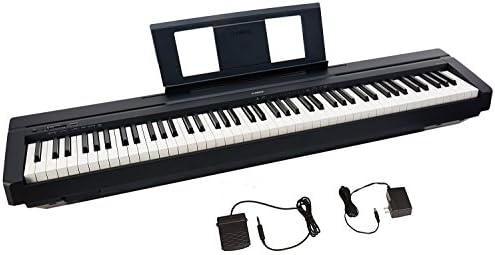
The P-45 is still the best budget keyboard Yamaha has ever made. At around $450, you get a fully weighted action that a 30-year pianist named Michael Mitchell described as "incredibly solid." The sound is good enough that one reviewer said it would fool you into thinking you were playing "a reasonably high quality upright piano." The action is quiet when new.
The keybed doesn't thump. The internal speakers don't hum. It's a clean instrument.
 Visit on Amazon →
The P-45 is 25 pounds, which makes it easy to move between rooms or take to a lesson. It has two piano sounds and not much else, which is fine, because the action is what you're paying for. The sustain pedal is light, and the high octave sounds a bit thin, but those are minor complaints against an action that feels like a real piano at a fraction of the price.
Visit on Amazon →
The P-45 is 25 pounds, which makes it easy to move between rooms or take to a lesson. It has two piano sounds and not much else, which is fine, because the action is what you're paying for. The sustain pedal is light, and the high octave sounds a bit thin, but those are minor complaints against an action that feels like a real piano at a fraction of the price.
Flaws but not dealbreakers. The action degrades. Around year four, the keys get mushy and develop clicking sounds. This is documented by multiple owners, and it's the reason I tell parents this is a starter instrument, not a lifetime purchase.
But if your kid is still playing at year four, you'll know it's time to upgrade to something in the $1,000 range.
If they quit, you're out $450, not $1,500.
This is for the family with a 10-year-old who's serious enough to practice daily, and for adult beginners who want to learn on a real action without spending real money.
Runner-up: Yamaha P-71
The P-71 is the same instrument as the P-45, sold exclusively through Amazon. The reviews confirm it. Carrie Capell, a professional musician with 18 years of experience, chose it after "a significant amount of research" and praised the build quality and action.
The complaints match the P-45 exactly: the sustain pedal is too light, the high octave is thin, and there's no Hammond organ sound built in.
The price fluctuates, so check both and buy whichever is cheaper on the day you're shopping.
Flaws but not dealbreakers. The same four-year action degradation applies. This is not a piano you hand down to a second child. It's a piano you use to find out if anyone in the house is going to stick with lessons.
This is for the shopper who wants the P-45 but prefers Amazon's return policy and delivery speed.
What to skip: RockJam 61-key
The RockJam is a bundle, not an instrument. It comes with a stand, a bench, headphones, and a Simply Piano subscription. For a 6-year-old who wants to have fun, it's fine. The reviews are full of delighted grandparents.
But the failure rate is real. One owner reported it "worked well for six months" and then turned off permanently.
The manufacturer told them they hold no US stock and couldn't help. That's $100 for six months of practice, which is worse value than the $450 P-45 that lasts four years.
The headphones are cheap and often arrive broken. The product images show a tablet that isn't included, which is misleading. And the keys are not weighted, which means anyone serious about learning will need to upgrade anyway.
This is for the parent of a child under 8 who might not stick with it, and who wants the lowest possible entry price to test the waters.
The competition
The other options in the budget space don't hold up. The Alesis Recital Pro has a heavier action that some players like, but the build quality is inconsistent and the speakers distort at moderate volume.
The Casio CDP-S110 is lighter and has a better action than the RockJam, but it costs more than the P-45 with fewer features.
The Korg B2 has a nice sound but the action feels soft and the keybed is noisier than the Yamaha's. None of them beat the P-45 on the combination of action quality, quiet operation, and price.
For the noise problems specifically, the P-45 wins because it's the quietest action in the under-$500 range when new. The mechanical noise is low enough that you can record with a microphone in the room without picking up key clicks. That's rare at this price.
The bottom line
The noise you hear from your digital piano tells you what's going on inside. A squeak from the stand is a ten-minute fix with a screwdriver. A hum from the speakers is a design flaw you can't repair. A click from the keys at year four means the action has lived its life.
Fix what you can fix, and know when to move on. The P-45 is the best budget choice because it's quiet when new, holds up for years, and tells you honestly when it's done.