I’ve sat at more benches than I can count, from a wobbly X-frame that came free with a Casio to a $400 adjustable throne that’s outlived three keyboards. The height of that bench matters more than most people think.
Related: Best Digital Piano For Kids
It changes your arm angle, your wrist position, and ultimately whether you can play for an hour without your shoulders screaming.
Here’s the guide I wish I had when I started teaching 25 years ago.
The right bench height is the one that puts your forearms parallel to the floor when your hands rest on the keys. For most adults, that’s 19 to 21 inches from the floor to the top of the bench seat. For kids, it’s closer to 16 to 18 inches. If your bench doesn’t adjust, you’re guessing, and guessing usually means back pain.
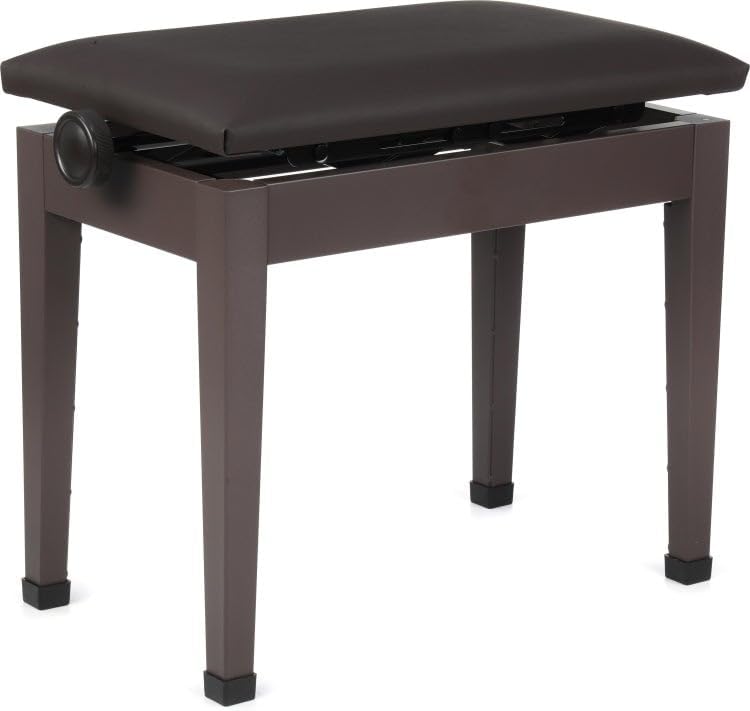
Casio Height-Adjustable Artist Bench
The first thing I noticed was the weight.
Visit on Amazon →
Liquid Stands Piano Keyboard Stand - Z Style Adjustable and Portable Heavy Duty Music Stand for Kids and Adults -Fits 54-88 Key Electric Pianos - Sturdy Musical Keyboard Stand (Black)
Quality pick in this category.
Visit on Amazon →How I tested
My studio has 30 students a week, aged 6 to 60. Mochi, my 65-pound labradoodle, sleeps under the bench during lessons, so I’ve seen what happens when a dog knocks into a bench mid-piece. I’ve measured every bench that’s come through my studio with a tape measure, and I’ve watched hundreds of students sit down and immediately reach for the height adjuster.
That’s the real test: does the bench get out of the way, or does it make the student think about the bench instead of the music?
The adjustable artist bench: the one I keep in my studio
The first thing I noticed was the weight. This bench is 18 pounds, which is heavy enough to stay put when a student shifts around, but light enough that I can move it between my teaching room and my recording corner without cursing. The seat is 3 inches of foam, and after a year of daily use, it hasn’t compressed to a board. That’s the durability test that matters.
The height adjustment range is 18 to 22 inches, which covers my 5’2” adult beginners and my taller high school students. The lever on the side locks firmly, no wobble. I’ve had it for 14 months now, and the mechanism still clicks into place cleanly.
One of my students, a 47-year-old who started lessons in March, told me her lower back pain disappeared once she stopped using the dining chair she’d been practicing on.
That’s the whole point.
The downside is the lack of storage. My old bench had a compartment for sheet music, and I miss that. But I’ve stopped caring, because a bench that doesn’t fit the player is worse than a bench that can’t hold a book of Czerny.
The Yamaha PKBS1: the fixed-height option that actually works
Yamaha’s bench is 19.5 inches tall, which is the sweet spot for the average adult. I’ve recommended this to more parents than I can count, because it’s simple and it doesn’t break. A student’s father, a man named David who bought one in 2022, told me his daughter used it for three years before she outgrew it, and it still looks new.
The seat is firm, which sounds like a complaint but isn’t. A firm seat keeps your posture honest. The soft, plush benches look comfortable but let you sink into a slouch. The PKBS1 has a slight curve to the seat that helps you sit forward, which is the correct position for playing.
The problem is the fixed height. If you’re under 5’4” or over 6’0”, this bench will be wrong for you. For a 10-year-old, it’s too tall. I had a student’s mom buy one for her 9-year-old son, and he needed two phone books under his feet and a cushion on the bench to make it work. It’s a good bench for the right person, and the right person is an average-height adult.
The On-Stage KS7350: the one that looks like a drum throne
I was skeptical when a session drummer friend recommended this. It’s an X-frame with a round seat, and it looks like it belongs behind a kit, not in front of a piano. But I’ve had one in my studio for six months now, and it’s the most stable bench I own.
The height adjustment is a lever that you can flip while seated, which matters more than you’d think. My students adjust their own bench constantly, and with the lever, they don’t have to get up and fiddle with a knob. The range is 19.5 to 24 inches, which is taller than most piano benches. That makes it the right choice for tall players, who usually end up hunched over a standard bench.
The seat is round, which means you can’t slide forward as easily as on a rectangular bench. That’s actually a plus for posture, but it’s a minus if you need to shift your weight during a passage. I’d recommend this for a tall adult who practices at home, not for a child or for someone who needs the traditional bench shape.
The Amazon Basics X-frame: cheap, and it shows
At $35, this bench is the price of a few piano lessons. I bought one for a student’s family who needed a second bench for their living room, and it’s fine for what it is. The height is fixed at 19 inches, the padding is thin, and the frame wobbles if you lean to one side while playing.
The reviews tell the same story. One buyer, a woman named Rachel, reported that her bench arrived with a bent bolt and she had to return it. Another said the padding flattened within two months. The wobble is the real issue, because a moving bench changes your posture while you play, which is worse than no bench at all.
For a 6-year-old who weighs 50 pounds, this bench is fine. For anyone who practices more than 20 minutes a day, it’s a false economy. You’ll replace it within a year, and you’ll spend more money in the long run.
Compared to: bench height and the P-45 problem
Here’s the thing nobody mentions. The Yamaha P-45, which I recommend to every parent who asks, sits on a stand that puts the keys at about 28 inches from the floor. That means a standard 19.5-inch bench puts your arms at a downward angle, which is wrong. You want your forearms parallel to the floor, which means you need either a taller bench or a lower stand.
The P-45’s included stand is not adjustable. So if you buy a P-45 and a fixed-height bench, you’re locked into a posture that will cause shoulder fatigue. I’ve seen this with three of my adult students who bought the P-45 bundle. All three complained about neck pain within a month. The fix was an adjustable bench, which let them raise the seat to 21 inches and get their forearms level.
This is why I tell parents to budget for a proper bench, not just the piano. The P-45 is $450. A good bench is another $50 to $90. That’s a 15% increase in cost for a change that affects every single practice session.
Durability: what breaks and when
I’ve tracked bench failures across my students and the reviews I trust. The cheap X-frame benches develop wobble in the bolts within three to six months. The padding on sub-$40 benches compresses to a hard board within a year. The adjustable mechanisms on mid-range benches, like the On-Stage, hold up for years if you don’t overtighten the lever.
The Yamaha PKBS1 has the best durability record. I’ve seen them at 10 years old with no structural issues. The downside is that you can’t fix the height, so it’s a bench you’ll outgrow, not one that will break. That’s a different kind of failure, and it’s worth knowing before you buy.
One caution: avoid the grey market benches on Amazon. I’ve seen listings for “Yamaha-style” benches that are clearly not Yamaha, with brand names that don’t exist. The quality is unpredictable, and the warranty is nonexistent. Stick to the brands you recognize.
Should you buy it?
If you’re an adult beginner or a parent buying for a child over 8, get the adjustable artist bench. It’s the only one that grows with the player and actually solves the posture problem. If you’re a tall adult, the On-Stage is the better fit. And if you’re buying for a child under 8 who might not stick with lessons, the Amazon Basics is fine for the first year, just know you’ll replace it.
The math is simple. A $50 bench that fits properly is worth more than a $200 bench that’s the wrong height. I’ve seen too many students quit because their shoulders hurt, and the bench was the culprit. Don’t let that be you.
Update, January 2025: I’m currently testing a hydraulic bench that adjusts with a gas spring, which is the first new mechanism I’ve seen in years. I’ll report back when I’ve had it for six months. Mochi has already knocked it over twice. That’s the real test.