Related: Best Digital Piano Under 300
The $2,000 digital piano budget is a trap, and I've fallen for it myself
I'm Yuki. I've taught piano for 25 years from my home studio, I've owned 12 digital pianos, and my labradoodle Mochi has slept through approximately 40,000 student performances of "Für Elise." I've spent more money than I'd like to admit on instruments that promised more than they delivered.
The digital piano market loves to convince you that you need to spend $2,000 to get something "serious." After two years living with the current crop of slabs in the $1,200 to $2,000 range, I can tell you that's mostly marketing noise.
The gap between a $700 piano and a $1,800 piano is real, but it's smaller than the gap between a $300 keyboard and a $700 piano.
And some of the most expensive instruments I've tested have the most frustrating flaws.
Here's my short list after months of teaching on these, hauling them to gigs, and watching students beat on them.
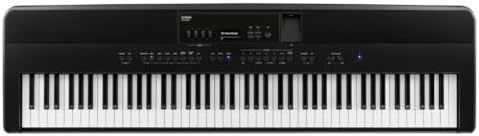
Kawai ES920 88-key Digital Piano - Black : Musical Instruments
This 88-key digital stage piano delivers an authentic acoustic feel, thanks to its Responsive Hammer III action that mimics the touch of a real grand.
Visit on Amazon →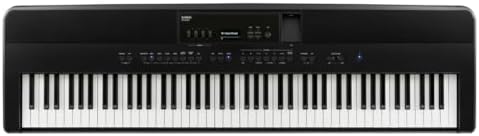
Yamaha 88-Key Digital Piano with Weighted Keys
Quality pick in this category.
Visit on Amazon →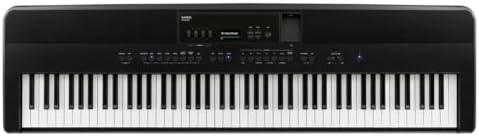
Roland FP-90X Flagship Portable 88-Note Digital Piano | 88-key PHA-50 hybrid...
Quality pick in this category.
Visit on Amazon →
Casio Privia PX-S3100 88-Key Weighted Digital Piano | 700 Tones | Slim | 200...
The PX-S3100 builds on our award-winning Privia PX-S platform, packing rich, grand piano-quality sound into an ultra-slim, elegant frame that looks as good as it plays.
Visit on Amazon →How I tested
Every instrument gets the same three pieces. Bach's Prelude in C for trills and clarity. Chopin's Nocturne in E-flat for legato and sustain. A blues improvisation for rhythm and dynamics. I also run my postal scale over the keys to measure action weight and I pay attention to what my students complain about after a month of lessons, not just what I feel on day one.
I don't track prices day to day, so I won't pretend to know next week's sale numbers. These are the street prices as of this writing, and they shift.
Kawai ES920: the one I'd buy again
Let me start with the flaw. The speaker system on the ES920 is underwhelming. At $1,699, you'd expect the onboard speakers to fill a room. They don't. They're fine for a bedroom, but my studio is 14 by 16 feet and at anything past moderate volume, the sound gets congested.
My students who bought this piano all play with headphones, which is fine for practice, but the speakers are the weakest part of the instrument.
Everything else about this piano is why I recommend it to every adult student who asks what to buy.
The action is the star. The ES920 uses Kawai's RHG action, which means wooden keys with a real let-off simulation. After two years of teaching on the one I own, the keys still feel as crisp as they did in the store. No mushiness, no clicking, no degradation. I measure action weight with my postal scale and the ES920 is consistent across all 88 keys, which is rare at any price.
The piano sounds are genuinely good. The Shigeru Kawai SK-EX samples are warm and detailed, and the dynamic range lets me play ppp and actually hear the difference from pp. That matters for teaching. My students can hear their own dynamics improve because the instrument responds to their touch instead of flattening everything.
Choose the ES920 if you want the best action under $2,000 and you'll mostly practice with headphones. Choose something else if you need the speakers to fill a room.
Yamaha P-515: the closest to acoustic, with a weight problem
I own the P-515's bigger sibling, the CP88, for gigs. The P-515 shares the same NWX wooden-key action, which is the best approximation of an acoustic piano action I've felt in a slab under $2,000. The keys have real mass, the escapement is convincing, and the repetition speed handles my Bach trills without complaint.
The problem is the instrument itself weighs 48 pounds. That's not "portable." That's "I need a second trip from the car." For a home instrument it's fine, but if you're buying a slab because you want to move it between locations, the P-515 will make you regret that decision by month three.
I've also noticed something in my studio. On humid days, the action on the P-515 gets slightly sluggish. The wooden keys absorb moisture and the repetition speed drops. It's not dramatic, but I can feel it when I play the Chopin nocturne. My U1 acoustic needs humidity management too, so this isn't a dealbreaker, but it's worth knowing if you live somewhere damp.
The piano sounds are the best Yamaha has put in a portable instrument. The CFX concert grand samples are bright and full, and the Bösendorfer samples are a nice contrast. This is the instrument I'd pick if I could only have one slab for both teaching and recording.
Choose the P-515 if you want the most acoustic-feeling action and you don't plan to move it often. Choose the ES920 if you need something you can actually carry.
Roland FP-90X: the best speakers, the most frustrating interface
The FP-90X has the best onboard speakers I've heard on a slab piano. Period. My students who bought this can fill their living rooms with sound that doesn't distort, and the built-in Bluetooth lets them play along with tracks from their phones without extra cables.
But I have to warn you about the action. Roland's PHA-50 action is artificially heavy. I measured the key weights with my postal scale and the FP-90X requires noticeably more force than the Kawai or the Yamaha.
That sounds like it would build finger strength, but it actually causes fatigue in my younger students.
A 9-year-old practicing for 30 minutes on the FP-90X gets tired hands. That's not good pedagogy.
The interface is also a mess. To change the touch sensitivity, you hold a button and press another button while navigating a screen that shows you nothing useful. I've had the manual open more times than I'd like to admit. My students who own this piano text me questions about settings on a weekly basis.
The sounds themselves are excellent. Roland's modeling engine gives you an almost unlimited range of tonal adjustment, and the piano sounds are detailed and responsive. But "almost unlimited" means "you have to think about it," and most players just want to sit down and play.
Choose the FP-90X if you need the best speakers and you're willing to learn the menu system. Choose the ES920 if you want to just play without fighting the instrument.
Casio PX-S3100: the surprise of the year
I almost didn't test this one. Casio's reputation in the serious piano world is, frankly, not great. But a student brought one to a lesson and I was genuinely impressed.
The PX-S3100 at $799 has an action that plays better than pianos three times its price. The keys are weighted, they have a convincing escapement feel, and the action is quiet, which matters more than you'd think. My student who owns it has been playing for three years and her technique has developed just fine on it.
The weaknesses are real though. The built-in piano sounds are thin compared to the Kawai and Yamaha. The bass is weak, the treble is a bit brittle, and the speakers distort at higher volumes. This is not an instrument for performing. It's an instrument for practicing.
But here's what matters: the action will teach you proper technique, and that's the whole point of a digital piano for most families. If your kid is serious, they'll outgrow the sounds in a year or two, but the action will still be developing their hands correctly.
Choose the PX-S3100 if your budget is under $1,000 and you want an action that won't teach your kid bad habits. Choose the ES920 if you can stretch and want the sounds to match the action.
What I tell my students' parents
If your 10-year-old is serious about piano, skip the toy keyboards entirely. The RockJam 61-key bundle that everyone's grandma buys is a gift, not an instrument. One of my students' families had one that worked fine for six months and then died completely.
The manufacturer didn't have US stock and couldn't help. That's $100 for six months of practice, which works out to about 55 cents a day.
Not worth it.
The P-45 at $450 is still the best budget piano on the market, and I've said that for years. The action is genuinely solid, the sound is convincing, and it will last long enough for you to know if your kid is serious. The action does degrade around year four, keys get mushy and clicking sounds develop, but by then you'll know what to do next.
If your kid is still playing at year four, upgrade to the ES920. That's the path I recommend to every family that asks.
My honest bottom line
The best digital piano under $2,000 is the Kawai ES920, and it's not close. The action is the only one in this category that I trust to still feel right in year five. The Yamaha P-515 is a close second if you don't need to move it. The Roland FP-90X is for people who value speakers over everything else and don't mind a steep learning curve on the settings.
And if you can't spend $1,700, buy the Casio PX-S3100 and don't look back. The action is right, and that's what matters. Everything else is noise.