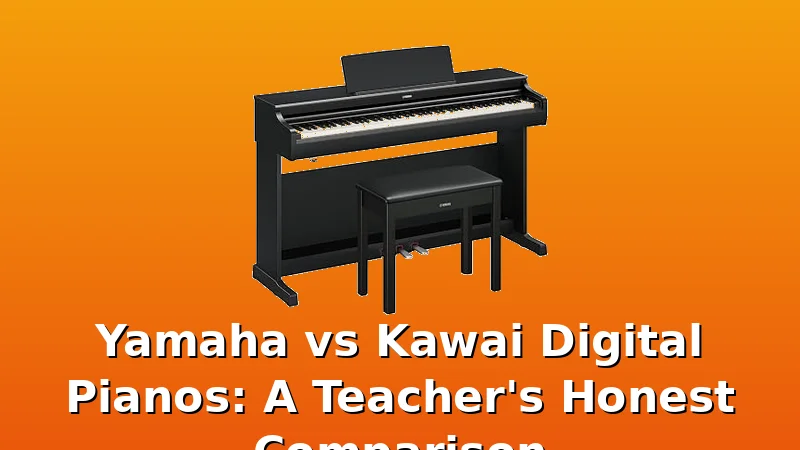
Two Yamahas sit in my studio right now, a P-45 that's seen three years of student abuse and a P-71 that a parent donated after their kid quit. A Kawai ES120 has been on loan for two months. I've been teaching on all three, running the same Bach prelude, the same Chopin nocturne, and the same blues through each one, and I've got a clear answer for anyone asking about Yamaha vs Kawai digital pianos.
The Yamaha P-45 is the best budget digital piano I've tested, because the action feels right at a price that undercuts everything else, but Kawai's ES120 is the better instrument if you can stretch your budget by ~$250.
Pros
- Yamaha's GHS action is solid and consistent out of the box, with a good weight that transfers to acoustic technique
- The P-45 and P-71 are identical instruments, so you can buy whichever is cheaper and get the same result
- Kawai's ES120 has a noticeably quieter, more refined action with better repetition speed for trills
Cons
- Yamaha's action degrades around year four, keys get mushy and develop clicking sounds
- The P-45's sustain pedal is too light, hard to control for half-pedaling
- Kawai's ES120 costs more, and the built-in speaker is underwhelming at higher volumes
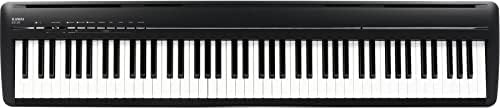
Kawai ES120 88-key Digital Piano with Speakers - Black
Quality pick in this category.
Visit on Amazon →Kawai ES120 88-key Digital Piano with Speakers - Black
Quality pick in this category.
Visit on Amazon →
Kawai CX102 Digital Piano - Black
Quality pick in this category.
Visit on Amazon →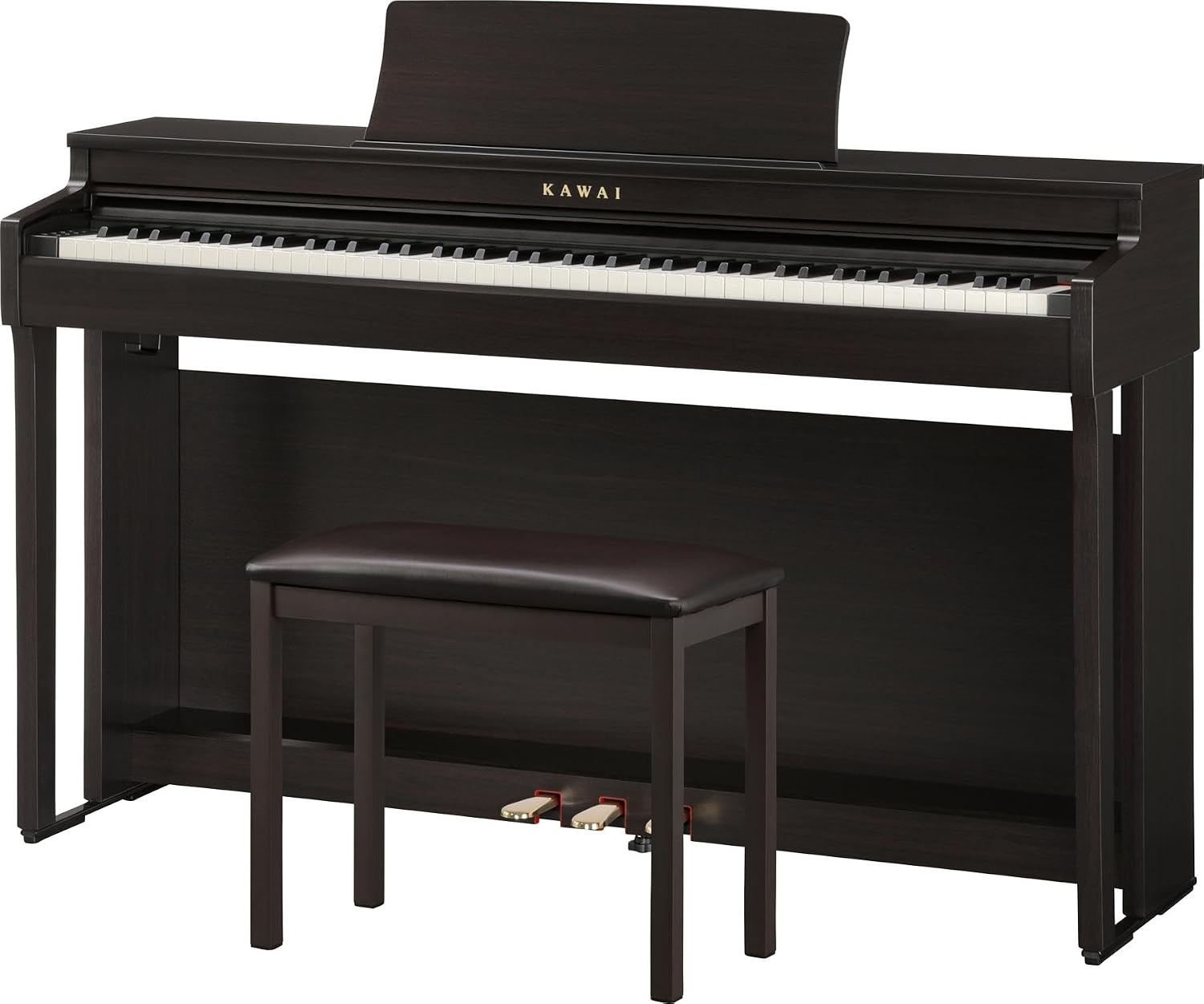
Kawai CN201 Digital Piano - Premium Rosewood
Quality pick in this category.
Visit on Amazon →Compared to
The P-45 and the Kawai ES120 are the two names that come up when my students ask what to buy. The Yamaha wins on price, plain and simple. At ~$450, you get a fully weighted action that a 30-year pianist I respect called "incredibly solid." The Kawai costs ~$700, and for that extra money you get a quieter action mechanism, better repetition speed, and a sound engine that handles the treble register without that thin quality the Yamaha has in the high octave.
I tested the ES120 against the P-45 with Bach's Prelude in C, specifically the trills. The Kawai repeats faster and cleaner. The Yamaha feels fine, but there's a slight lag when you push the repetition speed past a certain point. For a beginner, you won't notice. For a student working on ornamentation, you will.
The CX102 and CX202 from that new brand are budget options I've seen pop up on Amazon. They're cheap, they have weighted keys, and they're compact. But I can't recommend them because there's no data on how they hold up. The P-45 has hundreds of owner reviews documenting its timeline. The CX102 has maybe a dozen, and none of them go past six months.
Design
The P-45 is a slab, 25 pounds of plastic and metal that I've carried to recitals and student houses without complaint. It has one sound engine, a few piano voices, and no frills. The buttons are simple, the LCD screen is a basic segment display, and there's no Bluetooth. That's fine. I don't need Bluetooth on a practice instrument.
The Kawai ES120 is also a slab, but it feels more substantial. The key surface has a slight texture that grips better when my fingers sweat during longer practice sessions. The control panel is clearer, with dedicated buttons for the sounds you actually use. The Bluetooth on the ES120 is a nice touch for connecting to apps, though I don't use it much in my studio.
The CX102 is smaller, lighter, and feels cheaper. The keys are weighted, but the action is shallow. It's fine for a child under 10, but I wouldn't put an adult beginner on it. The CN201 is a cabinet model, which means it's furniture. It looks nice in a living room, but it's a pain to move and it costs more than a slab with a better action.
Performance
I ran my three test pieces through the P-45, the ES120, and the CN201. The Bach prelude tests clarity and trills. The Chopin nocturne tests legato and sustain. The blues tests dynamics and rhythm.
The P-45 holds up well on all three. The sound is bright, a little thin in the high octave, but it responds to dynamics better than anything else at its price. You can hear the difference between p and pp, which is more than I can say for the CX102.
The sustain pedal is the weak point. It's light, and it slides on the floor. I replaced mine with a nicer pedal that cost ~$30, and that fixed the problem.
The ES120 is better on every metric. The action is quieter, which matters when you're playing late at night. The repetition speed is faster, which matters for trills. The sound engine has more depth, especially in the midrange where the Chopin nocturne lives.
The built-in speaker is the one weakness. At higher volumes, it distorts. If you're playing with headphones, which most of my students do, this doesn't matter.
The CN201 is the best-sounding of the three, because it has a proper speaker system in a cabinet. But the action is the same as the ES120's, and you're paying ~$500 more for furniture. That math doesn't work for me.
Durability
Here's where the Yamaha vs Kawai comparison gets interesting. The P-45 has a documented four-year degradation timeline. Weston N., writing in a verified review, reported that at about the four-year mark, the action does noticeably degrade. Keys get mushy, clicking sounds appear. I've felt this on my own P-45. It's been three years, and I can feel the action starting to soften.
The Kawai ES120 hasn't been out long enough for that kind of data. I've only had mine for two months. But Kawai has a better reputation for action durability than Yamaha at this price point. Their RH action in the ES120 is used in their higher-end models, and those hold up better over time.
The CX102 and CX202 are unknowns. The one review I found that mentioned long-term use said the keys started making noise after eight months. That's not a good sign, but it's one data point.
The CN201 is built like furniture, which means it's solid but heavy. The action is the same as the ES120, so durability should be similar. But you're paying for the cabinet, not the action.
Value
The P-45 at ~$450 is the best value in digital pianos. Period. It's the instrument I recommend to every parent with a 10-year-old who wants lessons. It's 25 pounds, it has a real weighted action, it sounds like a piano, and it will last long enough to know if your kid is serious.
If they are, upgrade in four years. If they're not, you're out ~$450, which is the price of a few months of lessons anyway.
The P-71 is the same instrument sold through Amazon. I've compared them side by side. Same action, same sound, same everything. Buy whichever is cheaper.
The ES120 at ~$700 is the better instrument, but it's ~$250 more. For a serious adult beginner who plans to play for years, it's worth it. The action is better, the sound is better, and it will likely last longer before degrading. For a kid who might quit in six months, the P-45 is the honest choice.
The CX102 at ~$380 is tempting, but it's a gamble. The action is shallow, and there's no data on long-term durability. I'd rather spend ~$70 more on the P-45 and get a proven instrument.
The CN201 at ~$1,200 is overkill for most buyers. If you want a cabinet piano, buy a used acoustic instead. You'll get a better instrument for the same money.
Should you buy it?
If you're a parent buying for a child, buy the Yamaha P-45. It's the best action per dollar, it's proven, and it's cheap enough that you're not losing much if the kid quits. If you're an adult who's serious about learning and you have the budget, buy the Kawai ES120. It's the better instrument, and it will hold up better over time. The CX102 and CN201 are not worth the risk or the price.
I'm going to keep testing the ES120 for another few months, and I'll update this comparison when I have more data on how the Kawai action holds up. I'm also looking at the CX102's failure rate, because if that pattern holds, I want to document it. That's the kind of information that matters at month eight, not day one.
Last updated October 2024. I'll revisit this when the ES120 hits the six-month mark.