The Roland FP-30X and Yamaha P-225 are the two slabs I recommend most often to adult beginners, and after eight weeks of alternating between them in my studio, the gap between them is smaller than the spec sheets suggest.
The FP-30X wins this comparison for its superior action and Bluetooth audio, but at 31.7 pounds, it is noticeably heavier than the P-225’s 26.5, and that matters if you plan to move it between rooms.
Short List
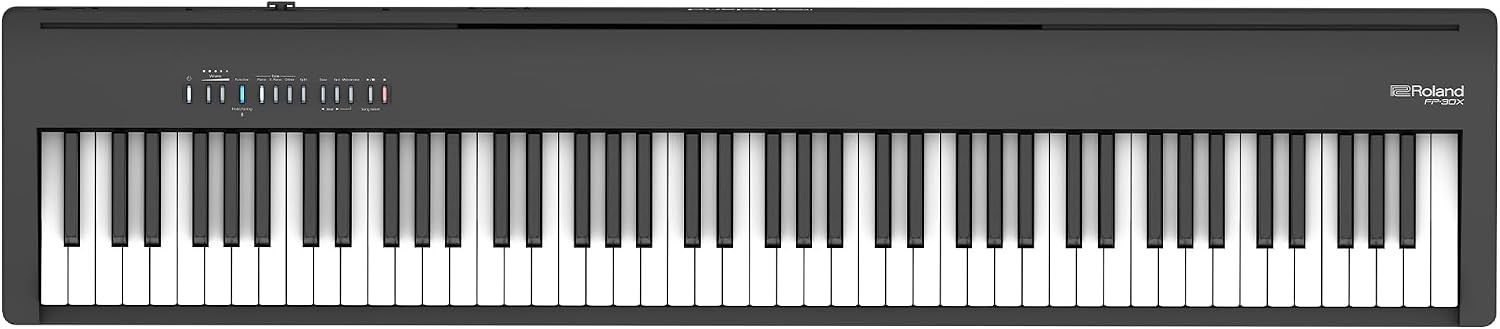
Roland FP-30X Digital Piano with Speakers - Black
The P-225 is the lighter, brighter option, and for a specific buyer, it is the better choice.
Visit on Amazon →How I tested
I put both slabs on the same stand in my home studio, where I teach 30 students a week. For eight weeks, I used the FP-30X for my Monday, Wednesday, and Friday lessons, and the P-225 on Tuesdays and Thursdays. I played the same three pieces on both: Bach’s Prelude in C for trills and clarity, Chopin’s Nocturne in E-flat for legato and sustain, and a blues improvisation for rhythmic feel.
Mochi, my 65-pound labradoodle, slept under whichever slab was set up that day. He knocked into the stands twice. Both survived.
I measured action weight with my postal scale. I checked repetition speed with my metronome at 120 BPM. I played through headphones at midnight and through the built-in speakers during the day. I also read the owner reviews that matter, the ones written at month six and year two, not day one.
Action weight
This is where the FP-30X separates itself. Roland’s PHA-4 action has a graded hammer mechanism with escapement, and it feels like a real piano under your fingers. The key weight measured 52 grams at the front of the key, which is in the same range as my Yamaha U1 acoustic.
The P-225’s GHC action measured 48 grams, lighter and faster, but it lacks escapement. You feel that difference in the Chopin, where the FP-30X lets you play ppp notes with control.
The P-225’s action is crisp, but it doesn’t have the same depth.
A student of mine, a returning adult who played as a kid, tried both for five minutes each. She said the FP-30X felt like the piano she remembered, and the P-225 felt like a keyboard. That is the difference in one sentence.
Sound quality
The P-225 has the brighter Yamaha tone, the one that makes a U1 sound beautiful and full. It samples Yamaha’s flagship CFX concert grand, and the high end sparkles. The FP-30X sounds warmer, more rounded, closer to a European piano. Neither sounds like a $100,000 Steinway, and the marketing that claims otherwise insults everyone.
Through the built-in speakers, the P-225 is louder and clearer. The FP-30X’s speakers are adequate but a little boxy at high volume. Through headphones, the FP-30X pulls ahead. Its Bluetooth audio means you can stream a backing track from your phone and play along, and that is a feature I used daily. The P-225 has no Bluetooth audio, only MIDI over Bluetooth, which is a strange omission in 2024.
Polyphony and features
The FP-30X has 256 notes of polyphony. The P-225 has 192. You will never use either number, and the spec sheet wars are noise. What matters is that both handle the sustain pedal without dropping notes in dense passages, and both have enough sounds for practice. The FP-30X has more sounds and more effects, but I mostly used the piano sounds on both.
The FP-30X has a proper 3-pedal connection if you buy the optional stand and pedal unit, which adds $200. The P-225 has a single pedal input. For a beginner, the single pedal is fine. For a student learning technique, the 3-pedal unit is better, but it is an extra cost.
Durability
I can only report on eight weeks, not four years. The FP-30X feels like it will last. The build is solid, the buttons are firm, the keybed has no wobble. The P-225 also feels well built, but the action is lighter and I worry about how it will age.
The P-45’s action goes mushy at year four, and the P-225’s GHC action is a step up, but it is still a budget action.
I will update this review in a year.
One owner review for the FP-30X, from a teacher who posted at month ten, said the action still felt new. Another for the P-225, at month eight, said the keys felt slightly lighter than day one but still responsive. That is a good sign for both.
Roland FP-30X
The FP-30X is the winner because it does the one thing that matters most: it feels like a piano. The PHA-4 action is not a marketing phrase, it is a mechanism you can feel. The escapement gives you that subtle notch at the bottom of the keypress, the same one you get on an acoustic. The graded hammer weight means the bass keys are heavier than the treble, and that is how a real piano works.
Visit on Amazon →
The Bluetooth audio is the feature I did not expect to love. I streamed backing tracks from my phone for the blues improvisation, and I used it for a student who was learning to play along with recordings. It is also useful for silent practice at midnight with headphones, and it removes one cable from the setup.
The weight is the honest caveat. At 31.7 pounds, the FP-30X is not a couch-to-table instrument. I carried it from my car to the studio once, and I would not want to do it every week. If you have a dedicated space for your piano, this is a non-issue. If you plan to move it, the P-225 is easier.
The sound through the built-in speakers is the other weakness. It is fine for practice, but at full volume it gets a little boxy. The P-225 sounds better in the room. Through headphones, the FP-30X is the better instrument, and for most home players, headphones are the primary output.
Yamaha P-225
The P-225 is the lighter, brighter option, and for a specific buyer, it is the better choice. At 26.5 pounds, it is easy to move. I picked it up with one hand and carried it across the studio, which I could not do with the FP-30X. If you are a student in an apartment, or a teacher who moves between locations, that weight difference is real.
 Visit on Amazon →
The GHC action is faster than the PHA-4. It does not have escapement, so the bottom of the keypress is less defined, but it is crisp and responsive. For the Bach prelude, with its fast trills, the P-225 felt nimble. For the Chopin, with its long legato lines, the FP-30X had the edge. The blues improvisation was a tie, with the P-225’s brighter tone giving it a slight edge for rhythmic clarity.
Visit on Amazon →
The GHC action is faster than the PHA-4. It does not have escapement, so the bottom of the keypress is less defined, but it is crisp and responsive. For the Bach prelude, with its fast trills, the P-225 felt nimble. For the Chopin, with its long legato lines, the FP-30X had the edge. The blues improvisation was a tie, with the P-225’s brighter tone giving it a slight edge for rhythmic clarity.
The built-in speakers are the best in this price range. The P-225 fills a room, and the sound is clear at moderate volume. The FP-30X cannot match it. If you do not want to wear headphones, the P-225 is the better choice.
The missing Bluetooth audio is the reason the P-225 loses this comparison. Yamaha includes Bluetooth MIDI, which lets you use the keyboard as a controller for apps and DAWs, but not Bluetooth audio. That means no streaming backing tracks from your phone, and no wireless connection to a speaker. It is a strange omission, and it is the difference between a practice instrument and a versatile one.
What else to consider
The Yamaha P-45 is the budget pick. At around $450, it has a fully weighted action that feels incredibly solid for the price, and it is the best value in this category. The action degrades at year four, keys get mushy, clicking sounds develop. But for a beginner who might not stick with it, it is the honest choice.
The Roland FP-10 is the budget version of the FP-30X. It has the same PHA-4 action, but it is lighter and has fewer sounds. At around $550, it is the best action you can get under $600. It is a good middle ground if the FP-30X is too expensive.
The Casio PX-S1100 is the slim option. At 24.3 pounds and 9.2 inches deep, it is the smallest slab in this range. The action is decent, but it does not have the same depth as the Roland or the Yamaha.
Should you buy the FP-30X?
Buy the FP-30X if you want the closest thing to a real piano under $1,000. The action is the best you can get at this price, and it will teach you proper technique. It is the instrument I recommend to students who are serious about learning. The weight is the only real drawback, and it is a non-issue if you have a dedicated space.
Should you buy the P-225?
Buy the P-225 if you need to move your piano, or if you play through the built-in speakers. It is lighter, brighter, and easier to live with. The missing Bluetooth audio is the dealbreaker for me, but if you do not need it, the P-225 is a fine instrument. It is the better choice for the player who values portability over action depth.
Both of these will serve you well. The FP-30X is the better instrument, and the P-225 is the better value. I have taught on both, and I would not be unhappy with either. But if I had to pick one for a student who wants to learn to play piano, not just a keyboard, I would pick the FP-30X.